

Jill Williams writes from the intersection of the sacred and the profane, where theological rot meets musty linen reality. Her prose aims for a piston-like violence that should come with warning labels. Her work has appeared or is forthcoming in EXPAT PRESS, CLOSE TO THE BONE, and HORROR SLEAZE TRASH, with additional fiction featured in several other journals. She lives in Georgia, where she still tries to find the sweet beneath the rot.
Category: Short Story

Pretzel For A President by Robert Sumner
The service elevator should’ve had a bellhop like the other elevators reserved for VIPs. Duggan Calthrop cradled a bowl of pretzels in his left arm and pushed the button with his right middle finger. It didn’t matter at the moment but sometimes he had to carry large platters of food. The elevator doors parted. It reminded him of that scene in The Matrix that cut from Agent Smith interrogating Morpheus to a slow motion shot of a door opening and Neo’s black boots stepping through just before the greatest shootout in cinema history. The black Rockport shoes he was wearing with his white servant uniform lacked that intimidating kickassitude but he felt just as determined. He stepped into the elegant red velvet and gleaming gold-plated box and pressed the button for the residential level. As the door closed, he resisted an urge to jump back through. As the elevator ascended, he resisted an urge to scratch his ear.
Duggan had already passed his White House security clearance and was hired to carry food from the kitchen to the president and the first lady and whatever cronies were present.
He’s Still Alive by Carl Page
Johnny Ray had coached the girls’ team since his release, the only basketball job he could find after the point-shaving scandal. For testifying against Roberson, he’d gotten the best plea deal the government would cut; but the three years he’d spent in a minimum-security federal prison had still seemed like twenty.
He got fifty dollars a game for coaching, which he used to supplement the income from his lawn care and snow removal business, as well as the foster care fees he and Marjorie received from the state. He calculated they about broke even at coaching and foster care combined. But the surrogate fathering of “his girls,” with their sundry addictions and tales of abuse, seemed to fill a hole inside him; one he knew he’d carved out himself.
He actually saw his new life as a sort of return to normality. That the girls suffered daily crises of one sort or another hardly phased him. Somehow it seemed little different from showing a player how to set a ball screen or avoid a blocking call: it was all about technique and discipline, practicing the right habits. More importantly, he was on the right side of the law this time.
Ever since he’d bolted from Eastern Kentucky as a young man, he’d felt the mountains tugging at him, as though he were a fugitive from justice. “You don’t belong out there,” they whispered in his ear. And now, here he was, back where it all began, in the hollows of Mount Horeb. He’d had visions of becoming a super-coach, perhaps retiring to a cozy job as an ESPN color commentator. He certainly had plenty of “color,” he thought; though lily white, there had been few more colorful coaches in the profession.
Braided Armpits by VJ Hamilton
How strange it was, Georgia thought, the gradually dawning awareness when Brenda
Dagmar a.k.a. Brady went missing. Four days’ absence from school at end of month was not
unusual, but she’d been gone nearly two weeks. Mrs. Roy, the Home Economics teacher, asked
her Grade 11 class what they knew.
“It’s just Brady and her dad living out there,” Georgia volunteered.
“It’s gotta be her old man,” said Kayley, a fan of crime shows. An army vet, Mr. Dagmar
had a temperament as touchy as the improvised explosive devices he had to defuse while
stationed in the desert.
Farm girls who rode the same school bus as Brady spoke up. Her old man was mean,
alright. If you crossed Mr. Dagmar, rumour had it your septic system would mysteriously back
up. One girl claimed Dagmar had slit her neighbour’s dog’s throat. Another girl said her uncle
had found a box of rat poison left near a culvert, leaching into his cattle’s water supply.
All hearsay and rumours. Georgia had never seen bruises on Brady although, when
voices got loud, the girl had a way of going dead in the eyes. “Maybe she just left,” Georgia said
Braided Armpits Page 2 of 9
to Mrs. Roy, imagining her classmate packing up her grubby lime-green knapsack and heading
for the city.

Rituals by Mike Lee
We sat together having dessert at DiRoberti’s: a little cheesecake, a cup of latte, and misplaced anger.
“I gave trust as a relationship dynamic up for Lent sometime in the 1980s, and I haven’t returned to it yet.”
I glanced at Maddie, who peeked at her mother while reading A Horse and His Boy. She wore the expression of someone prematurely mature. I didn’t like this sense of my failure to prevent that everyday cynicism from filling the cracks that had opened in her heart, but this was the mortar she needed to harden those fissures into a paste. Maddie would act out in enraged frustration sometimes, pounding her fists first on me, then on herself.
Marie and I had discussed therapy, but it wasn’t until one afternoon when we took her to the park near our apartment that we decided to pursue it. Maddie ran out into the street to chase after a Pokémon Super Ball she was bouncing, and I grabbed her suddenly.
Crying, Maddie wrestled herself from my grasp and ran. I chased after her, and when I caught up, Maddie began shaking. Then, she told me what her mother was doing. I held Maddie in my arms, stunned. Then, as we talked, I noticed Maddie referring to her mother as Marie. I tried to correct her at first, but Maddie’s scowling face caused me to lapse into silent acceptance.
Maddie was ten.

Windfall by E.A. Mayer
When Martin sees the weathervane on the steeple of the abandoned church—thanks to a random skyward glance on his morning run around Bedford—he knows exactly who will buy it. This is his talent, although it hadn’t prevented him from receiving a rating of Needs Improvement in his latest performance review at Tipton’s. He just needs an opportunity to redeem himself—to connect the dots between object and collector. And there is it: backlit by the weak November sun.
That afternoon, he confirms his initial hunch through binoculars. The weathervane is a Hutchfield & Sons stallion model, circa 1872, with all the bells and whistles: muscled chest, rippling mane, legs in full gallop, and an embossed H&Co. stamp on its underbelly. Even better, it has a terrific verdigris patina, marred only by streaks of bird shit and a small bullet hole on the left side which, in the quirky economics of the trade, is a mark of authenticity that will boost its value significantly. The last weathervane of this caliber was hammered down at Sotheby’s for $5.8 million. At the professional level, collecting is a contact sport, and his gut tells him that George and Helena Krantz will pay a substantial sum to possess it, if only to keep it out of the collections of their fellow point-one-percenters. They have probably driven—been driven—past this shabby chapel countless times on the way to their North Salem horse farm.
Martin has a puzzle to solve. In normal circumstances, an acquisition of this magnitude would be relatively straightforward; however, the focus of this deal, roughly two-and-a-half stories in the air, poses obvious challenges.
After a few hours of online searching, he learns that the church building was once a house of worship for a dying offshoot of Congregationalists but now exists in a state of legal limbo. A Greenwich developer has been skirmishing with a committee of underfunded preservationists over the vacant husk of the building and its slate-toothed cemetery. That makes it fair game. He is simply liberating a priceless artifact from potential destruction. Why wouldn’t he? Hadn’t the same logic built and filled the world’s museums?
When Nothing Changes, Except the Reason by Mike Lee
After busing tables at the beach club situated on the lakefront, Katerina sat behind the steering wheel of her dead father’s car, Janis Joplin on the cassette deck. Katerina was feeling blues instead of punk, with a list of legitimate reasons, compulsion playback risking her brain freezing like a tape grinding, twisting around the gears on a cheap Realistic player like the one she bought to replace Dad’s. It broke a week before he died.
She tried to get Mark to install it, but he didn’t. Finally, Katerina learned to do it herself.
Yeah, Dad. Mom found him slumped on his drafting table in March. I was supposed to go on the senior trip to Italy in a week, but I cancelled it for the funeral.
No post-graduation trip either. I had to adjust. I did it. Take another piece of my heart, will you? These feel like white girl problems. But I remind myself, almost everyone loses a parent. Does that mean I should just feel numb and get used to missing him? There are no more work-site trips or help with declensions or math. He got me through pre-college calculus—91 on the final. Too bad he didn’t see me make salutatorian. Too bad he missed Prom. But honestly, I’m glad he did. I’m not sure he could have handled it if he knew.

A Single Step by Katherine Rea
John stands outside the Double L and watches the sun dip below the Sierras. The Mt. Whitney range casts a long shadow over everything east of it, including the town of Lone Pine.
“Excuse me,” says a young man with stringy blonde hair as he makes his way into the bar. He’s clearly someone from out of town, a backpacker. His face is sunburnt and rubbed raw from the wind. He wears khaki zip-off pants from REI and a wrinkled flannel shirt, one that he’d stuffed at the bottom of his pack in preparation for just this night: a night of revelry from coming off the mountains, before the long drive home tomorrow morning. The perfect in-between time.
John grunts as he lets the young man pass. Easy does it, he reminds himself. Before, he would have said something. But now, he’s not supposed to be reactive. He’s just supposed to worry about keeping his side of the street clean. Let others do what they’re going to do.
He leans against the exterior wall of the Double L and passes a hand over his weather-worn face. He’s forgotten to shave this morning (or had he just not bothered?) and his stubble is beginning to come in. He takes one last look at the sinking sun before making his way inside, into the welcoming darkness.
A few regulars sit at the bar, mixed with the occasional out-of-towner. They each sit in their own world, eyes fixed on the game playing on the TV in the corner. The regulars are all men, with graying hair and oversized cotton T-shirts. Everyone else is just off the trail, and many are still wearing hiking pants and moisture-wicking shirts. A group of backpackers huddle together in one booth over pitchers of beer.
John notices two women who are out of place. They’re dressed nicely, and not just nicely for the Double L—they could be out for drinks in any town, maybe even a city. They sit near the pool tables, perched on barstools, sipping mixed drinks from clear plastic cups and watching the players.
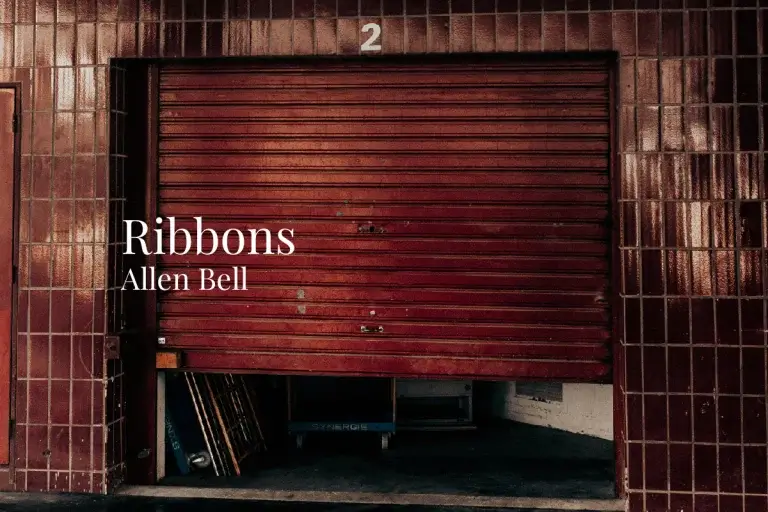
Ribbons by Allen Bell
Mom would tease Uncle Sid, saying, “Why you been payin’ fifty-five dollars a month to store six hundred dollars of garbage for the last ten years?”
On his deathbed, Sid left me his bankcard and password. I could have drained the account and let the storage fees pile up, but I felt that would have left a bad name for him. Although I needed every dollar, I’d do it right and settle any outstanding payments.
When I called the owner of Frontier Storage Units, he told me that the contract stated fees would be processed unless the locker was empty.
Maybe I’d find something in the locker for a keepsake before tossing everything in the dump.
***
Frontier Storage was a forty-five-minute drive from Saint John’s, Newfoundland, and then twenty minutes down a dusty dirt road. It was a hot, humid summer morning, and I had the windows rolled down in my pickup because I couldn’t afford to get the AC working. I could see how someone might keep putting off coming out here to empty their unit. But I had a big expense due, and needed to deal with the locker.
I parked beside the wooden barn that had been converted into storage units. I made sure the truck was perfectly parallel to the building, got out, and looked up. Faded red paint flaked off the face of the building in strips. I checked for any loose boards that might fall from the dilapidated structure and hit my truck, or worse, have the building collapse while I was inside.
“You, Marty,” I heard from behind me.
A small, pudgy man was approaching. When he got close, I could smell whiskey on his breath.
“I called earlier about my uncle’s locker.”
“You, the runner, Sid used to talk about?”
“I guess.”

In a Minute. A Second. by Mike Lee
We met on the corner. Stared: the sun’s rays reflected in her hair. She looked pretty, no, better than that. Hard to define, to find the word, and I searched desperately in vain for a descriptive word that was not obvious or pithy. Beautiful, gorgeous, stunning, and desirable: they were all those yet more.
My former lover stood under the one-way sign in forsaken Brooklyn, looking at the entire world as I first saw her. Still a kid, albeit heavier with childbirth and experience, but still that soft-toned teenage girl, angelic—now that was a word I missed—and I remembered her standing against the wall by the outdoor entrance the our high school drama theater at fifteen, cigarette between fingers, smoke wafting through the air, lovingly staring at me with baby blue belladonna eyes, curling iron bangs blowing by her eyes, smiling sweetly, black cotton vest white t-shirt and blue jeans, strappy leather sandals, a Greek fisherman’s cap perched high on her head.