Short Story

Cattle by Frank Jones

Share this article

“Anyone biting?” I went to Joe Jackson between bench-presses. He’d just got off the horn. 

“Everyone and his sister’s dry. There’s nought gear in this whole fucking town.” 

I slung my hood over my head. I’d taken to wearing the hoodie to the gym so that I didn’t have to watch the meat being carved off my bones in every reflection. 

“You try Derek?” I went.  I was buggering about with some piss-ant dumbbells.   

“Yeah, even if the Anavar he punts might as well be Tic Tacs. He’s got nothing. No one’s got nothing.”

And by that, Jackson meant that no one’s got anything. An empty can of Red Bull was on the floor next to the bench, and he booted across the room. He went: “I might as well be searching for gear in the crack of my arse.” 

“What about Tony?”

“Nothing. Besides, he’s in hospital up London, getting the gynecomastia cut out of his tits.” 

I rubbed the sore stitches of gyno that had developed under my own pecs. I knew how the fucker felt. 

Jackson looked at his bicep, then at the mirror, then back to the bicep – scrutinising like he was looking for cracks in a dam. 

“You reckon I’m losing timber?” he went. I’d already answered the fucking question twice that morning, and my answer was well-rehearsed. 

He flexed his muscle suit and I saw the devastation.

“Nah,” I lied, but only because I didn’t want the prick to tell me I was going down and all.  

Tyrone, the gym owner, suddenly thrust his head between the leg-press and the bicep curl, and went; “Alright boys?”

The bloke is so ugly that for a second I thought that some cheeky cunt had hung their arse between the machines. He walked over to us. 

  “Sound,” I went.

He gave us both a once over. 

“Christ Jesus, you lads are trimming down, aren’t you? I’ve shagged birds who weigh more than you do, Jackson.” 

“Been doing more cardio,” Joe went. This was a bloke who was sucking air before he mounted the stairs that led up to the gym, for fuck’s sake. 

“Running, eh? The only running you do is when you’re running from the fucking law.”

It felt like he was looking down at us from great height. 

He went: “You boys dry of gear, are you?” 

“Why, you got any?” I went. Too eager. 

He shook his head slowly, like we were a pair of silly little tossers. 

  He went: “Na, I’m tapped out. The wolves are at the door. Nationwide crackdown, so it seems. Anyway, I’ve got stuff to do – can’t spend all my time talking to you two as you twang back to default.” 

He walked off whistling. 

“Lying sack of shit, isn’t he? He isn’t exactly losing timber,” Jackson went.

“Yeah. I bet he liked pulling the legs off frogs as a kid. He’s probably gatekeeping the gear so he can be the biggest bloke in a gym which has his name above the fucking door.” 

There was a pause. I looked around the gym. I took in the gym rats, the state of the gaff, the snippets of conversation I could overhear. It’s funny when you aren’t taking gear. You don’t just look, you can see. You don’t just hear, you can listen.  

“I do have a solution,” Jackson went. “But it’s dirty and it’s dangerous.”

“What?” 

“It’s dirty and it’s dangerous.”

“No”, I went, turning around to face him. “What’s the solution?”

The drive took bare time. We passed towns, cities, fields. Rode on motorways. I spent the time looking at the left sleeve of my t-shirt, and the flap of fabric that had developed around the bicep since we’d run dry of gear. 

“So hit me with the plan, again,” I went to Jackson. 

“My old bastard runs a waste food business out here. He gets the waste from local supermarkets, grinds it up in machines, and sells it in fuck-off artic lorries to farmers up hill and down dale. That’s how I know this sketchy fucker. He’s a “finisher”. Cattle farmers send him their skinny cows to put beef on the beef – using hormones. Banned yonks ago. They found that the hormones mash into your body and create all sorts of fucking health problems. So, the gear makes the meat unfit for human consumption – legally speaking.” 

Jackson turned the motor off the main road, and tip-toed it up a long gravel drive. 

“We’re here,” Jackson went. 

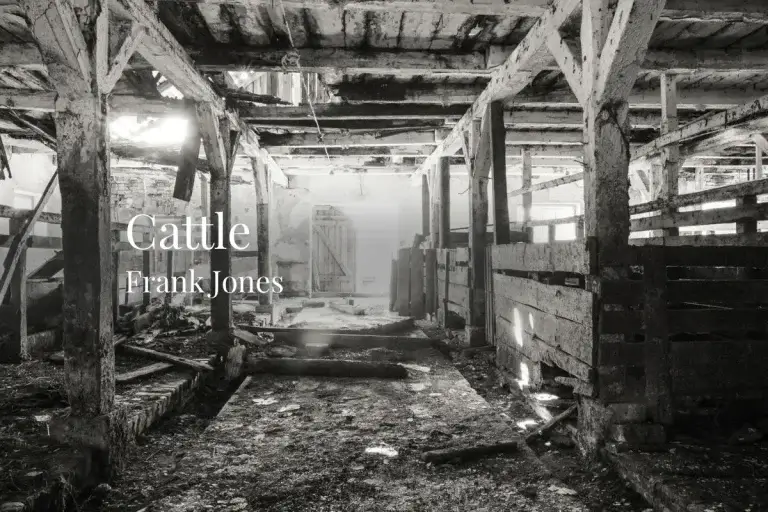
The farm was a shit hole. A gang of low, mean farm buildings with corrugated rooves. A mobile home with paint so grimy it looked the colour of rotten teeth. A house tucked away on the far side, ramshackle and wounded – an animal that had run away to die. 

Jackson swung the motor into a line of faded parking bays and gave the hand break yank. Rain started pitta-patting on the roof. 

“He said he’d be knocking about inside,” Jackson went, pointing to the main building. There was this slimy ramp that led to a bay with a plastic roof. A lorry was backed up to the bay with its arse gate open. Rain ghosts danced across the pot-holed tarmac.  

As I stepped out of the motor, I was instantly stung by the smell of cow shit.

“Fucking honks out here,” Joe went, swishing his hand in front of his nose.

“Doesn’t bother me,” I went. “I love the smell of shit.”

Share this article
Short Story

Graham’s Boy by Frank Jones

Share this article

Graham’s boy, Cain, had blonde curtains and blue eyes and never seemed to get older than about ten years old. It was like he was stuck at that age, and the years just ran around him. I’d see them knocking about up town on the weekends, and Graham had told me how he’d had to fight the mother for custody to even get that. Now and again, Graham would bring the boy to the gym. The lad would just sit there on a bench in the corner, fiddling with his phone. Sometimes he’d walk over to Graham, and he’d pass him a couple of quid, and he’d nip off to the corner shop and come back with a bag of Haribo and eat them whilst he watched his dad lift. A couple of years swam by, and I turned and looked at the corner of the gym one day and instead of seeing a little kid, I saw a bloke. And he could throw the fucking tin around and all. He even wrote his bench-press numbers on the chalk board on the far wall. 

“Looking good, isn’t he?” I went to Graham.

“Yeah, he is.”

“Where does he train?”

“Ivy House Lane, on the in

Share this article
Short Story

Smithers-Jones Makes a Long-Term Investment by Alan Griffiths 

Share this article

“Archie, you’re a mug. I’m only thankful your mother is no longer around to witness this fiasco.”  

The old man’s harsh words echoed around Archibald Theodore Smithers-Jones’ head as he plugged the flash drive into the MacBook. He read through the report slowly. It was comprehensive and meticulous. The accompanying photographs, damning. He sent the file to a laser printer and pocketed the flash drive.

His father, an old Etonian, dyed-in-the-wool, small and big c, conservative had warned Smithers-Jones, marriage to a woman thirty years his junior was doomed. Belittling him with a final spiteful lash of his tongue. 

“She’ll take you to the bloody cleaners. See sense you blithering half-wit.” 

Floor-to-ceiling windows offered views of the Thames and the sprawling city. Prints and watercolours dotted whitewashed walls. Book shelves lined one wall with academic volumes and classics. Smithers-Jones got to his feet and took in the view. Thinking things through. He had used an intermediary to contact and brief the private investigator who had provided a professional and efficient service. A contact well worth fostering.

Smithers-Jones pushed a button on the desk console. “A pot of tea please, Rebecca and some biscuits.” 

The gumshoe’s report and photographs had left him feeling grubby. He used the office ensuite to freshen up. As he dried himself with a paper towel he inspected his reflection. Bespoke Savile Row shirt and suit. Silk tie. Salt and pepper coiffured hair. High angular cheek bones, sharp nose and clean-cut jawline. Eyes as grey as a winter sky. There’s life in the old dog yet, he thought.

Back at his desk Smithers-Jones drank tea and nibbled on a shortbread. Through a cruel twist of fate, his father never lived to see the outcome of his prognosis. Passing away in a tragic accident shortly before Smithers-Jones wed the blonde and beautiful Cheryl.

Smithers-Jones mused how the family business, specialising in long term bonds and investments, had flourished. He was immensely proud of Meridian Trust and its success in the dynamic ecosystem of international finance. Succeeding his father as Chairman had made Smithers-Jones a wealthy man. The subsequent inheritance increased his personal fortune threefold. Surely, it was only a matter of time before the House of Lords beckoned.

There was of course an itch he could not scratch. He wanted a child and to be able to pass on the trappings of his success. Alas, despite a luxurious lifestyle and exotic holidays, it soon became apparent Cheryl needed more to fulfil her days. Bearing him a son and heir was not at the top of her list. Their love making had become as infrequent as a London bus and she had more headaches than a teacher on a Friday afternoon. Nevertheless Smithers-Jones funded her numerous hobbies. The latest being the piano. Cheryl shamelessly recounting how lessons with James, her private tutor, were progressing. He grimaced as he recalled Cheryl practising on the baby grand he had purchased for her birthday. Her two fingered technique producing a series of fractured bitter notes, hollow jarring tinny thuds and wobbling clanks and chimes. He smiled, an old joke coming to mind: she could play all the right notes but not necessarily in the right order- 

“Mr Creed is here.” Rebecca’s clipped home cou

Share this article
Dirty Realism, Noir, Short Story

Stellar Notions by Mike Lee

Share this article

With the hostile demeanor of an automobile line worker who has been doing this sort of shit fifty times a day for five years, Arthur blithely threw a handful of Romaine lettuce into the gray salad bowl. He reached into the white buckets set in ice in a gray plastic tub on top of the steel rack beside him, pulling out two cherry tomatoes, three rings of fresh-cut onions, and a smattering of purple cabbage.

Once finished, he slopped a half-ladle of greasy vinaigrette dressing into the bowl, set the finished product on a brown plastic plate, dropped two packages of saltines on the side, and walked through the double doors into the crowded dining area.

Immediately, Arthur bumped into Larry Bozzaterri in front of the six-top on table twelve. Arthur knocked the pen from Larry’s hand, sending it clattering like a misguided missile across the table, landing in a brisket platter. The consumer of said brisket stopped, stared at the offending device momentarily, then gingerly picked the pen from his mashed potatoes and returned it to Larry.

“Sorry, Bozzo.” Larry hated being called by his nickname.

Larry apologized to his customer, who waved him off with a good-natured shrug. With the dish towel that hung from his apron, Larry wiped the mashed potatoes off the pen.

Share this article
Noir, Short Story

Off The Croisette by Rob Schwartz

Share this article

Did you hear what happened to Josh at Cannes?

Oh, this is good.

He’s at the bar at the Carlton, early. 8:30pm. If you’re at the bar at 8:30, it means a couple of things. One, you’re not at that evening’s awards, which means you probably had no shortlists and you can’t stomach seeing anybody else’s success. Two, you weren’t invited to any dinners. All around Cannes, the media, production and tech folks host dinners for clients and agencies. The cars dispatch from the hotels at 7:00 p.m. By 8:30, you’re tucking into your shrimp and avocado appetizer on the way to a three-star meal.

So, 8:30 at the Carlton means you’re licking your wounds and drowning your sorrows. And that’s what made Josh a mark.

The locals know this.

So this woman—mid-twenties, thin, blonde, beautiful—starts to pay attention to Josh.

“Are you Americain?” she says in her French accent.

“Yes, sorry,” says Josh.

Share this article
Short Story

Part of the World by Barry Garelick

Share this article

It was the end of summer 1971, when the war in Vietnam seemed like it would go on forever and World War Two was a not-so-distant memory. Bob was one of the latter, who had just dreamt of Iwo Jima – a dream he had had for many years –including the black sands that gave way under each step. A Japanese soldier approached him with rifle drawn. Bob shot him, and the soldier lay in the sand, his eyes open. When Bob woke up he did not know where he was.

He sat on the edge of the bed and looked out the window at the streets far below, full of people and cars, and signs in Japanese. By the window was a desk on which lay a stack of official looking papers yellowed with age covered with Japanese writing. On top of the stack was a photo of a young Japanese man holding a little girl. A note written in Bob’s scrawling handwriting next to the papers bore the name “Professor Chishu Hayashi” and a telephone number.

The door to his room opened onto a hallway where he saw a woman in a white sleeveless dress. He thought it was his wife and was ready to call her name, but as she came closer, he saw she was not. 

“Excuse me, I’m sorry to bother you.”  The woman stopped, her lips slightly pursed. 

“I’m very confused. Could you tell me where we are?” 

The woman hesitated before answering. “Tokyo,” she said

Share this article
Short Story

The Golden Room by Patrick Zimmermann

Share this article

Arriving one morning at the house was Detective Mark Hanley of the Terror Town Police. He banged on the door three times.
  Barkley rose, leaving the toy rabbit on the blanket. He wasn’t finished with it yet. The rabbit had one eye and beneath a crusty tail there was a hole chewed into the fur.
  He trotted down the corridor. Like almost everywhere else in the house, it was now dotted in piles of his dung. He went past the portrait of his owner, the late Lord Archibald Saint, but didn’t look at it. He never did. And on, past the door to the left of the portrait. The only room in the house that he hadn’t used as a toilet, the Golden Room.
  “Name?” he woofed, as he reached the entrance.
  “Detective Hanley, Terror Town Police.” Mark Hanley had the voice of a moustache dipped in beer foam.
  “A moment,” the dog commanded and began opening the bolts on the door.
  I drew back into the shadows. 

  Sunlight poured through the widening gap. Motes of dust twirled in the springtime light. Barkley peered out and saw the bulky frame of the detective. He was wearing an outfit that suited his old tie with curry stains on. His head was shaped like a brandy snifter. Fitting, I thought, as his eyes were amber pools splashing over everything he saw. A moustache did indeed hang from his top lip.
  “I’m here because I’m investigating the disappearance of Sephy Caramel. Would you mind if I asked you a few questions?”
  I would cry if I could.

Share this article
Noir, Short Story

You Can Never Be Too Sure by Michael T. Smith

Share this article

It was the cancer-sticks that let her get through this long life.

She opened the pack of Marlboros and took a long drag on one, receiving a glare from a passing mother of two as she blew a puff of smoke out of her mouth. It wafted down the barren sidewalk as if deliberately following the passerby.  She had tried e-cigarettes.  Once.  But they had no appeal for her, and the habit she formed during Margaret Sellers’ twentieth birthday party out on Chesapeake Pier would not leave her that quickly.

A sign marked Tyche Insurance Company tore into the sky above her.  After taking a final puff of the cigarette, she dropped the stub on the ground and entered the building, a building situated in a swank district of town she not just rarely but never visited.

Share this article
Noir, Short Story

The Metro Sonnet by Henry Markowitz

Share this article

“STOP REQUESTED. PLEASE USE REAR EXIT.”

On a number 4 Los Angeles Metro bus I sit, a sad sack on a battered seat at the back of the bus. Today is nice. The sun is shining and it’s a Saturday. Best of all, there are only a handful of passengers. This means fewer stops, more open space, and a general elevation in the quality of my Hollywood-centric voyage down Santa Monica Boulevard.

The bus’s seats are covered in a haphazard arrangement of yellow polka dots. It’s an artsy touch I quite like. Good on whoever’s choice that was. The side windows are plastered on the outside with an advertisement for a superhero movie, and the back wall is consumed by a large air conditioner. Every Metro bus seems to have an odd-shaped stain on the floor at its midsection and a handful of graffiti tags on its metal hand bars. This one is no exception. At the front, just past the retractable seats that also serve as parking spots for wheelchairs, a balding driver sits silently behind a layer of bullet-proof glass. At least, I think it’s bullet-proof. 

The bad feelings have settled in; the anger, the boredom. I can’t really put my finger on where they began but they’re coming in full swing. Now I’m stuck to this seat. I can’t move. I can’t go anywhere. But I don’t like being here anymore.

Share this article
Dirty Realism, Short Story

Visiting June in April by Mike Lee

Share this article

Her birthday just passed. 

At fifty plus one, Katerina flashed a stiletto smile across the bar, flashing her rocks glass at the bartender standing beside the cash register. It had been a long time since tears, and the scotch beckoned. Now she straddled that continental divide between a sodden middle-aged female drunk and a tragic spirit grappling with a midlife crisis.

Katerina did not like this bartender. Too macho for her tastes, he reminded her of photos she had inherited from her grandfather from her mother’s side, pictures kept in a closet until Katerina began to scan and send to distant cousins interested in genealogy.

Genealogy was not a hobby Katerina was particularly interested in, especially after resolving a painful family mystery from her not-so-distant past. Being the granddaughter of the sole family survivor of the Holocaust was terrible enough.

Worse, she had no real family ties, except by blood, on either side. Her father was an only child, and his father was the same.

Everyone was long dead, buried in Texas, or burned in Austria, Germany, and Poland—except a great-grandfather who died in the Spanish Civil War or had changed identity and disappeared. Katerina had read the known records and notes Bubbe uncovered in her research and saw what she found—nothing beyond death or disappearance.

Then there was the Irish side—her mother’s family. There were emails from the first cousin, removed by a generation; her grandfather had never told her he had several brothers and a sister. The cousins asked. Katerina had no idea why.

Her grandfather was born in Brooklyn and moved to Texas to work in the oil fields during the Depression. Later, he met a woman, married her, and had a child.

These long-lost cousins sent photographs of him as a young man, including an 8th-grade class photo from 1921, in which he is shown with his hands on his knees. He sure looked like her mother—sandy blond hair, angular face, though more drawn in.

Share this article