
(4030 words)
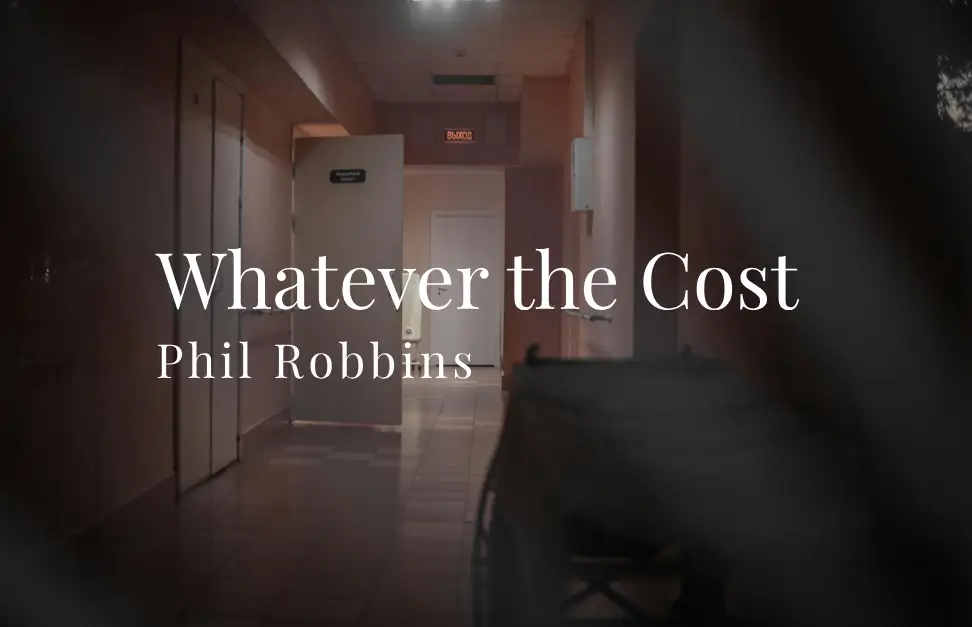
It’s never good news when the doctor calls you and your wife out of your kid’s room to talk. You’re not going into the hallway, with its glaring fluorescent light and sterile smell, to find a cozy place to chat. And the doctor’s not hiding anything from anybody, because your little boy, the angel of your life who has brought nothing but joy into your home for ten years, may have cancer, but he’s not an idiot. You can barely contain your grief, and you bite your inner lip hard, hoping that you can deflect the pain upward, away from your heart.
You and Celia have taken turns supporting each other these past eighteen months. Somehow, one of you has always been able to find a fragment of strength when the other has fallen into the darkness from which escape seems impossible. Somehow, one of you has been able to throw a lifeline, scooping the other to a place where comfort is possible. But now, as you detach from yourself and watch your feet transport you out of Room B234, you both lean into each other, a pyramid of sorts, precariously balanced on four rubber legs.
His words are underwater. “I’m sorry,” he says. “It’s not what we’d hoped.” Do you really need the details? Is it necessary to know that other organs are now involved? Aren’t his organs under warranty? Your fucking windows were replaced for free when they failed. Windows get lifetime guarantees, but ten-year-old boys don’t?
He leaves, and it’s your job to go in there and explain that “it’s not what we’d hoped.” The two of you have to tell him the truth. But there’s just no way you’re going to do that. Because you have a job to do. You’ve always had a job to do. And that’s letting this little man who spoke sentences at two, who was reading at four, and who danced around your living room singing Beatles songs at five know that his Mommy and Daddy are out there fighting off all the world’s monsters. Monsters under the bed, monsters in the closet, monsters in the basement, and most especially monsters masquerading as mutated cells invading his perfect little body. So, you go in there and lie.
“He told us that the results weren’t quite what we’d expected, but that we’re still a long way from knowing whether the treatment worked,” you say.
“What does that mean?” he says, holding Celia’s hand.
You look at Celia, who cannot look at you while you twist the truth. “It means that medicine like that needs a lot of time to coat all the little gremlins crawling around in there,” you say, jiggling your fingers up his jammies until he giggles. You read somewhere that humor heals.
“I thought he went out there to tell you that I’m going to die,” he says.
“He did not say that,” you say.
“Truth, Daddy? Is that the truth?”
“Ceci—did he tell us that he’s going to die?”
“No, baby,” she says. “He most definitely did not mention anything about dying.”
“See chumly love-bug?” you say. “I may be prone to big giant whopper lies about fishing, but you know your Mom couldn’t lie if she was offered a bag of those little chocolate balls she hides from us every Christmas.”
He laughs, nodding.
“Wait a minute,” Celia says. “You didn’t say anything about chocolates. Which color wrapper are we talking?” she adds, and the three of you giggle as if cancer is only a zodiac sign.
“Speaking of which,” you say, “who wants a snack? I think I saw a vending machine out there somewhere. You guys want anything?”
“What d’ya think, bud?” Celia says. “Should we let Daddy surprise us?”
They both nod, and you go out. You look around the hall. Everything is the same, yet nothing out there makes sense. Nurses writing on whiteboards, doctors in light blue scrubs writing in charts, orderlies wheeling hospital beds in and out of rooms, anxious family members carrying flowers and baskets of fruit. You want to scream at them to stop what they are doing, just stop. Haven’t you heard? The results are not what we expected. Just fucking stop.
You pass a room with its privacy curtain open, revealing an elderly man in bed, holding a younger woman’s hand. His daughter, you think. Probably just in from LA, caught the redeye when she heard her old man was back in the hospital. He was a bastard to her growing up, but he’s mellowed on Medicare. She’s hoping to make up, to forgive. You turn and go down the hall, passing a couple of kids on portable game consoles. Maybe Uncle Charlie’s relapsed. It’s in his bones. If he’d cut out the cigars, these kids could be outside playing baseball instead of inhaling molecules of isopropyl alcohol.
Just ahead you walk into the family lounge, where a few visitors have taken a break and are staring at a TV. Are they watching, or are they staring mindlessly to pass the time between tests? You follow their eyes to the screen, where there’s some kind of talk show with more fighting than talking. You get out some change and turn around. Where’s the machine? It was right there in the corner the last time he was admitted.
You go back into the hallway, the fluorescent lights flickering a bit, like a strobe light. Maybe one of the nurses can tell you what happened to the machine. You head that way, but the desk appears far away. The hall is dark, and light, and dark. Jesus, can’t they afford the electric bill with what they charge? Every time one of them puts on a pair of latex gloves it seems you have to take out another mortgage.
“Oh, there it is,” you say to no one. The machine is in the hall, next to one of those emergency kits you’re supposed to use if someone drops dead on the way to the lounge. You grab a bunch of change and look at the machine.
“What the fuck?” you say. “Where’s all the food?” You sure would like one of those bags with all the snacks mixed up, like cheese sticks, pretzels, and nuts. Or maybe something sweet, like a Kit Kat or Snickers bar. None of that is in the machine. The right side of the machine has a slot for the change—two quarters only, the label reads. Below the slot are the letters A, B, C, and D and the numbers zero through 9. But where the candy, cookies, and chips would go is just a bunch of numbers with a letter prefacing each one. They label empty rows.
“Sixty-five thousand dollars you cost our insurance company last time and you can’t keep this thing filled?”
No one responds because you’re talking to a machine.
You turn around to see if you can get a nurse’s attention, but the hallway is completely dark. Really? Now what the hell is going on? The only light now emanates from the machine.
You take a step to leave but stop.
“What?” you say to no one. Or is it no one? You could have sworn you heard something.
“Choose one? Why? I want the mixed snacks and I’m pretty sure they’re gonna want Oreos and cherry Lifesavers.”
You pause and listen. “Why?” you say.
You listen again. “Okay. You’re right. Why the fuck not?”
You put two quarters in the slot, and you pick one, B207, imagining a bag of peanut M&M’s. The slot hums, turns, and the little white coil spins and deposits nothing into the bin.
You open the little compartment anyway and reach your hand in, just in case.
You turn and head back down the hallway, figuring you can take the elevator to the ground floor and see what you can drum up in the cafeteria, when all hell breaks loose.
“Code Blue, Code Blue,” on the speaker. “Code Blue B207.”
Two docs jump up from the nursing station—what the fuck? The nursing station is right where it was before. Right there in front of you. And the lights. The lights are fine, bright as always. The docs are running in front of you, down the hall, and a nurse is racing behind them, pushing some kind of rolling medical cart with computers and all kinds of gizmos attached to it.
This is an event. A happening. You follow because rubbernecking is one of those things you learn with your ABC’s. You usually gripe when the line of traffic backs up for miles, complaining that people should just keep driving and not slow down. But you don’t accelerate sooner than anyone else, because you want to see what all the fuss is about. You look to see if death is in someone else’s car. And that’s what you do now. You follow the traffic to B207 and rubberneck the shit out of the moment you pass the room. You watch while Mrs. O’Flannery, or maybe Mrs. Langer, or some other unlucky Mrs., and her two grown children also watch as the doctors are unable to get the computer signal to bounce.
Back in the room, he’s asleep. Ceci is still holding his hand and looks up as you return. She looks at your hands.
She whispers, “What happened?”
You whisper back, “Some older guy down the hall flatlined.”
“What are you talking about?”
“The Code Blue,” you say pointing down the hallway. “Room 207. It’s the strangest thing.”
“The snacks, hon. What happened with the snacks?”
“Oh, shit. I meant to go to the cafeteria, but I got sidetracked with the code. The machine was empty. It’s the strangest thing.”
“What’s strange about an empty machine? Lot of people here just sitting all day.”
“I’ll go down to the cafeteria now. You want dinner?”
“Sure. Something light.”
You turn to leave. “What were you saying about that room?” she says.
“207. Never mind. I’ll be back in a few.”
The hallway has settled down, except for a couple of family members standing outside room B207. Hugs, tears, silent vacant stares. You go the long way to the elevators, taking a quick glance into the lounge. The vending machine is back where it’s been for months, and it’s fully stocked. The hall near the defibrillator is empty.
You’re tired. That must be it. No doubt traumatized by the doctor’s words, you must have had one of those little dissociative episodes you heard about on NPR. You were worried about him and the test results, and you just slipped into La-la land, imagined a world in which death is not random and certainly not dictated by a weird glitch in a genetic code. You need sleep. Ceci will stay with him tonight and you’ll go home, get something to eat, and get some shuteye. You’ll be back first thing in the morning. You throw a bunch of quarters into the machine and grab a package of Oreos and a few other sweets.
Ceci stares at you when you return. Her face is scrunched in worry, the face you’ve seen repeatedly this past year. Frown lines that never exist when she’s sleeping curl above her auburn eyebrows. She grimaces as if she’d just tasted a rotten lemon. You feel that familiar sense of panic.
“What?” you say. “The doctor again?”
“No,” she says. “You.”
“Me? What?”
She looks at the pile of candy in your hands.
“I thought you guys like the ones with the double stuff,” you say, holding up the Oreos.
“Honey. Did you not just tell me the machine is empty and you’re going to the cafeteria?”
You pause, look at the candy, and smile. “I did, didn’t I? Maybe it’s time for me to sleep. Can you stay tonight?”
She reaches out for your hand and pulls you toward her. Her embrace is warm and her hair smells sweet, of lavender and cinnamon oatmeal. “Get some rest,” she whispers in your ear. “Love you,” you both say.
Your sleep is battered by images of patients in hospital gowns running up a descending escalator. You sit in a control car at the bottom, alternately placing your foot on the brake and the accelerator. “Candy, anyone?” you say. No one wants what you’re selling. “It won’t cost you much. Just two quarters of a century.” A musical soundtrack accompanies the images, a monotone beep that awakens you to your alarm buzzing.
His room is empty when you return, and there is a brief moment of panic until a day nurse explains that your wife and son have gone to radiology for another scan. You try to settle into the chair by his bed, holding his teddy bear. You hope to feel him here, breathe in his little boy smell, his laugh, his trust, hold it in your body and cleanse yourself of fear. But the fear is always there. The thoughts you always tell yourself not to think push past the fragile wall you’ve created. You and Celia have erected towers of Jenga blocks to not think what you think, but you look at each other and know that certain thoughts cannot be unthought. After all, Jenga games are half building and half breaking.
“Yes,” you say to no one, “I need to get out.” You leave the room and walk the halls. The floor is set up in a square, each side a wing signified by a letter. You walk the square and look into each room, noticing families hovering over beds. You imagine them feigning interest in box scores and movie releases and the weather. And, as you complete the square and move toward the lounge, something cold and dark seeps into your soul. There is only so much Death can do here, you think. Only so many souls it can take on each pass. And you think, no, you know, that your job is to slow its advance. It’s the least you can do. It’s what you must do.
You turn the corner and, again, the lights are out. This time you are not surprised. The vending machine is in the hallway, a beacon inviting your selection. You’ve decided what you want to choose before you even get to the machine. C156, you think. It was some old lady. She had to be in her eighties, her cancer stripping her of any semblance of vigor, her body already a corpse. No flowers, no decorations of home, and never any visitors from what you’ve seen these past several days. No one to miss her.
The machine is still empty, but the coin slot is gone, replaced by a credit card scanner. Fifty dollars! Talk about inflation. You get out your wallet, scan your American Express card, and press C156. The slot hums, turns, and drops nothing obvious into the bin. You reach in and pick up nothing obvious.
Moving quickly, almost jogging, you retrace your steps to C-wing in time to see a hospital bed wheeled out of C-156, a body covered fully by a sheet and taken into the staff elevator at the end of the hall. As you pass the room, you see two orderlies spraying disinfectant and wiping counters.
Your family is back when you return. They’re excited to see you. He’s sitting up in the bed, laughing, as Ceci has just pulled the wrong block out of a stack of blocks, crashing the pile onto his breakfast tray, covering the little pieces of wood in oatmeal.
“Hi Daddy,” he says. “I just beat Mommy three times in Jenga.”
You lean in and give them each a kiss. “What can I say?” she says. “You’re the best. More oatmeal?”
“Definitely. It’s actually good this time. It doesn’t have that pasty feeling in my mouth, and I think they added some sugar or something. Maybe maple syrup.”
You want to stay here and drink this in; it feels so good. And look at him! His eyes are bright and the sallow patches under his eyes have faded. He’s digging into that oatmeal as if it was Frosted Flakes or Count Chocula.
“Your turn, Daddy. I bet I can beat you this time.”
“Not a chance, showoff. Set ‘em up.”
The doctor comes in as the tower is half assembled. He’s beaming. “What have you been eating?” he says.
“Oatmeal. It’s good.”
“Well, guys, maybe it’s the oatmeal and maybe it’s the treatments. But check this out.” He holds up a printout of images, each a body filled with colors. It reminds you of those large elementary school maps your teacher would pull down, with different colors representing mountainous regions, jungles, and deserts. You think, what happened to all the deserts?
“What are we looking at?” you say.
“What we are looking at,” he says, “is more than a seventy percent reduction in hot spots. This is remarkably good news.”
There are four people in the room. Two are smiling; two are crying.
“Does this mean I can get out of here?” he says. “I think next week are baseball tryouts.”
Ceci and you look at the doctor.
“Well, let’s give it a couple more days and do another test Friday. If the results look anything like this, I’d say we kick you outta here. Deal?”
“Deal,” he says.
You wait for the doctor to leave before you and Ceci wrap your arms around this little bundle of love wearing Spiderman pajamas. The pajamas are a size too large now, not fitting him as they did a few months ago. You try to push away the thought that he’ll need more candy to fill out the jammies, aware that thinking about not having a thought is having the thought.
Two days later, you arrive early, while he’s still sleeping. Feeling hopeful, you’ve brought his little carry-on bag, the one with the Yankees logo on it, the one that was filled with toys the last time you were able to take him to Disney. He’d jammed so many of his animals in there that you had to tell him he’d need to leave space for any new characters he’d meet in Orlando who would want to come home with them. Celia didn’t know you were coming early. You let her sleep, too. You have a job to do.
You’re impatient as you leave the room, not stopping to greet the nurses who have taken such good care of your little man. You get to the end of the hall and the lights are on. The machine is not in the hall. Your pace slows as you walk to the lounge. Oh God, no. The machine is in the corner of the room, fully stocked.
You run back to the nursing station. Code blue, you say to yourself. A nurse looks up from her work. She must be able to see the distress on your face.
“What’s wrong?” she says. “We just checked on him. He was sleeping.”
“The machine,” you say, barely able to spit out the words. “It’s been moved back. Where is it?”
“What machine?” she says.
You point down the hallway. “The vending machine. The other one. The one without the candy.”
She looks at you as if she hasn’t any idea what you’re talking about. Because, of course, she couldn’t possibly have any idea what you’re talking about. “I’m sorry, the only vending machine I know of is the one in the family lounge. It’s been there as long as I’ve been working here. Almost three years.”
You can’t think of anything to say. What could you possibly say that won’t get you sent for psychiatric screening? You nod and walk back to the lounge. The machine is still there, filled with snacks.
You walk slowly to his room and sit quietly, not wanting to wake them. They’ll be up soon, and Ceci’ll stay with him while they repeat the scan. You will sit here and hope the empty machine returns in time for the results. You have a job to do. With inflation, you expect it will cost considerably more. Maybe five hundred dollars this time. Five thousand the next time. And, Jesus, maybe fifty grand after that. Whatever it costs will be worth it. Whatever it costs.
Later, the three of you pack his suitcase and you give them both hugs as he goes with Ceci and the tech. This time he is in a wheelchair, no longer needing to be wheeled in his hospital bed. He’s all smiles and two thumbs up as he leaves the room. “Wish me luck,” he says as you watch him going to the elevator. You blow a kiss to him as the elevator doors close.
Your hands shake as you walk down the C and D wings. You scout the rooms, trying to find the ones who could take his place, the ones who, you tell yourself, would be willing to take his place. D211 looks like a good bet. He’s not old, but you can tell he’s not going to last. No way. Whatever he’s got is eating him from within, some form of flesh-eating bacterial cancer rotting his liver and kidneys. How many more beats can his heart pump blood through that obstacle course of plaque? You can practically hear the strain on his blood vessels and that thump, thump, thump in your ear is most definitely not your pulse. You don’t need any fancy contrast MRI or CT scan to diagnose him. It’s clear as day that night has come to room D211. You’ll pay the price.
Your heart accelerates while your legs become putty, slowing to a stop next to the defibrillator, where once again there is no machine. Just ahead, you can hear the faint hum and see the red light of the Coke display on the machine, in the lounge. You walk to the doorway and see the candy. “Please,” you say. A woman seated in the lounge looks up from her magazine.
“Yes?” she says.
“Please. Have you seen the other machine?”
“Only one I’ve ever seen is right there,” she says, pointing.
You nod and leave. You go back the way you came, down C and D halls. They’ll return soon with the results. You need to make a selection. It’s the only way. Baseball tryouts are next week. You wished him luck, but he needs more than luck, you know. He needs you to take care of him. He needs you to chase away any gremlins that might find their way through the world of safety nets you and Ceci have created.
You pause at room D211 and look around before stepping in. His eyes are closed. He looks asleep. But you understand these things now. He’s in a coma, his vital functions failing. You pull the privacy curtain closed. You slide the chair to his side, so close you can hear his breaths. You can tell the escalator is descending fast. No way he could possibly keep ahead of it. It’s gonna happen with you or without you, you know it. You have no choice, of course. Your little boy is counting on you. Just like he counted on you to clean that first fish he caught. Just like he counted on you to teach him to ride a two-wheeler. Little boys count on their dads to do the right thing. And he needs you now. So, you sit in the control car, foot on the pedal. The escalator is headed down, but not fast enough. You accelerate its descent until you can hear the monotone of your alarm clock.
Back in the room, he and Ceci are waiting, grinning, and giggling.
“Where were you, Daddy? You missed the doctor.”
You look at them. They are so excited, so beautiful, so full of life. “What?” you say.
He looks at his mom. “The scan was…” They look at each other. He counts “one, two, three…” and they shout together, “One hundred percent clear!”
You look at them. Whatever the cost, you think. Right?
.
THE END
Bio
Phil Robbins is a clinical psychologist who began writing in earnest during the pandemic. He is currently completing his MFA in fiction at the Mountainview Program at SNHU. His short fiction has appeared in Rock and a Hard Place, Passengers, The Wilderness House Literary Review, and Military Arts and Press: As You Were.
More
- Night Shift Politics by Michael Wegener
- Shangri-La by Robert M. Ingram
- Pauli by Matt Gossman
- The Butterfly Collector by Eamonn Furey
- Intoxication by Lynda Williams
Out Now
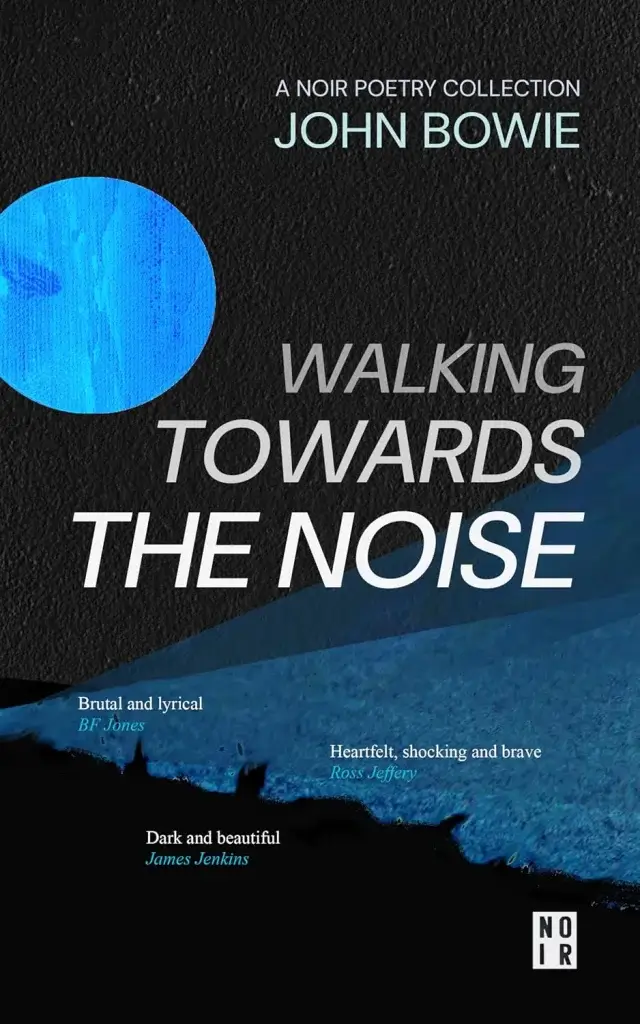
Get ready to be swept away in a raw and powerful collection of modern poetry. “Walking Toward The Noise” by Bowie is a journey through life’s complexities, inspired by the likes of Charles Bukowski, Sylvia Plath, Rupi Kaur, Sarah Kane, and Ted Hughes.
As the words on the page come to life, the setting shifts from gritty city streets to quiet, contemplative moments in nature. Through it all, we follow the main character, a complex and relatable individual navigating the ups and downs of life.
But just when we think we know where the journey is headed, a twist sends us reeling and questioning everything. If you enjoyed other works by the authors mentioned, you’ll find yourself immersed in this provocative and emotional collection.