
Dick.
Not my actual name, but
when you’re a PI,
you get called all sorts of things,
most of which I could not repeat
in polite company—
not that I would recognize polite company
even if it rolled out of my bed
after a night of carnal commiseration
and bit me on my ass.
~
Pea soup obscures the blinking sign
above the seedy dive bar.
SHA_G__-LA, it sputters.
Shangri-La.
Max, the owner, should have
fixed the damn sign—or better yet,
changed the name of the dump—decades ago.
“But how would our customers find us?”
he whines at the blasphemous suggestion—
as if the odor alone would not
be enough to guide them.
~
The weathered door begs for life support
as I enter the dimly lit establishment.
Max calls it “ambience”—
which he pronounces ironically
more like “ambulance.”
More likely, he’s just too cheap
to replace the burnt-out bulbs.
Still, it’s the kind of place
where you probably don’t want
a clear view of the people
you are likely to run into anyway.
~
Entering the trash trap,
I am immediately assaulted by
the familiar stench of sweat-fueled musk,
anonymous sex, and incessant desperation.
~
The Shangri-La is, for many,
a tabernacle, a house of worship,
where the priest behind the bar,
frocked in traditional liturgical vestments
(skin-tight black T-shirt and black jeans),
dispenses holy indulgences for the price of
a Jack Daniels or a Bud Light;
where absolution is often sought—
and sometimes found—
in the sanctity of dark naves;
and communion is 90 proof.
~
In this chapel, the choir
consists of the antiquated jukebox,
from which a country singer
laments the fact that his wife left him
and took the Ram pick-up,
his Remington shotgun,
and his faithful bird dog.
Life sucks! Amen to that, brother.
~
More quarters feed the starving box,
and a singer who has been trapped in there
for decades sputters out the blues.
The garbled words might as well be Latin
to the faithful parishioners,
too stoned to understand the lyrics anyway.
After all, it’s the spirit that counts, right?
~
A weary couple, middle-aged but seeming
as old as the jukebox itself,
perhaps even older than sin,
shuffles across the dance floor,
stained with stale beer,
worn-out confessions,
and nostalgia that routinely
lies to itself in order to survive.
~
Mea culpas and empty promises
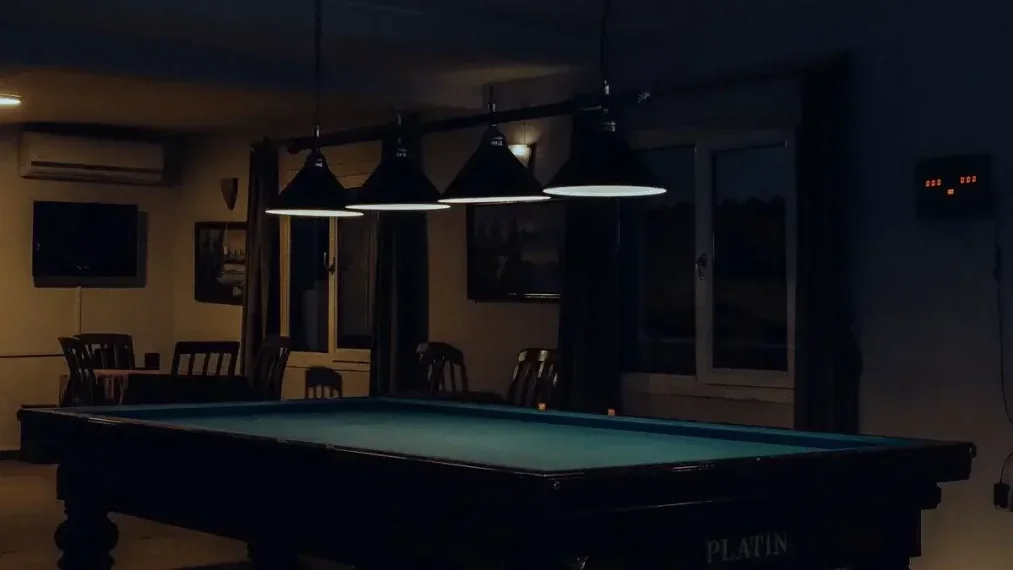
roll mindlessly over the unbalanced pool table,
never finding their intended pockets.
“Rack ‘em up again,”
demands the young player,
who used a fake ID to get in and
quietly hustles the unsuspecting old men,
who grudgingly sacrifice their watches
and silver belt buckles
to the dark angel of gullibility
and deception.
~
Just before 2:00 a.m.,
Jake, the ordained bartender,
announces “Last Call,”
a benediction for the faithful.
Last call: my favorite part of the service.
That’s when suburban housewives
who have drowned their unquenchable loneliness
in hard liquor and beer chasers
find me most attractive.
That’s when I find salvation…if at all.
~
Through the pea soup,
thicker now than before,
my new friend and I stumble
back to her place or mine,
light a candle, share a bong,
fall prostrate before the altar of Erebus,
primordial god of darkness and shadows,
and Dionysus, lord of lust and debauchery,
and, for the next few hours,
until the merciless dawn
robs us of our alibis,
we pretend to be the answer
to each other’s prayers.
Bio
inspired by the noir detective fiction of Knox Barrington, “Shangri-La ” is my first attempt at noir poetry. I have tried to emulate Barrington’s use of language, particularly how he treats abstract concepts as tangible objects.