
(5,616 words)
Single track, shuttle service, two changes from the nearest city. The train terminates on a hill overlooking the bay. Beyond, the land falls away steadily towards a promontory that kids jump off every summer. The station sits to the side, and, with only insubstantial buffers to mark the end of the line, every driver must consider the possibility, by decision or distraction, of plunging straight through, roaring, roaring downward to the sea.
The station consists of an unwelcoming pub, an unwelcoming cafe for people afraid of the pub, and an unwelcoming ticket office for people afraid of the cafe. It was a glorious autumn afternoon, the light golden and warm, so I waited outside for the minicab I’d booked earlier that week. (“I’ll have to move things around,” Kev of Kev’s Cabs had said, resentfully, before making me pay in advance.)
A dozen men gathered, drinking: russet with a tinge of pink, tan on burn on tan on burn, almost exclusively shaven headed, looking like – and I mean this descriptively, not unkindly – clothed potatoes. We shared the space amicably, as other passengers dispersed and I waited with my bag for Kev.
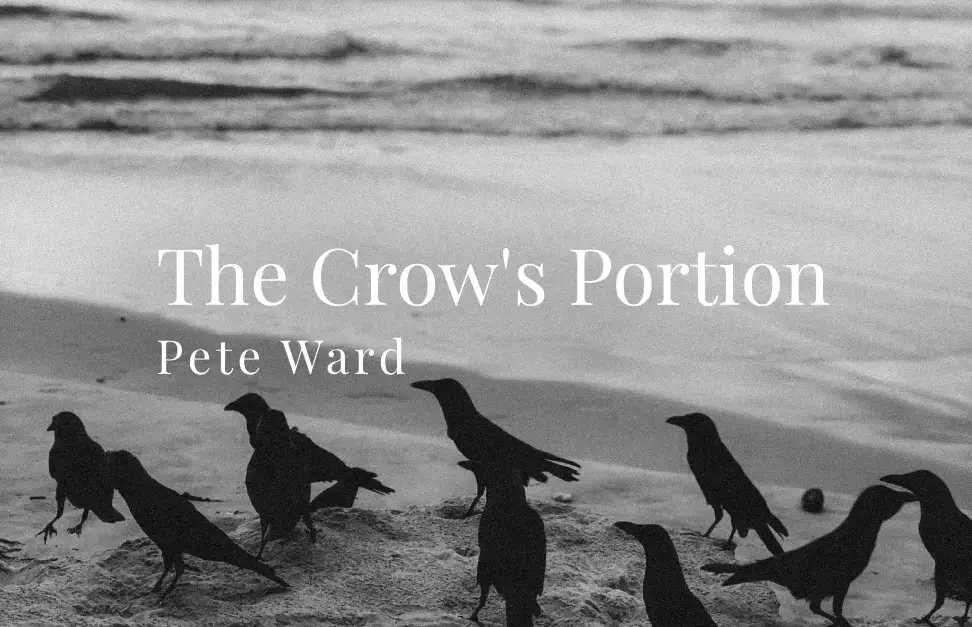
Someone dropped a glass, and a great, hidden shroud of crows rose as one, a sheet pulled over the sky. I gasped, and the men laughed.
“First time?” one smiled. His rings caught the sun as he sipped his pint.
I shook my head. “I used to live here. It wasn’t like this then.”
“Crows chased away the seagulls a few years ago. Who were little shites in their own right, but at least they were local. Anyway, it’s a metaphor.”
“Is it?”
“Sure. You let one black bastard in, they bring all their mates – and then where are you?”
When the laughter had died down – this was clearly a recurring bit – I did The Thing again.
“A hateful little town. This was why I left.”
“Oh yeah?” he snarled. “Well, no one missed you so you can fuck back off where you came from if you don’t like it.”
“Don’t worry, I will.”
We shared the space less amicably. One of the potatoes – I mean it unkindly now – said If you’re waiting for Kev, he’ll be a while, and they giggled.
“Well, one for the road,” the ornithologist said, eventually. He guzzled a fresh pint, before a protracted and elaborate ceremony of leave-taking began, curiously tender, kissing cheeks and fondly touching foreheads. You’d think he was leaving for war, but I knew he’d be back tomorrow, that he’d only temporarily ever be anywhere other than here.
He headed away from the sea towards the car park where I lost sight of him until – of course – he drove up, lowered his window and said “Are you getting in then or what?” He haphazardly slapped magnetized livery to the door: Kev’s Cabs. The Sack was delighted, and their hoots and cheers startled the crows into the sky once more.
“Let’s go see your father, you ungrateful mutt,” Kev said.
*
The car was old, barely adequate, and the boot didn’t open, so my bag was in the back seat. I sat up front, fighting waves of nausea from the potent pine-scent freshener. I always sit up front because – and I know how this sounds – I don’t want them to feel like taxi drivers. I had the strangest sense I’d been in the car before. It wasn’t impossible, it took me to the station on the day I left, that Kev was my driver. My recall of that period was one of carefully-maintained uncertainty.
“He knew you’d take your time.”
“How did you know about my father?” I stumbled referring to him. It’s like a ladder with two rungs missing.
“A good man. Didn’t deserve what you and your mother put him through.”
The Thing, always there: “Mention my mother again and I’ll kill you.”
He guffawed, not unreasonably. “He could never back down either. You know that’s where you get it from? You know you look like him?” He glanced at me, dismissively. “A skinny, weak version of him. You can see your mother in you.”
We drove in silence for a while, before Kev abruptly turned and grinned, shimmering with menace: “What, not killed me yet?” Then, I guess because he was at heart a cabbie, he started to complain.
“Town’s dying. Doesn’t matter how beautiful it is. No real work. Tourists can’t handle the country roads. Gleaming Land Rovers wedged in a hedge. Three trains a day in the summer. Goddamn debacle with the rail electrification means you gotta change twice – of course you know – get onto one of those old shunters, falling apart. That’s why you’re here so late, right? Only way to get here early is to start so close it’s not worth coming. Everything’s falling apart.”
“You forgot the welcome committee of racist pricks.”
“I don’t like that word.”
“What – prick?”
A police car flashed once and came to a stop on the empty road. Kev pulled alongside, and wound down the window.
“This him?” the officer asked, and I tasted acid. He wore his uniform with the affected scruffiness of a schoolboy. “Ungrateful mutt.”
“See you later,” Kev nodded, and as we pulled away asked: “Nothing clever to say now?”
“Yeah, you’re going the wrong direction.”
“We’re not going to the hospital.”
*
Kev drove me to the house.
Looking at it on Street View a few days before, I’d seen how tastelessly my mother’s influence had been gouged from the property. The flower beds and front lawn were destroyed, replaced by tarmac. It was bad on screen, but appalling in person, dark and hot, a hard scab between the rain and earth. He’d cut down the mature trees on the property line, leaving a stark, blank margin around the detached house, and erected a high fence in their place. It was hideous. It was in keeping with the area.
Kev indicated that I should follow him, so I went to get my bag, an indestructible waxed canvas hold-all I’d found in a charity shop. The zippers were padlocked.
“You won’t need that. What’s in there anyway? I know you weren’t planning on staying for long.”
“What’s in there doesn’t interest you.”
“And how would you know what interests me?”
“Books. For the journey.”
“Huh,” Kev said disinterestedly.
It was unlocked. The smell of frailty, human and architectural, like the building failed with the bully, like its structural integrity was contingent on someone to defer, someone to flinch, someone to suffer. Like tears nourished the foundations. A patina of mould on almost every surface, darkening towards the crevices of walls, soft-looking as old fruit. I suspected I could press my thumb into them.
“You let him live like this. You let him die like this.”
“If it was up to me, he would’ve died differently.”
“Little yappy dog, snatching at everyone’s heels. Eventually, you’ll get stepped on.”
“I’ll deal with you later.”
His scornful laugh felt a little hollow, a little less sure.
“Where are his ashes?” I asked.
“He wasn’t cremated.”
“The person I spoke to at the hospital said his last wishes were – ”
“His last wishes were that you were told he was cremated. He had other plans and asked me and the boys, to carry them out. We adored your father, would do anything for him.”
“And this is it? Try to shame me with the way he chose to live?”
“It’s part of it.”
“Where’s his body?”
“That’s part of it too.”
I walked through the house to the kitchen window that looked out on a wildflower lawn with a single mown track that led to an apple tree. I knew it had been razed and astroturfed, but now dandelions and other stems, resplendent, pierced the cheap tennis-ball fuzz.
“You got to keep treating it. I told him. If you don’t keep spraying it always comes back. We had some good barbecues out here until he got ill. Do you even know what killed him? Do you even know how he went?”
“How did you find me?”
“Jamie – you saw him in the police car earlier – did his stuff.”
“Hmmm. Legal.”
“We’re not concerned about that here.”
“Yeah, yeah. I’m tremendously fucking bored by all this, so I’ll find my own way back. Hell, I’ll walk.”
“You don’t want to do that. Dangerous. All those country roads without a pavement? In the kingdom of five and drive? Everyone knowing these roads like the back of my hand? They’ll need the crows to help find your body. Anyway,” Kev checked his watch. “It’s time.”
*
We drove through the town centre, the high street empty but for charity shops, charity shops empty but for shit that no one would want. Bare storefronts bore the sickly rose-green mark of the dynastic local estate agents, a foul tone, with the bloom of decay. The sun was getting lower, strikingly lighting the skeletal spiceheads as they shuffled, their spontaneous gestures and peculiar, floppy grace giving the impression they were dancing with their long shadows.
“This is what we call up-and-coming fanny,” Kev smacked his lips, and slowed to roll alongside a girl of about fifteen, denim shorts cut bumcheek-high.
“Hey, Frankie.”
“Tommy, hi,” the girl said shyly. “What are you doing in that car?”
“On a mission. Coming later?”
“Yeah, ’course,” she said, with a kid’s sense of cool, but he kept looking at her until she squealed and shimmied: “I said yeah ’course!”
“Little bitch,” he said, watching her in the mirror. “Knows exactly what she’s doing.”
“You’re Tommy?”
“Eh?”
“You’re not Kev?”
He shook his head. “Didn’t matter which cab firm you rang, I was going to be your driver, this was going to be your car. You don’t even remember the car, do you?”
“No. Sort of. Why should I remember it?”
“It was his. He loved this car.”
“He loved this car? It’s a piece of shit. It’s filthy.”
“No. She’s a little tired, but he doted on her. Ran sweet every day for twenty years. Earned his respect.” He patted the steering wheel. “Your father was happiest, right here.”
Back at the station, the Sack had become a much larger gathering. (A Field?) The slope overlooking the bay was filled with barbecues and beer coolers, and there were five times as many people, at least, with some scattered women too. Tommy/Kev weaved through the now-haphazard parking lot, past several police vehicles, and drew up beyond the train station amidst the party itself. He did a three-point turn, facing uphill, and erupted from the car, arms aloft, to huge cheers. Toy trumpets blasted tunelessly.
He leaned through the window: “Get the fuck out, mutt.”
I was received with genuine hostility, and felt for the first time like I should consider the threat they represent, and not just the threat they intend. All they planned to do was scare me, I was sure, but over the course of the afternoon, actually carrying out my father’s wishes, I’d become some monstrous Other. Between rage, drink, and drugs, half of them were shaking their heads, seething and twitching.
I glanced into the car at my bag, felt The Thing rising, but this was a lonely place to fight a whole town. A different way made itself apparent. Tommy / Kev was saying something about my father and I cut across him.
“Everyone shut the fuck up a second,” I said, loudly. “I’m not sure what you think you know about me – I said shut the fuck up.” I held the silence. “I’m not sure what you think you know about me, or why my father and I were out of touch. That doesn’t matter. Families are complicated. But regardless of our differences, I’m… glad he had so many friends.” I was surprised to find the strain in my voice was authentic, and the crowd recognised it. “I didn’t like him, but I’m happy that those who did can say goodbye. If I may, I’d like to say goodbye with you.”
“You don’t have to ask,” Tommy / Kev said. “We’re gonna make you.”
He opened the boot – some part of my brain started to object because the boot was broken; he told me that just a few hours ago – and revealed my father’s body, grey-yellowed, shrunken, suited, bundled and bent. The crowd cheered and chanted his name, surged to the vehicle and laid offerings with him: a matchday programme, a tie, a ring, a bottle of whiskey.
Tommy / Kev, roughly yoking my throat with the crook of his arm, hissed in my ear: “Pretty words won’t help you, mutt. Fucking whelp. If it was up to me I’d cage you. If it was up to me you’d be in there with him.”
Though most were contributing to the trinket-midden, a handful of men watched me closely. If I moved too quickly – for the road, or for my phone – they’d deal with me. I pushed my way to the car. Now everyone was watching me closely.
I nudged a packet of pickled-onion Monster Munch off my father’s corpse. With great care, I took out my wallet and withdrew a folded piece of paper, pressed it against his chest, wordlessly, and then slipped it between the buttons of his too-large dress-shirt, directly against his skin. I turned to face the mob.
“I could do with a fucking drink.”
A couple laughed. Someone shoved a can in my hand.
Tommy / Kev took my phone away.
*
It was important to do it slowly.
The truth was these men had fathers they hated, were hated fathers. They wanted to see through me the redemption they hoped for themselves. I drank alone, but soon enough someone came over – older than me, not as old as him – who told me he hoped I was pleased, told me I broke a good man’s heart when I left with my mother.
“I didn’t leave with my mother.”
“Yeah you did.”
“I chose him, first,” I shook my head. “I stayed. I followed her after.”
“I’m not saying I don’t get it,” he slurred, heedless of the correction. “Fatherhood is failure, right? If you’re doing it properly. Motherhood too, but you can’t talk about that. Gotta love your mum, but it’s your dad that does the work, keeps you straight. Gotta love your mum, because your mum wants to be loved and liked. But your dad needs neither because he loves you most.”
I let him talk for a while, occasionally looking distractedly beyond his ear at his shaven head. I didn’t disagree, even when he talked about his daughter “shacking up with some monkey, makes me sick.” I smiled and thanked him for talking to me, told him he was onto something. Said there were things I’d do differently now, and then interrupted myself.
“Yeah. Listen. Have you seen your dermatologist about it already?”
“My what? Seen about what?”
“The raised mole in the occipital region.” I pointed on my own skull, and the man pawed at himself, inelegantly. “You should,” I continued. “As soon as you can.”
“Why?” he started to get agitated, half-tried to turn around to see the back of his own head.
“My uncle – my mother’s brother. It’s not appropriate to diagnose… OK, scrap that. Nights like this really bring it home, right? It’s a malignant melanoma. No doubt. I wouldn’t even biopsy if it came to me, I’d remove as much tissue as I could and hope that speed makes a difference. I’m… sorry.”
I rested my hand on his shoulder.
The girl I’d seen in town, Frankie, arrived with a few others around the same age. Unsteady in their heels, unsuited to the terrain, they tottered and clutched each other. A couple of boys lagged behind, clearly uninvited, hands down the front of their tracksuit bottoms. They tried to nod at the men as men seem to nod at each other when one is a boy, about forty degrees too extravagant in their efforts.
Tommy / Kev greeted the girls and showed them my father. They giggled.
“You go ahead. He’d have wanted you to be happy. Comfortable too – girls, take those heels off. You’ll be leaving ankles all over the downs. Just kick them over there.”
When they did, and sank to below his chest, he emitted a disturbing sigh, heavy with intent.
“To get you happy,” he rummaged in his pocket. “We’ll start with a half each, see how you go.” He licked his finger, dabbed it in the pre-dosed baggie, told each girl to Say Aaah and placed a pill fragment in their mouth like some deviant mass. When he got to Frankie, he mimed an empty bag and shrugged, before turning it into a here-comes-the-airplane that landed on his own tongue. She reached for it, but he recessed that fat, oily muscle and shook his head affronted. He bent down, extended it again and she kissed the tip, catching the pill between her lips.
“Remember now, hydrate, but don’t over-hydrate, yeah? I’ll check in with you in a half hour. Brought your little brothers did you, that’s sweet. They can have a few beers as long as they don’t get out of line. You hear me lads? I won’t have trouble. Tonight is respectful.”
I walked to a group nearby and introduced myself, with an irony that was lost.
“Yeah, we fucking know.”
“Tell me about my father,” I said, and tuned out.
*
All the appliances of pleasure were amply provisioned, and the crowd thrummed with the energy of knowing this would be one of the great nights of their lives. I spoke to councillors, businessmen, PE teachers. I spoke to doormen and bank managers, drug dealers and boat salesmen. Gradually, I shed my handlers because, despite the disadvantage of my starting position, I am a tremendously good time. I seemed to drink more than I did, told tall tales, and chewed gum furiously. In all, I did everything I could to seem harmless, disparaged: just a good lad who fought his dad. Hadn’t we all? Weren’t we supposed to? I made my father’s anger seem immoderate: had he not hated his father? That father hated, hated his?
It seems he’d tried to find me. Would mention it when very drunk.
“Looked for you on the internet but only found your running times. Saw a photo of you at some ultra-cross-country-endurance thing? Sounded awful. He, uh,” the man barked a laugh. “He said it proved running away was all you were good at! He didn’t ask Jamie until the very end,” he gestured at the cop, who glared at me.
“I hear you’re the reason I got the uh, invite?”
Jamie had gotten changed and was taller than I expected. He wore a faded cap and one of those space-fabric jackets that emit a low, radioactive glow in the dark. He spat on the ground.
“We don’t need to fucking hug or anything. I just want to say I’m grateful.”
That was all I needed to give Jamie right now.
They loved tales of cruelty. I cycled through noncommittal phrases, and let them tell me about crimes actual and imagined. The younger son of the dynastic estate agency was there, his wife pregnant with their first child – You’re not supposed to say it, but it better be a boy – telling tales of rent collection from young single mothers: “The thing is to make them think it’s their idea. What? Hell no. They still owe it, they just have longer to get it.”
They dreamed of killing refugees, wishing that the coast they defended faced the continent so they could wake at dawn and weigh scattered corpses with stones and spare the nation the front pages.
“It’s encouraging,” said the councillor. “They see dead bodies make it and think live ones have a chance. Better they disappear.”
The PE teacher excitedly sketched out a network of watchtowers, situated on the high places of the coastline. Before his family were local, he told me, they were Vikings – that inclination to conquer still existed in his blood. He’d had a trial for a League Three team once.
The boat salesman told me about feminising substances in the drinking water, about the failure of masculinity to defend itself, about the necessity of violence in a world without virtue: “It’s preposterous,” he said, in a flowery shirt unbuttoned to the ridgeline of his hard round belly, “Not to prepare our young men. Not to acknowledge one of the few mechanisms we have to genuinely change the world. Violence gets results. It’s how bullies are tamed, how tyrants are overthrown.”
“I couldn’t agree more.”
“You need to strike terror into the heart of your oppressors.”
“Undoubtedly.”
The mosque, he said, was being built despite objections. The community it served was negligible, for now. The men around him nodded.
“We know how they do it: a friendly few, bringing good recipes.” Laughter from the assorted goons. “Then breeding, and demands, and destruction. A church could’ve stood on that plot of land. Should’ve! But now it can’t. We need sons of this soil to defend it. If it happens brick by brick, or all at one with cleansing fire, that abomination will come down.”
“While they’re in it,” said a voice, thick with menace and drink, and the assorted goons didn’t laugh this time.
*
With solemn and measured steps, I seeded horror and disgust among them all.
“Sorry, staggering all over the place! You didn’t feel it? Tough old toes. Christ you’re in flip-flops too! Oh. Diabetes is really tough. My wife’s uncle, they had to amputate – Oh, sorry man! I presumed it was diabetic neuropathy, your feet look exactly like… It means lost feeling in extremities. Hey, you know what? Ignore me. But, uh, please: get an appointment. We men don’t look after ourselves like we should. Nights like tonight really bring it home.”
“Johnno was just telling me about his bitcoin empire – I gotta hand it to him, he seems to have played it really well. Fifty K. Bought the dip, whatever the hell that means. Johnno. No, I’m sure. Short fella, giant earlobes? If you drew faces on them it’d look like he had children sitting on his shoulders: they’d charge him a family ticket at the zoo. Sorry mate, why are you so angry about it? How much?! Well. Maybe it wasn’t Johnno after all. Yeah, massive earlobes to be fair, so it probably is him, but I don’t know much about it. Maybe it’s hard to turn into real money? I’m sure he’d pay you back if he could.”
“Sorry, do you mind me asking? Did they catch it early? Those tremors. My mother’s father, well… When something like that happens to a family member you become something of an expert. Oh god, I’m sorry – listen, I could be wrong! But, please: get an appointment. We men don’t look after ourselves like we should. Nights like tonight really bring it home.”
“We talking about the bird Ian’s banging? He said he was just back from there last weekend. The things he said she did – Oh fuck. I must have it all confused. God I’m sorry. Maybe your daughter knows her? Does Ian know your daughter? Well there you go. Maybe he met Charlotte through your daughter. Your daughter’s name is Charlotte? …What a coincidence.”
“Man that’s a cough! Here, do you want to sit down? How long have you had it for? It’s just my wife’s father, he was a smoker and, um – are you a smoker? Ah. How long have you got? Oh god, I’m sorry – I’m misunderstood. It’s just the cough was so similar, and I presumed… But, uh, please: get an appointment. We men don’t look after ourselves like we should. Nights like tonight really bring it home.”
It was astonishing how little they remembered me, or remembered what I knew of them. I’d grown up here, where nothing really changes, and so I knew the relationships, the interconnectedness, business and personal. The only thing they seemed to enjoy more than betraying each other was talking about it, with oblique references of dazzling transparency. For many, their poor health was a matter of public record, privately granted – the horror was that their decline was visible, evident.
Gently, gently, I turned the night, and, illuminated only by campfire and starlight, the mood shifted to one of bitterness. It was as good a time as any to bring it to a close. I made my way up the hill towards the car, picking out the safest route along the scrubline, checking for rabbit holes and rocky ankle-rollers. I reached through the open back window and got my holdall from the footwell – the plan wasn’t impossible without the bag, but I was still pleased no-one had thrown it off a cliff out of spite.
Tommy/Kev emerged from some bushes nearby, and Frankie followed shortly after. I quickly rummaged through the boot, past the rubbish that gathered on my father’s corpse – someone had eaten the Monster Munch and left the packet – and retrieved the paper I had slipped into his shirt.
“I know you’re up to something,” Tommy / Kev growled in my ear.
“What did she have to lick this time?”
“You’ve got to guide young’uns`. You think it’s more responsible to let those grubby little rats she brought with her leave their mark? She’s safer with me.”
“I owe you for earlier.”
“Eh?”
“I owe you honesty, though, too. C’mere.”
I rested the holdall on the bonnet of the car. The whole gathering lay below us. Sounds of scuffles and raised voices, but there were also the dim outline of bodies scattered all the way down, stargazing or paralytic.
I unlocked and unzipped the bag, telling him my original plan. I was going to pick up my father’s ashes, and, too late to murder him, I was going to murder his house. Underneath a couple of books and some clothes, I showed him an unpleasant array of tools, chosen for the utter disrespect of their condition: the hammer, the handaxe, the crowbar were notched, filthy, rusty. And when I was finished puncturing every wall, and smashing every tile, and heaving floor boards, I was going to burn it down. I showed him the accelerant. I was going to cremate the prick twice.
“But you changed everything. I need to thank you for that. This was,” I gestured with the hammer at the bag, “Childish.”
“You’re damn right it was.”
“Attacking the symbol seemed my only option when I couldn’t attack the source. But he isn’t even the source,” I gestured towards the boot with the hammer. “That’s a child’s awe speaking. He’s not a monster, he’s just a man. But this,” I gestured broadly, “This is the source. This culture.”
I heard an argument approach critical mass on the slope below. It was time. Tommy wasn’t quite following the thread, and though something about my tone made him wary he wasn’t expecting me to smash his skull with the hammer.
I granted myself a few hissed words of explanation, while he flopped on the ground and made wet noises. I dropped a decent sized rock on his face too, to give the impact a more ragged aspect. He was still alive. My phone wasn’t in his pocket. I threw the holdall back through the window, reserving some items. Moving quickly, I dragged his body downhill, beneath the car, lining his face up with a back wheel. A crowd had gathered around the fight – I heard indistinctly something about bitcoin and daughters – towards the bottom of the hill and directly beneath the car. Jamie glowed off to the side, presumably with the other cops, doing nothing.
I took the handbrake off and got my shoulder into the door frame. It moved easily, silently, like it wanted to, but I didn’t have time to watch it plunging straight through that mass of bodies, roaring, roaring downward to the sea. I set off towards the promontory in a curving sprint, concealed by the scrubline, holding hammer and accelerant. I launched the hammer off the cliff edge and far from where I’m sure police divers would be spending their morning. I’m not so quick that I can outrun a car in the dark on uneven ground, but I’m quick enough to appear, as if from the foot of the slope, colliding into Jamie with my head in my hands aghast at the human wreckage and the sounds of suffering and chaos.
“What happened?”
“A car just shot through – ” He was getting there. He looked slowly up the hill, past the screaming debris and peered towards where the guest of honour had been installed.
“That piece of shit. The brakes – ?” I planted the idea, before focussing Jamie’s attention where I needed it. “The police cars have first aid kits?”
“Uh, yeah.”
“You need to call it in. Turn the cars around, get lights on this immediately – ”
The can of accelerant, dropped onto a campfire as I ran past, exploded. It was near where my father’s car was aimed, where I thought the ambulatory survivors would gather. I was right. The fireball scorched a handful, who screamed and rolled on the ground. Jacket Potatoes. Then another smaller explosion elsewhere, which was nothing to do with me.
“We’re being attacked!” shouted the PE teacher, before, disoriented, dashing to the cliff edge and throwing himself off – for an instant, wonderfully suspended, a silhouette against the sea – and plummeting to where even I knew there was nothing but rocky shards.
We heard him screaming.
“Jamie. Lights!”
Jamie barked some orders, and soon the hill was illuminated. Jamie edged his car further down so we could see the full scale. This next bit was critical: I saved as many lives as I could, as visibly as possible. I tied tourniquets and raised limbs. I found the estate agent unconscious with a chunk torn from his leg, bleeding freely, so I rolled him into the recovery position and surreptitiously packed dirt and grit into the wound. When paramedics arrived, I helped and carried.
No one quite knew what to do about the PE teacher, who was still screaming. The lifeboat launched from several miles away and they feared the downdraft from the helicopter would blow the injured off the cliff.
“Thank you,” Jamie said. “Listen – ”
“We’re so lucky you got here quickly,” I said slowly and clearly.
“What?”
“You and the other cops – you were nearby, heard a commotion. Happened to be passing.”
“…Yes.”
“The other cops know this, of course.”
“They will.”
“Horrible accident. Doesn’t have to ruin any more lives than it has.”
They opened the station to use as a major incident hub, so I volunteered to make lots of sweet tea for the survivors. There was a staff washroom in the cafe, which gave me a moment alone with a mirror. My vesture was dabbled in blood. My brow was besprinkled with scarlet horror.
*
Operations continued past dawn and well into the morning, with trains suspended. The crows took their portion. No one who was buried was buried whole.
In my statements to both the police and the press, I had no insight into the events of the evening or the nature of the gathering: I was, on all matters but one, thoroughly dull and unrevealing. Yet when I talked about Jamie, I came alive: I spoke of his leadership, his calm, his heroism. I said far more would have died if not for him. (My father went unmentioned, best I could tell. He was just another corpse fished out of the sea, and Jamie would tidy it up on his end.)
Eventually, a rail replacement minibus arrived. I was the only passenger.
“Ticket?” the driver asked, as he stepped out of the vehicle.
I unfolded the piece of paper from my wallet and he laughed.
“Okay Grandpa! Why not use your phone?”
“Battery is dodgy. I print it out, just in case.”
“Ready for anything eh? Fair enough. Mind if I have a smoke? It’s not like we’re going to be on time.”
I shrugged.
“Look at this madness. A guy drove a car through a crowd? Bloody terrorists everywhere, nowadays: even in the arse-end of the world. Christ. Ay-up: the filth’s after you.”
Jamie was calling my name and walking with a heavy tread. He had slipped off at some point to put his uniform on. He wore it immaculately. It took him a long time to reach us.
He put out his hand: “You’ve always got a home here, if you choose it. You’ve been a good son of this soil. Your father would be proud,” he said, and then sobbed, briefly, efficiently. “Christ. I think one of the girls. I think she might lose her leg. And Tommy. It looks like he was lying down and it went right over him. What am I going to tell his little boy? I did all I could.”
The uniform, the unblinking acceptance of my mythologising, let me know the trap was already closing. Jamie believed he was born anew, heroic and clean. This terrible man, this useless cop, corrupt and hateful, was two weeks away from giving an interview so self-aggrandising, so devoid of self-awareness, that all the shit in his life would rise as from a clogged sewer and drown him while the nation watched. I could already see cameras flashing as he leaves his home, wincing, hands up as if weakly defending a blow.
I rested my hand on his shoulder.
“We just need to look after each other. A thing like this… really brings it home.”
.
THE END
Bio
Pete Ward (he / him) is a charity worker based in Birmingham, England. He has only recently started submitting, and can be found on Bluesky at phenryward.bsky.social