
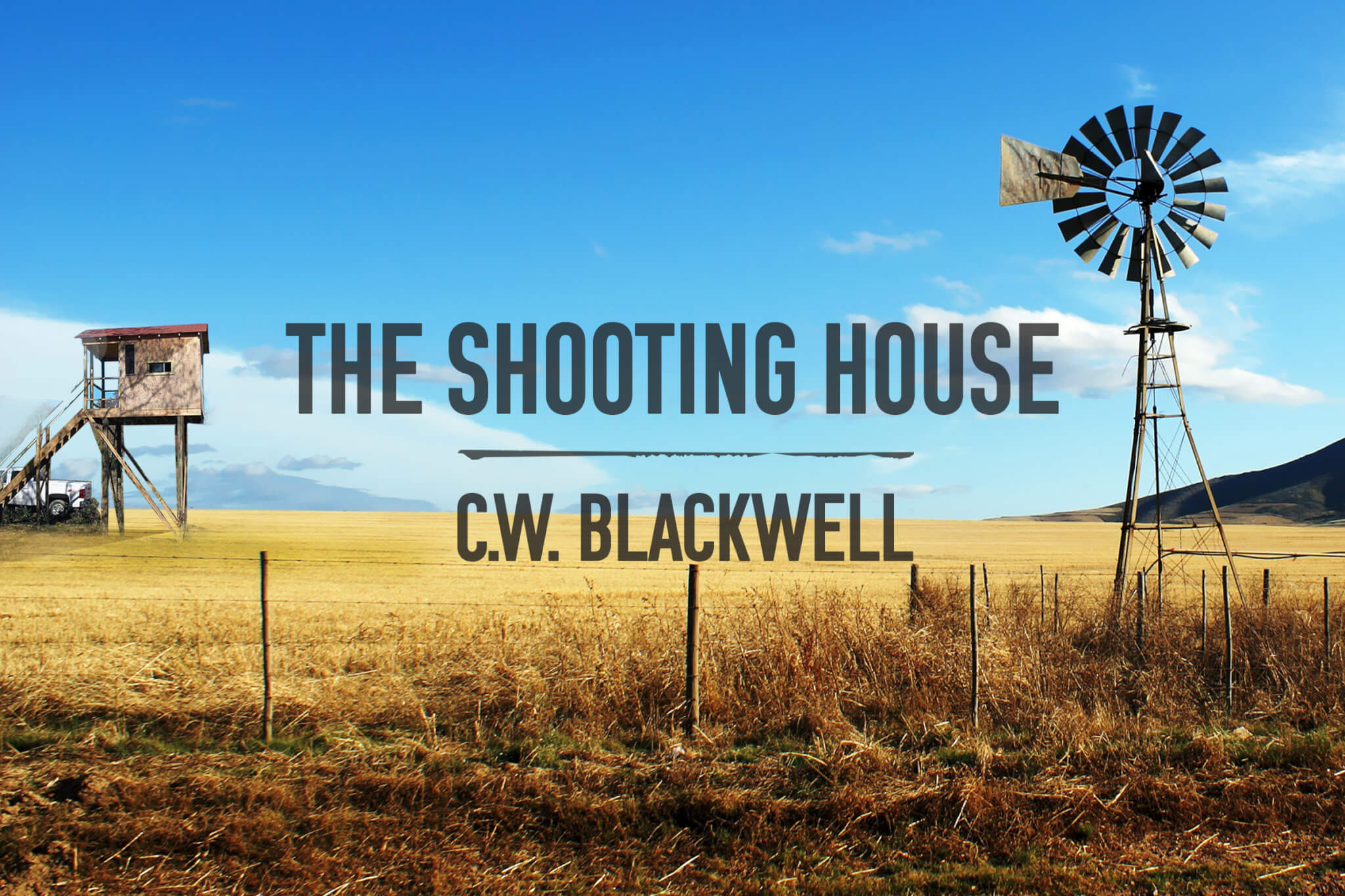
When they released Pops from Tehachapi State Prison, we knew his old enemies would show up to settle the score. This was in the Fall of ‘83, when the Western Sierras still felt wide-open, unspoiled by strip malls and retirement parks—just sprawling oak trees and rolling country roads as far as you could see. On one of those roads, about a quarter-mile from our home in Hopeton, Norm Sunderville and his gang set up a roadblock to intercept Pops before he got to enjoy his first hot bath and glass of whiskey.
“You all right back, there, Pops?” said Joe, my older brother. He looked nervous as the roadblock came into view, one hand on the steering wheel and the other on the rearview. He tilted the mirror to get a good look at the old man’s prison-weary face.
“Quit asking if I’m all right,” said Pops. “You’re both aggravating my nerves.”
“I didn’t say anything,” I said. “Joe’s the one doing all the talking.”
“Bullshit. You asked me twice about the ankle radio.”
“Well?”
“It goddamn itches, if you have to know.”
Joe set the e-brake and idled the car as Sunderville strolled toward us. With his pistol hanging loosely from a shoulder holster, he looked like some fly-by-night lawman. Three of his goons squatted in the road beside an old Lincoln sedan, rifles laid neatly across their knees.
“Morning, fellas,” said Sunderville. I could smell the cheap booze on his breath from the far side of the car. He glanced into the backseat, feigning surprise. “Well good goddamn. Is that Frank Tennyson back there? He free to chat?”
“He’s not in a conversational mood,” said Joe. “Best let us through.”
Sunderville clicked his tongue. “See, that just won’t do. We’ve been waiting a few years already. Damn near five if I’m not mistaken. Me and these fellas here have a problem we need to solve and your father is the only one that can help solve it.”
Joe shook his head. “He’s not in a problem-solving mood, either.”
“Tell him it has to do with a certain little Greek lady.”
“He doesn’t know any Greek ladies.”
“Buddy, she’s the only reason he survived the prison yard every morning.”
Pops leaned forward from the back seat and cleared his throat. “Tell you what, Norm. If you can settle a bet between me and my boys here, we might work something out.”
“What’s the bet?”
“Joey says the car horn on this here Ford sounds like a squealing pig, but Sonny thinks it’s more of a peacock sound.”
Sunderville gave a chuckle and folded his arms. “Well, go on then. Let’s hear.”
Joe shot me a grave look and palmed the steering wheel twice, the horn bleating out into the hilly countryside. Sunderville straightened, crossed his arms thoughtfully. It looked like he was about to render a verdict when his arms shot up and blood geysered from the back of his head, left eye nothing but raw goose liver.
Then came the rifle report.
Crows launched from a distant oak tree.
Pops handed us a pair of shotguns from beneath the seat and we kicked open the doors, used them as shields as we fired on the rest of the gang. We’d reinforced the doors with steel plates for extra protection, but it might have been overkill—Sunderville’s men only managed to fire a round or two before falling dead on the road.
I watched Coral come down off the hillside with a rifle over her shoulder, grass steaming in the morning sun. She was the youngest sibling by far, but a better shot than any of us stacked together. When she joined us, we all stood looking over the dead men, blood gathering and pooling in the shoulder of the road.
“Dump their bodies in the old well,” said Pops. “I’ll junk the car in Merced.”
#
I was eleven years old when Pops went away.
Joe filled the void, working odd jobs all day and night. Mostly farmwork and auto repair gigs. School wasn’t an option. Momma didn’t do much but watch her daytime TeeVee shows and smoke her extra-long cigarettes. She drank cheap drugstore wine and slept all night on the couch, wore the same nightgown for weeks at a time. Eventually, I dropped out too, and that left Coral the only one with a chance at graduation. When Pops came home, we all thought things would change, that somehow we’d get back on track.
But nothing really changed.
Pops talked big, though. He said we’d all be rich soon. Swimming in it. We overheard him telling Momma that in December, just before Christmas, a tall man would drive up the road in a brand-new Cadillac and hand us a briefcase with a million dollars inside. Joe and I thought he’d lost his mind. We thought that prison had made him a little crazy, a little frail even. Sometimes he could hardly catch his breath and he often became angry and confused. One day, I asked him about Norm Sunderville and the Greek lady. He slapped me hard and told me never to bring her up again, that if I did, he’d send me on a slow boat to Siberia.
My jaw hurt for a week.
I was beginning to wish he’d never come home.
“What would we do with a million dollars?” Coral asked me.
“Nothing,” I said. “‘Cause it’s just talk.”
“Well, I believe him.” She’d always spoke highly of Pops, even though she never had a chance to know him well. Maybe he just never had a chance to let her down. Even though Joe and I loved the old man, we knew he was a serial schemer—it’s what landed him in Tehachapi, after all. It’s why we’d gotten into a shootout with the Sunderville gang and had to dump their bodies down a well.
November came and went.
The bills went unpaid, the hard work pressed on.
Then one day, Pops disappeared.
Coral and Momma seemed genuinely distraught, but it didn’t surprise Joe and I at all. We knew family life never suited him. Like the song, Pops always thought of himself as a rolling stone. And that’s exactly what we told the Probation Department when he missed his first state-mandated check-in.
Thing is, they didn’t believe us.
Another two weeks went by, and this time the probation officer showed up with a federal marshal, a chubby guy named Ed Buckley. They asked us a lot of questions about where Pops might be, but they played coy about it like they knew something we didn’t. We talked in circles for another hour until Buckley finally came clean.
“Your father participated in an experiment, a trial for a new parolee tracking system using radio telemetry.” He watched us for a reaction, but we gave none. “Did he talk about the ankle radio at all?”
Joe told him we knew about it, that Pops didn’t like being a guinea pig.
“He told me it itched,” I added.
“I’m sure it did,” said Buckley. “Thing is, we’re getting a signal from your property, somewhere a mile north of the house. We’ve been through there, but we couldn’t find him or the transmitter. The technology’s still new, so we could really use your help.”
“There’s an old quarry,” said Momma. “Maybe he threw the radio into the pit.”
Buckley shook his head. “We found the quarry. It’s too far east.”
We bantered a while longer until they got frustrated and left, and when they did, Coral cupped her hands and whispered something into my ear. I knew what she was going to say before she said it.
We all did.
“The shooting house.”
#
Before they hooked Pops for wire fraud and racketeering, we spent a whole summer building a shooting house on the north end of the property. We only got one good hunting season together, then it was mostly Coral who kept it going—tacking the camouflage and sweeping out the rat turds. Some weeks, we’d have gone hungry if it wasn’t for Coral’s hunting skills. Deer, turkey, quail, rabbit. We wouldn’t get fat off any of it, but Joe and I knew how to butcher the game and Momma made a decent stew.
Thing is, we’d never gone to the shooting house at night.
We waited until full dark before heading out on foot with flashlights and heavy coats. It was the middle of December. Starry skies, frost in the grass. We went single-file through the stony meadow where the land gradually rose into three small hills. Between the second and third hill, we followed a narrow draw to a grove of oak trees where the shooting house stood hidden in the shadows. If the point was to blend into the background, it had served its purpose, fooling beast and man alike.
When we passed our lights over the structure, something caught my eye: a shovel leaned against the ladder, and someone had dug a hole directly beneath the frame. I picked up the shovel, turned it over.
Fresh dirt on the spade.
“There’s mud on the ladder,” said Coral. She shined her light in our faces. “Well, which one of you brave soldiers are going up there?”
“I’ll go,” I said. I don’t know why I said it. Maybe I felt Joe had already done enough, and I didn’t want Coral to suffer whatever shock might be in store up there. I leaned the shovel against a nearby oak tree and climbed the ladder one-handedly, the light held firm in the other hand. As soon as my head cleared the plywood flooring, I stopped.
The sole of a boot.
Motionless.
“What do you see?” said Joe.
“I think he’s up here,” I replied.
I called to Pops—nothing.
One more rung and my flashlight illuminated the ashen face of my father. Mouth slack, eyelids slightly parted. The expression on his face looked anguished, as if he’d died in a sudden flood of pain. A beetle looped through his icy fingers and my stomach tightened like a fist. Something else stood out, and at first I couldn’t make any sense of it. In his right arm he cradled a marble statuette. It looked heavy, and very old. The likeness of a woman with her hair up in a knot, a robe falling just beneath the cups of her breasts.
The Greek lady.
Maybe the old man wasn’t so crazy after all.
#
We quietly buried Pops the next day beneath the shooting house, using the hole he’d already dug for the statue. Momma suggested we throw the radio transmitter into the quarry, and that’s exactly what we did. If Buckley did another sweep, he’d think Momma had been right all along, and that was something she took pleasure in.
The house returned to its usual rhythms.
Joe and I wrenched on cars and tractors for money, Coral brought down whatever game she could hunt in the hills. Momma smoked her long cigarettes and spilled wine on her nightgown when she got too drunk. The only thing that stood out was the Greek goddess posing in the corner of the living room like some out-of-place museum artefact.
And perhaps that’s exactly what it was.
On Christmas eve, while Joe and I drained the coolant from the family Ford, a black Cadillac cut off the main road and rolled slowly up the driveway. I tapped Joe on the shoulder and he watched too, the hair on our necks standing on end like we’d grabbed the wrong battery cable. The car looked fresh off the lot. No plates, heavy tinting. Coral and Momma stood on the front porch, eyes glued. A tall man unfolded from the driver door. He wore brown slacks and a cardigan sweater, a neatly trimmed beard.
He flashed a smile full of perfect teeth.
“Frank around?” he said.
Nobody knew what to say.
Momma took a step toward him. “You missed him by a week or so.”
“Oh?” The man gave a puzzled look. He glanced over his shoulder as if he’d driven a thousand miles of crooked roads. “I’ve come a long way. Do you know where I can reach him?”
“Well,” said Momma. She rubbed her hands together, looked at the sky. The radio had foretold of a storm and we could all feel it coming on. “We buried him up in the hills. Dead of a stroke. Heart attack, maybe. Thing is, we still got what you came for. The Greek lady. Frank said you’d come.”
The man cheered up.
“Splendid.”
He went to the trunk and removed a large tan briefcase and laid it on the hood of the car. He popped the hasps and the briefcase clammed open, stacks of cash neatly packed inside, filled to the brim. One more bill and he couldn’t have gotten the thing closed to begin with.
Momma threw us a wild look as if the whole world had suddenly turned to gold. “Boys,” she said, voice cracking, eyes like hot sparks. “Go on and get that fucking statue.”
I couldn’t say exactly how much money it’d take to put up with a scheming father, one that gets jammed up in prison for years, leaves his children to fend for themselves. I couldn’t do the accounting on all the lying and killing and hair-brained conspiracies, having to drop out of school, half-starved, hopeless, and overworked.
All of the heartbreak and shame.
Maybe they just didn’t have math for those kinds of things.
But as I watched the tall man cut back onto the main road, the four of us standing mute and dumbfounded with the briefcase resting in the dirt, I thought maybe a million dollars came close enough.
THE END
ABOUT THE AUTHOR
C.W. Blackwell was born and raised in Northern California, where he still lives with his wife and two sons. He has been a gas station attendant, a rock musician, and a crime analyst. His passion is to blend poetic narratives and pulp dialogue to create evocative genre fiction. He writes mostly crime fiction and horror. His recent work has appeared in Pulp Modern, Shotgun Honey, Switchblade Magazine, Rock and a Hard Place Magazine, EconoClash Review, Gutter Books, and All Due Respect.
MORE ON BRISTOL NOIR