
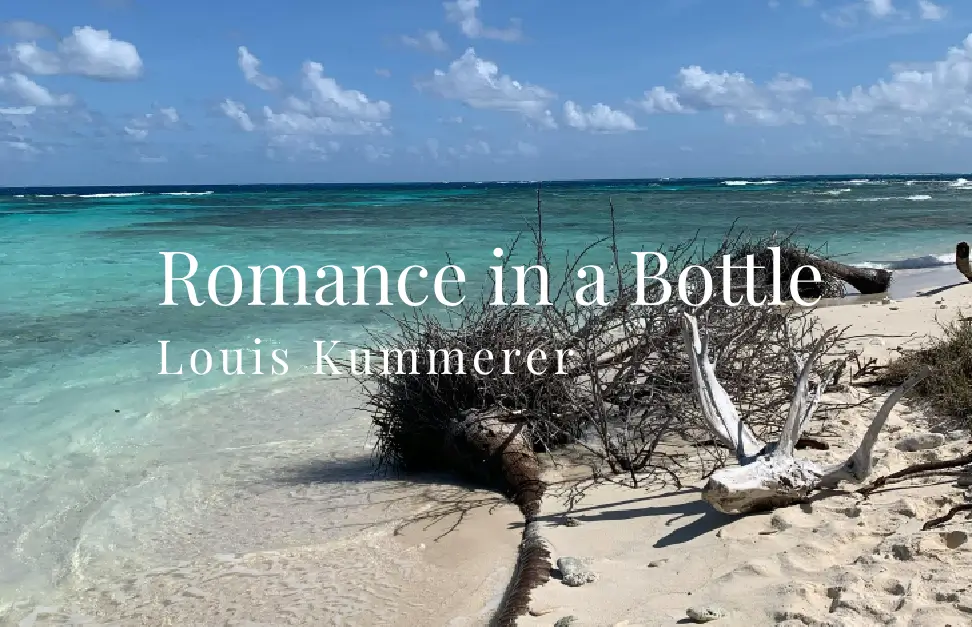
(2,835 words)
The island is my only reality now.
Everything before is no longer real. Everything before is abstract, flat, devoid of life, frozen in place like dioramas in a museum: prehistoric hunters attacking a woolly mammoth; two women haggling in a mediaeval marketplace; an early American blacksmith shoeing a horse. Except my dioramas are more personal: my office the day I was fired; the custody hearing for my daughter, my ex-wife’s lawyer arguing that I’m not a fit parent; the embarrassing scene I made when they took my daughter away.
The crash is still real. The loud thud followed by a violent vibration, the aircraft veering sharply and plummeting downward. The terrified screams of the passengers. The galley cart careening down the aisle, hitting the flight attendant, Daphne, and sending her tumbling into my lap. The rush of emotions as the two of us looked into each other’s eyes and realized we were both about to die. The sudden, spontaneous, passionate, all-consuming kiss we shared, two complete strangers, desperate for one final chance to feel alive. Then the jarring impact as the plane slammed into the ocean and broke in half, the frenzied panic of trying to unbuckle my seatbelt, Daphne and I being torn apart in a torrent of rushing water. And then nothing. And then waking up on the sandy beaches of this island.
Now, this harsh, bleak island has become my only reality, a reality that weighs down on me day after day like a heavy stone, threatening to crush my will to survive.
In the early days, when I was still energetic, still focused, still hopeful, I established a daily routine: Forage for food in the morning, fish in the afternoon, gather firewood for the beacon fire I keep lit in the evening. I thought a routine would help me stay organized, help me focus on surviving for a few days, or a few weeks, while I waited to be rescued.
But the prospect of a rescue grew slimmer with each passing day and now it’s become little more than a fantasy. But I cling to the routine anyway simply because it anaesthetizes me, numbs me to the realization that I will probably spend the rest of my life here. More importantly, the daily routine distracts me from an increasingly powerful urge to swim out and allow the ocean to reclaim me.
I’m on the beach trying to spear a particularly aggressive eel that’s trapped in a tidepool. A large wave rushes in, knocking me off balance and carrying my prey back into the sea. I stand in the receding water for a moment, frustrated and angry.
I begin pondering whether there is any point in going on like this, trapped in the endless monotony of survival, a monotony distinguished not by weeks, months or years but simply by another day, another day in which my singular goal is to ward off starvation. To that end, I’ll be out here fishing in tidepools tomorrow just like I am today. I’ll be doing the same thing the day after tomorrow. The day after will always be like the day before, on and on until I die. And eventually I will die, maybe today or maybe 10,000 days from now.
So why not today?
As I stand there trying to summon the courage to swim into the ocean one last time, another wave washes in, leaving behind a glass bottle that glistens wet and shiny on the beach. I stare at the bottle for a moment, watching as each new wave laps at it, rolls it gently back and forth in the sand. Then I rush to retrieve it before another large wave robs me of this treasure.
I pick the bottle up and examine it carefully. It appears to be an empty wine bottle, clear glass with a screw-top cap. The label has long since been soaked away, and as I look more closely, I can see a paper scroll tightly rolled up and tied with a piece of string.
I unscrew the bottle cap and poke a small twig into the bottle to extract the scroll. I delicately unroll the paper and find that it contains a note, hand-written, each letter perfectly formed as if a medieval monk had spent hours ornately crafting it.
But the message isn’t from a monk. It‘s a plea for help from a woman who had been working as a flight attendant when her aircraft crashed into the ocean, leaving her stranded on a tiny island somewhere in the Pacific. The message is signed “Daphne.”
I sit in the sand for several minutes, reading and re-reading the message. My first reaction is one of elation, knowing that someone else has survived the crash, and more importantly, the survivor is Daphne, the woman I kissed as our plane went down, quite likely the last woman I will ever kiss in my life.
For the next couple of days, I stumble through my daily routine in a daze. I find very little food, and only with a great effort am I able to scrounge up enough firewood to keep the beacon fire alive. I can’t focus because my mind is completely consumed with the discovery that Daphne is still alive. I spend too much time sitting in my hut, re-reading her note and wondering how much her life is like mine.
But eventually, my elation morphs into a deeper concern for Daphne, stranded like me, alone on an island. Daphne launched her message with the desperate hope that someone would find the bottle and come to her aid. By plucking her message from the sea, I was robbing her of the one small ray of hope she was clinging to.
I rummage through my belongings to retrieve a ballpoint pen that was in my pocket when I first washed ashore. Daphne had left the back of her note blank, and I use that space to scribble a message of my own, noting that I too had been on the same flight as Daphne and that I am also stranded on a completely different island. I write that, oddly enough, Daphne had been knocked onto my lap just before the aircraft hit the water. I don’t mention the kiss.
I roll up Daphne’s note, tie it with the same string she had used and I insert the roll back into the bottle. I tighten the screw-top and walk to the same location where I had originally found the bottle. With all my might, I launch the bottle in a high arc towards the sea. Flashes of sunlight glisten off the glass as the bottle rotates end over end and finally splashes into the water some distance from the shore. I watch it bobbing in the waves for several minutes as it floats away from the island and eventually disappears from my sight.
Then I sit on the shore for a long time thinking about Daphne and myself, about how destiny has tied us together in an improbable bond and about the fact that we are now inextricably linked by a single hope floating in a bottle in the middle of the Pacific.
I return to my daily routine with a renewed vigour. I am no longer tempted to swim away and meet my death. Each day is lightened by the knowledge that Daphne is alive and that our fates are now intertwined. I cling to the irrational hope that the bottle will eventually be found and that we will both be rescued.
Days later, my hopes are dashed when I’m walking along the beach and I find the bottle again lying in the sand, taunting me with the blunt realization that any dreams of being rescued are futile. I nudge it with my toe, rolling it slightly from side to side. Anger begins to rise up in me as I pick the bottle up. I’m about to smash it against a rock, when I notice that the roll of paper inside seems different.
I extract the note and I’m astonished to find that it’s a second message from Daphne on a fresh piece of paper. She tells me that she doesn’t know how ocean currents work, but somehow the bottle with my note in it had returned to her. She says she’s thrilled—and the word thrilled is double underlined—to hear that I am still alive. She suggests that if the bottle won’t rescue us, maybe we can at least use it to begin communicating with each other.
I finish reading Daphne’s message, and for the first time since I arrived on the island, I feel genuinely happy. Ignoring the rest of my daily routine, I rush back to my hut and pen a response on the back of her note.
I tell her that she has given new meaning to my life on this desolate island, that before I discovered the bottle, I was beginning to fear that I no longer had the will to face another day and that on the very day I discovered the bottle, I was contemplating ending it all. I tell her that, in a very real sense, she had saved my life.
Then I launch the bottle with my message back into the sea.
I begin counting days, and on the eighth day, a return message washes ashore. Daphne describes how desperately alone she feels on the island, how much she longs for human contact, how she hungers to talk to, listen to, feel the touch of another human being. She tells me that she was also contemplating suicide before my first message arrived. So, we had saved each other’s lives.
Our bottle exchange soon becomes the most important part of my life on the island. All my activities are now governed by the bottle’s 8-day send-and-receive cycle. For the first two days after I send off my message, I am able to concentrate on my daily chores, energized and fully engaged. But as the time gets closer to the eighth day, my mind begins to wander. I daydream about Daphne, what she must be doing now, what she will write about in her next message. From the sixth day on, I spend most of my time on the beach, waiting for the bottle to arrive.
At first, we discuss the mundane details of our life: what we eat; how we built our shelter. I tell her about the beacon fire that I keep burning in the hopes that a passing ship or aircraft will notice it. She tells me that she has carved a huge S-O-S into the sands of the beach. Below the S-O-S, she’s also drawn a twenty-foot outline of a naked woman with large boobs. She says she’s pinning her hopes on the remote possibility that the naked woman might trigger some sort of testosterone force field that will act as a tractor beam, pulling male pilots towards the island.
But we quickly move on to more personal details. Her favorite writer is Joan Didion. Mine is Cormac McCarthy. We both love Tchaikovsky. We both hate hip-hop. We both love Peruvian food. Her favorite dish is pollo saltado. Mine is aji de gallina. I enjoy a glass of single malt scotch, straight up, no ice. She loves champagne, generally drinks Manhattans but will occasionally have a glass of single malt Scotch. Straight up, no ice.
Eventually, our messages become more intimate. I tell her about my divorce, how I lost my daughter and how I lost my job, how I was running away from all the pain and misery of my previous life when our flight went down. She tells me that her closest friend and only living relative, her mom, died a year ago. She tells me that her husband cheats on her, that her stepdaughter hates her and that the isolation and hopelessness of being stranded on the island is, in many ways, a distillation of what her life felt like before the crash.
All of my happiness is shattered one afternoon when the bottle washes ashore and I find a sombre note inside. Daphne tells me that she has been writing our messages on paper torn from a notebook that washed ashore shortly after the crash. The note I am holding is the final page torn from that notebook. With no more pages left, there can be no more messages.
She tells me how our bottle exchange has re-animated her life, and how much she will miss hearing from me, and how sad the remainder of her days will be without me. She bids me farewell and says that her most fervent wish is that I might someday be rescued from the island. She signs the note “Forever yours, Daphne.”
I quickly pen a response. I tell her that I have fallen in love with her, and I don’t know how I can go on without her. I tell her that, even though we can no longer communicate, I will never forget her, that she will be in my thoughts every day and that, if I’m destined to die on this island, I will utter her name with my last dying breath.
Then I seal the bottle, and for the last time, cast it back into the ocean.
Daphne’s final message leaves me utterly devastated. For the first time since I landed on the island, I abandon my daily routine. I sink into a lethargic morass, drowning myself in grief over the woman I’ve lost. I’m too depressed to address even my most basic needs. I stop foraging, I stop fishing. I even let the beacon fire go dead. I decide that I no longer want to go on living without Daphne, but I lack the energy to swim out to sea and drown myself. So I lay in my hut for days, not eating, sleeping fitfully, hoping that starvation will end my wretched existence.
I would have died had not a violent storm swept across the island, tearing apart my hut and forcing me to my feet. Emaciated and unsteady, I stumble around blindly for hours, pummeled by the wind and the torrential rain.
When the storm finally subsides, I find myself on the beach a few hundred meters from where I’d first found the bottle. I begin looking around for any useful debris that the storm might have blown ashore. Just ahead of me, I notice a large bundle, crumpled up on the shore, waves occasionally washing over it. I approach the bundle and suddenly realize that it’s actually a body, a human being, a woman lying face down in the sand. I gently roll the body over and I’m stunned to find that it’s Daphne, semi-conscious, nearly dead, but still breathing. Lying at her side is the empty bottle we had used to exchange messages.
With great difficulty, I carry her back to where my hut had been. I give her fresh water and hastily construct a bed of palm fronds for her to lie on. I gather some live fish that had floundered on the beach during the storm, light a fire and began feeding Daphne small portions of cooked fish.
Eventually, she revives enough to begin talking. She tells me that she has fallen in love with me too and that after she received my last message, she decided to swim out and try to find me. She said that, as remote as the probability of survival was, the pain of dying couldn’t be any worse than the pain of living without me. So she cast the empty bottle into the ocean and swam out to follow it. For days, she continued swimming, braving hunger, exhaustion and shark-filled waters in a desperate attempt to keep up with the drifting bottle. When the storm hit, she struggled valiantly against the ferocious waves. But fatigue eventually overcame her and she blacked out. She told me that she was moments away from death when I rolled her body over. Seeing my face again lit the flame that brought her back to life.
Daphne and I live together on the island now. In the daytime, we fish and tend to the small garden we’ve begun cultivating. At night, we sit by the fire. Sometimes we talk about philosophy and art. Sometimes we recite poetry. Sometimes we sing songs together, songs we remember from the old days or songs we have composed ourselves. Sometimes we dance. Sometimes we just make love and fall asleep to the sound of the distant waves crashing onto the shore.
I don’t build a beacon fire anymore, and she no longer traces the outline of a naked woman into the sand. We don’t want to be rescued. We’ve talked about our world before the crash, her husband cheating on her, my wife taking my daughter away, her stepdaughter, my boss. That’s not the world we want anymore.
The world we want is here. The island is our only reality now.
.
THE END
Bio
Louis Kummerer is a technical writer working and living in Phoenix, Arizona. His work has been published in New Delta Review, The Brussels Review, Bristol Noir, 10×10 Flash, Yellow Mama, Punk Noir, Micromance, CaféLit, Bright Flash Literary Review, Flash Fiction Magazine, The Chamber Magazine, Friday Flash Fiction, and 101 Words. A collection of his work appears at louk247-fiction.com.