Noir, Sci-fi

My Generation by Alan Griffiths

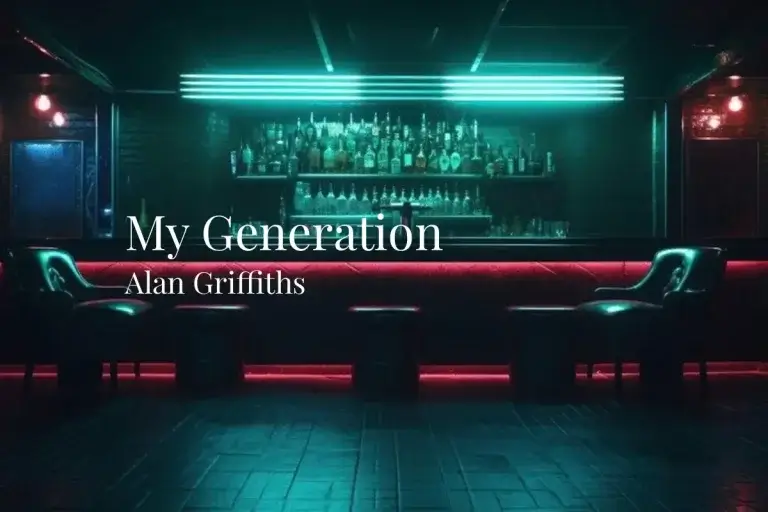
art balled a steel fist and wrapped on the Plexi. The sound echoing in the darkened bar. 

Nada. Zilch. Zip. 

He wrapped again. Harder. 

The speaker crackled, a monotone voice: “Capital W, lowercase n, d, five,”. The droid’s mechanical voice, wrapped in static, continued: “Lower case w, zero, low-.” The head slumped forward as if garrotted.

The android is humanoid, dressed in a superhero suit: head and face, smoked triple toughened Plexi, ringed from chin to temple in neon. Torso and limbs brushed alloy. Soft flexi multi-jointed hands and feet. Designed and evolved to interact autonomously. Last night I’d watched this one autonomously despatch a posse of shit-faced proles into the middle of next week.

“Speak you metal freak.” Hart glowered and raised his PR-2758. “SPEAK.” 

“Whoa big man.” I got myself between Hart and the unit. He’d been known to beat on the AI help. “Easy. We need the rest of the code.” Or we’ll both be tap-dancing down shit street wearing flip-flops. I tapped his tin arm, “Besides, you’re half-brothers.”

Behind the counter and dotted around the interior were a small army of dormant server-bots. Some held mops in mid-clean. Antiseptic and cleaning fluids in the air. The AC silent. Later, the floor will be a sticky mess. Nastier smells present, musty beer, alcohol, congealed food, chemical vapes, body odour, vomit, testosterone and blood.

Hart lowered his prosthetic, a relic of the Long Winter War. The ancient military tech hummed and convulsed spasmodically. He cursed under his breath. Maybe at me. Maybe at artificial intelligence in general. Wiping perspiration from his brow with the back of his meaty good hand. A solid muscular lump. Salt-and-pepper crew, bent nose, a slash of a mouth. When he smiles it never quite reaches his flint eyes. He’s my friend though and business partner and no one better in the trenches. 

“Scheduled maintenance?” Hart asked. “Gone tits up.”

“Haven’t a clue,” I said. “I’m an establishment mushroom.”
Noir, Short Story

The Metro Sonnet by Henry Markowitz

“STOP REQUESTED. PLEASE USE REAR EXIT.”

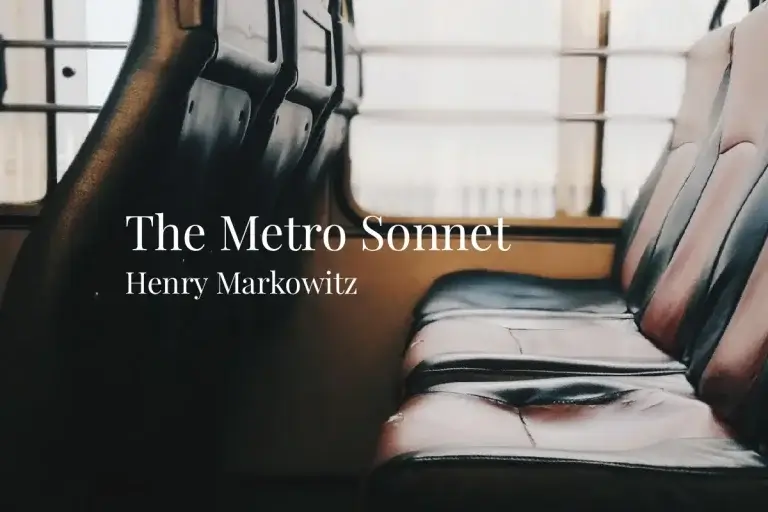
On a number 4 Los Angeles Metro bus I sit, a sad sack on a battered seat at the back of the bus. Today is nice. The sun is shining and it’s a Saturday. Best of all, there are only a handful of passengers. This means fewer stops, more open space, and a general elevation in the quality of my Hollywood-centric voyage down Santa Monica Boulevard.

The bus’s seats are covered in a haphazard arrangement of yellow polka dots. It’s an artsy touch I quite like. Good on whoever’s choice that was. The side windows are plastered on the outside with an advertisement for a superhero movie, and the back wall is consumed by a large air conditioner. Every Metro bus seems to have an odd-shaped stain on the floor at its midsection and a handful of graffiti tags on its metal hand bars. This one is no exception. At the front, just past the retractable seats that also serve as parking spots for wheelchairs, a balding driver sits silently behind a layer of bullet-proof glass. At least, I think it’s bullet-proof. 

The bad feelings have settled in; the anger, the boredom. I can’t really put my finger on where they began but they’re coming in full swing. Now I’m stuck to this seat. I can’t move. I can’t go anywhere. But I don’t like being here anymore.

Dirty Realism, Short Story

Visiting June in April by Mike Lee

Her birthday just passed. 

At fifty plus one, Katerina flashed a stiletto smile across the bar, flashing her rocks glass at the bartender standing beside the cash register. It had been a long time since tears, and the scotch beckoned. Now she straddled that continental divide between a sodden middle-aged female drunk and a tragic spirit grappling with a midlife crisis.

Katerina did not like this bartender. Too macho for her tastes, he reminded her of photos she had inherited from her grandfather from her mother’s side, pictures kept in a closet until Katerina began to scan and send to distant cousins interested in genealogy.

Genealogy was not a hobby Katerina was particularly interested in, especially after resolving a painful family mystery from her not-so-distant past. Being the granddaughter of the sole family survivor of the Holocaust was terrible enough.

Worse, she had no real family ties, except by blood, on either side. Her father was an only child, and his father was the same.

Everyone was long dead, buried in Texas, or burned in Austria, Germany, and Poland—except a great-grandfather who died in the Spanish Civil War or had changed identity and disappeared. Katerina had read the known records and notes Bubbe uncovered in her research and saw what she found—nothing beyond death or disappearance.

Then there was the Irish side—her mother’s family. There were emails from the first cousin, removed by a generation; her grandfather had never told her he had several brothers and a sister. The cousins asked. Katerina had no idea why.

Her grandfather was born in Brooklyn and moved to Texas to work in the oil fields during the Depression. Later, he met a woman, married her, and had a child.

These long-lost cousins sent photographs of him as a young man, including an 8th-grade class photo from 1921, in which he is shown with his hands on his knees. He sure looked like her mother—sandy blond hair, angular face, though more drawn in.

Flash Fiction, Noir

French Fry and Shake by Michael Jared Kite

When people dream of love, they think orange sunsets, or fucking with the lights on. They don’t think of neon paint, power lines, and concrete underpasses that drip even after the rain stops.

Up and down Route-13 dead-eyed non-lookers drive diesel, flanked by abandoned billboards, looking for cheap gas or grub between endless used car lots and fast food spots. 

I was trembling, dope sick outside McDonald’s and she offered me fries. She figured I could score meth and I knew she had money. So, we moved on. Two dead phones and a purpose, cursing the shitty northeast dealers that don’t call back.

I called her “French Fry.” She called me, “Shake.” We posted up together behind the Sunoco. We spent our nights ripping materials or gathering tools from construction sites. The days, scrapping, hustling, running, pawning.

Flash Fiction, Noir

What Would Riggs Do? by Michael Wegener

The woman was waiting for me when I walked out of the theater.

I’d just caught my third screening of Lethal Weapon in as many weeks. I’m obsessed. My feet are still hurting in my new cowboy boots, I have my mullet growing—all I need now is to lose my wife in a car accident and get suicidal about it.

Stepping back into the sunlight with the matinee crowd, the woman made me bump into her, spilling Coke from a lidded paper cup all over herself. I kept apologizing while she dabbed at her soaked halter top and glistening cleavage with a paper napkin. Fifteen minutes later I was buying her drinks at a bar around the corner—the least I could do, according to her—and another half hour later I followed her to a nearby motel, because of course I did—my wife and I haven’t had sex since Elvis died, and just looking at this chick would’ve given a geriatric eunuch a phantom boner so hard, they’d have to castrate him all over again.

The almost painful throbbing in my pants was miraculously cured, however, by the cold kiss of a gun barrel planted onto my temple as we entered the low-rent motel room.

Dirty Realism, Poetry

Poetry by Ralph Spurgin

Bad Ass

He’s a black-baller,
a night-screamer,
the dark architect
of despair.

Virgins go barren,
their screams frozen
in their throats.

He is a fire-melter—
an ice-maker—
an embalmer
with hollow eyes
and marble hands.

He is a blackguard,
a widow-maker,
an opium-eater,
a doom merchant.

Dogs skulk
with tucked tails.
The wind blows
a piercing cold.

He never knew
happily-ever-after.

When he was gone,
three women spilled tears:

A virgin.
A widow.
His lover.

Dirty Realism, Flash Fiction, Noir

Two by Ian Clark

Baker taps his foot—a white Reebok trainer. His fist punches his thigh in time with the beat.
He stops the tape. A solid thunk as the mechanism cuts out. He hits eject, holds the cassette for a moment, then looks away. He slides it back into the deck and presses play.
Incessant. Hard rhythm.

Outside, a train rolls to a halt at the station. Rain streaks the glass. Metallic squeal. Muffled tannoy announcements.

He looks down at a small drop of dried blood on the side of his shoe. He licks his finger and rubs the spot until it vanishes. Satisfied, he nods his head.

The doorbell rings.

He looks towards the bay window. Stands. Carefully pulls back the net curtain.

A man in his early twenties. Stooped posture. Baggy purple hoodie. Long, greasy hair.

Footsteps upstairs. Pipes rattle and sigh.

He bangs the table once with a clenched fist and walks to the hallway.

Takeaway menus and leaflets litter the floor. He pushes them aside with his foot.

The door has patterned glass panels and dark green paint peeling at the edges.

He pauses.
Looks at the dark silhouette behind the glass.

Opens the door.

The man is soaking wet. Lank hair dripping.

Dirty Realism, Poetry

Poetry by Vanya

Tonight I should write

Tonight I should write.
I have swept her memories under the rug
and the table is clean.
I dusted the chair,
straightened the books,
put the phone on silent,
turned on the lamp.

I have thought about the fountains
that are still running.
I have also thought about the mosquito
buzzing in my ear.

If the rug weren’t worn through.

Dirty Realism, Noir

The Corn Stand by Craig Roads

Running west out of Rockford Illinois, US Route 20 skirts the spine along the Wisconsin border, and the land rises as it nears the valley carved out by the Mississippi River. Out there near Terrapin Ridge, right along the highway, sat the neat and tidy farm of Roland Fleck. 

Roland ran a decent-size dairy operation and sold most of his milk to the many cheese producers along the Illinois/Wisconsin state line. He also kept a few hogs for personal use, which Roland always clarified to mean pork chops and not some darker purpose, and on the few acres where he didn’t grow dent corn for feed, Roland decided to plant a crop of sweet corn, which he intended to sell at a roadside stand out on the highway. 

Roland put together a little stand using scrap two-by-fours and plywood. In his shop he found a half-used can of spray paint he used to letter out a sign that said, “Sweet corn”. As a retail establishment, it was not impressive, but functional enough. 

The first season, Roland being plenty busy with his cows and the rest of his operation, he operated the stand on the honor system; he’d stock the counter with ears of corn and put out a can where people could drop in payment. Just before he came in for supper, Roland would go out to the road and shut the stand, collect the money from the can, and re-stock the corn.  It worked well for a while, people being generally honorable, but one evening Roland came out to the stand dismayed to discover that his faith in humanity had been misplaced; all the corn was gone and the cash can was empty.