

(1107 words)
Strike a match. There’s no wind, so the flame holds steady for a moment, and you can survey your handiwork through the chain link fence. Even after two decades, the rubble remains. Suburban decay. That’s what the Catskills Leader editorials scream annually – that the town of Etna won’t – or can’t – bulldoze the debris. But you see it more like an unintentional monument to a twelve-year-old genius. It’s the least they could do for you. The flame inches toward your fingertips. You shake the match, toss it to the ground. Light another. Hold it up looking at the arched doorway beyond the fence. St. Ignatius Academy, the gold lettering burnt around the edges. Ignatius was a warrior too.
***
You were always the forgotten one. The last one off the bus. The last one picked for kickball. The first one hit during dodgeball. You were smaller than the rest of the kids – certainly the smallest boy in class from kindergarten on up – and even a few of the girls (Karen and Donna especially) towered over you through much of grade school. And no one could remember your name. Daniel? David? Not even your teachers. No one saw you sit alone at lunch or raise your hand in class. Only Charlie knew your name, the janitor who showed you around the incinerator, taught you how it worked, among other things, all hidden in the basement. You never forgot to bring finished homework assignments, but how many times did your teachers forget to grade them? Forget to return them to you?
“I’m sorry. I didn’t hand that back to you, David? Uh? Daniel?”
“Daniel…David…Tomlinson,” your staccato voice sounding more like a computerized reply from the robot in Lost in Space than the tortured response of an overlooked, unloved, twelve-year-old boy.
Sister Agnes looked embarrassed searching through her piles on a desk for a nonexistent paper from her nonexistent student. You try not to cry, but who would see the tears anyhow?
“It’s OK, Daniel. Uh…David. My mistake. Take your time on the assignment. You can finish the paper over the weekend. Hand it in on Monday”
Sometimes your teachers, not wanting to admit their carelessness, would give you an A for an assignment they never graded, never returned. Not that you wouldn’t have gotten all As anyhow. You were already the primary subject of your parents’ academic research before you were ten (see The Neglected Child: Studies in Childhood Isolation and Parental Indifference by C.K. Tomlinson, Ph.D. and E.A. Graves-Tomlinson, Ph.D., American Psychological Association, 1972). But later, those mistakes would work in your favor. Something shifted by the time you finished grade school and moved on to junior high.
Sitting at a cafeteria table at the edge of a long bench with several classmates after gym, a few of the boys were talking about watching an episode of Welcome Back, Kotter on television the previous night. You knew about the show, but your parents wouldn’t let you watch television, and they reminded you of this every time you entered the living room when they were watching some moronic program instead. Every damn time. You had your chores. The rats needed feeding. The cages needed cleaning. But the boys, all seventh graders like yourself – Jay, Bobby, Donald, and Anthony – were laughing hysterically, free from all the responsibilities you carried – one hand raised above each of their heads.
“Oooh! Oooh! Oooh!”
“Horshack!” yells Donald. “Arnold Horshack!” and everyone starts wheezing, snorting, choking on their laughter.
Jay says something like “Mr Kot-TAIR,” and they all start laughing again.
“Freddie ‘Boom Boom’ Washington” they scream in unison.
Anthony shouts “Vinnie Barbarino!” and then Bobby says “Who? What? When? Where? Why?” while Jay falls over the hard plastic bench connected to the sticky lunch table, laughing.
Suddenly, Donald turns to you and says, “Hey, I didn’t see you there. You new here or something?”
Anthony shakes his head. “That’s David.”
“No. That’s Daniel. Isn’t your name Daniel?” Jay asks but turns his head before you can answer. The bell rings signaling sixth period. Jay, Bobby, Donald, and Anthony get up from the bench, grab their trays, still laughing about Mr. Kot-TAIR – except Donald looks back at you a moment and shakes his head as he leans over to Anthony.
“I swear. I didn’t see that kid sit down next to me.”
“Who?”
“I don’t know. What’s his name? Daniel? David?”
“Oh, him.”
“Well…?”
“Well, what?”
“Well, what’s his name?”
“I don’t know. He’s been in my class since kindergarten, but you know, he’s not all there.” Anthony taps the side of his head. “I mean, he’s there, but it’s like, you know, you don’t see him.”
“Gotcha!”
And while your classmates file out of the lunchroom, you sit there grasping knowledge you didn’t have only a minute earlier. How could someone so smart be so blind to their own truth? Their own power?
You are invisible.
You are invisible.
You are invisible.
Invisible.
And suddenly you smile because for the first time ever, you’re not worried about getting caught in the hallway without a pass, without an excuse that you’ll be late to class. Because no one will ever notice.
Because you’re invisible.
You open up your red, white, and blue metal dome lunch box with the gold letters spelling U.S. MAIL that you get teased for bringing to school while every other kid is brown-bagging it – the only time anyone seems to notice you – and pull out a carton of milk, a baloney sandwich, your lucky rat’s tail, and a collection of matchbooks from all the Howard Johnsons and Holiday Inns your parents visit without you in tow. Picking up the rat’s tail, you look around the cafeteria which has now completely emptied. Not a lunch lady in sight. You smile, raise your hand high, swinging the rat’s tail yelling, “Oooh! Oooh! Oooh!”
***
Jay and Bobby survived. Donald and Anthony didn’t – although Anthony didn’t succumb to his burns the way most of those kids did. Took him another three months to die. You didn’t have to like someone to still admire them. One of many lessons you learned from that day.
Another match. Another strike. The wind is picking up and the flame blows out from the last gust. Shadows on the sidewalk behind you. Heads down. Hunched hoodies. Hands in pockets. Three of them. Old enough to cause trouble. Young enough to take out. They walk right past you. But of course. Why not? You’re invisible.
One last look at your alma mater. Your handiwork. No. An early masterpiece. You make the sign of the cross. Then turn. And follow.
.
THE END
Bio
Brenda Kilianski is a writer based in Albany, New York. A finalist for the Edith Wharton-Straw Dog Writers Guild Writers-In-Residence Program and a recipient of a grant from the New York State Council on the Arts, her work has been published in Brava! Chronogram, Half Hour To Kill, ONTHEBUS, Shotgun Honey, Spillway, The Metaworker, and The Yard: Crime Blog. She currently works as a reference librarian, the closest she could get to becoming Nancy Drew.
More
- Night Shift Politics by Michael Wegener
- Shangri-La by Robert M. Ingram
- Pauli by Matt Gossman
- The Butterfly Collector by Eamonn Furey
- Intoxication by Lynda Williams
Out Now
‘Set in 1998 in Bristol, England, Bowie’s dark, hard-edged crime novel Untethered inaugurates a promising series.’— Publishers Weekly
‘Noir fans will find a lot to like.’ — BookLife
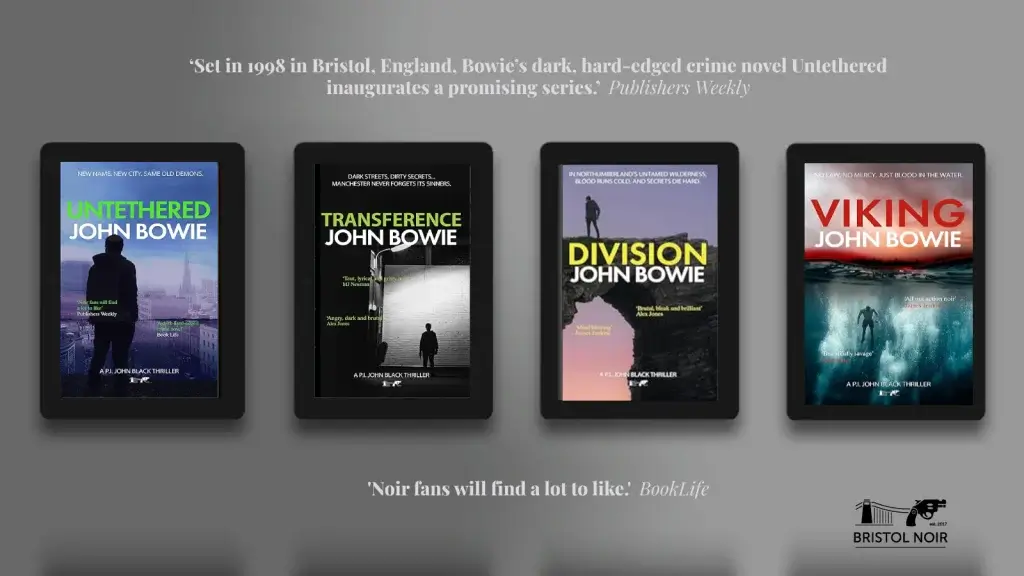
‘…there are so many great writers that this book brings to mind: the dirty realism of Bukowski, Fante and McCarthy and the best noir writing from Raymond Chandler and James Ellroy.’ — Storgy magazine
‘Hard-hitting and oh so good. Perfectly blends hard-boiled crime with poetic beauty with prose that is intoxicatingly hard to swallow. This is the rise of what I believe will be a powerhouse in crime writing for years to come.’ — Ross Jeffery, author of Tome
‘It’s a loopy surreal fever dream of a novel, a dark, disorienting Moebius strip of people and places that are not always what they seem.’ —The Thrilling Detective
‘John Bowie’s ’90s set Untethered is a violent and intense read. Lyrical, moody, funny and as gritty as hell, Untethered is like a British blend of Jim Thompson and Nelson Algren.’ —Paul D. Brazill, author of Man of the World
‘Untethered was a joy to read, and I look forward to the next in the series!’ —Tomas Marcantonio, This Ragged Wastrel Thing
‘Its pages are packed full of deceit, human depravity and surprisingly dark humour.’ —Amanda Brightman, Independent Reviewer