
(1505 words)
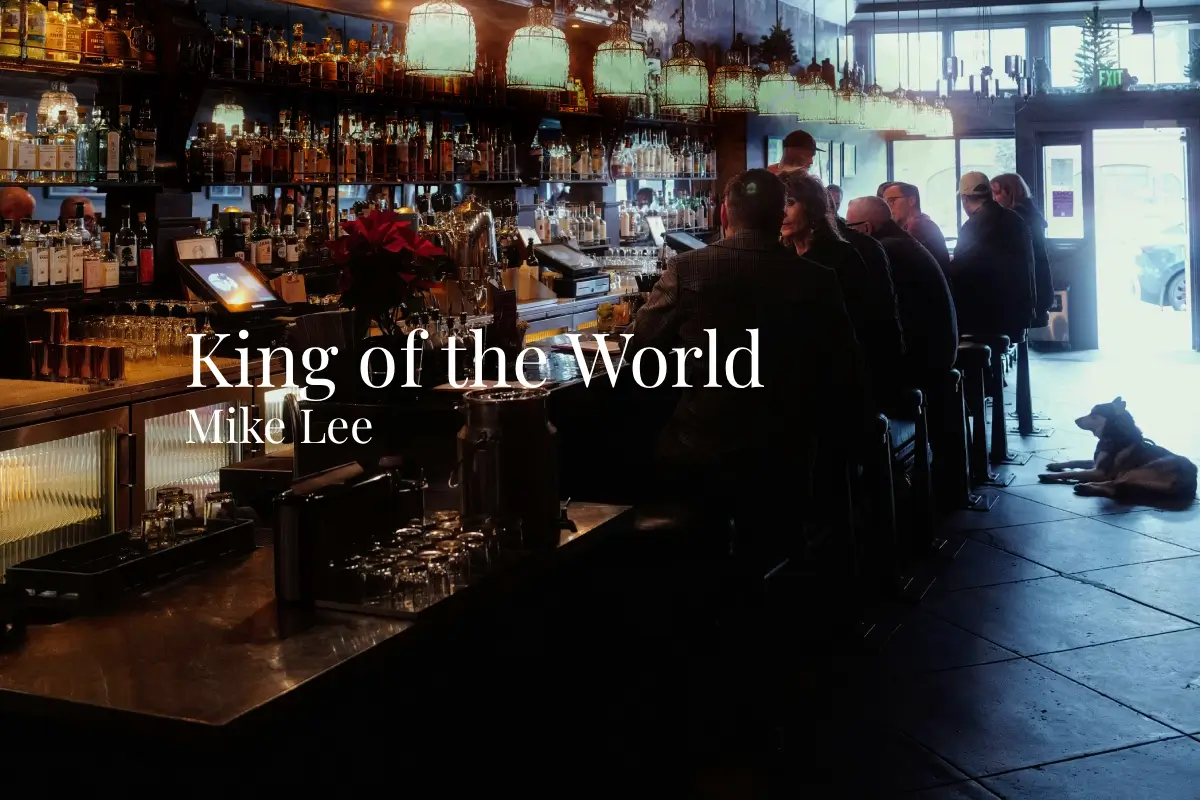
“Hey Manny, look alive. What the fuck are you thinking about?” Alton, working the bar shift looked at him with passable concern.
Manny snapped out of his early evening daydreaming to focus across the bar at Alton, who looked back at him while scrubbing out a barrel glass used as an ashtray by a customer.
“Uh, what was I thinking?” Manny grappled with the words. It was a long day, doing Bozzo a favor by coming in to work his morning and doing a double shift on half-price chicken fried steak night. He was exhausted and none too out of it, on top of the usual brooding of a man who wasn’t there even though he was standing beside you, which his coworkers discussed and accepted, though with some discomfort. Manny was Manny, and he was the top salesman at the restaurant. His quirky distance worked out. Alton concluded there was a limit to Manny, but the problem was no one knew where it lay.
Manny straightened up on the bar stool, running a hand through his hair. “I will take another one.”
“Another Stoli?”
“Yeah.” Manny’s two-shift drinks were not enough. As usual, he was feeling rather lonesome. He was a rebel against rebels, as one of his fellow writers at the weekly magazine he freelanced for said. However, Manny knew it was less out of being a lone wolf with an imperceptible cause than just his distance from others. Pining away after Shannon, now two years after they had broken up, was no longer the reason he remained reticent around people;
Manny was naturally guarded. He was able to get laid, at least; usually, he would pick up girls at Liberty Lunch shows and occasionally at the Monday ten-cent Corona nights at The Boathouse. He and his running buddies from the restaurant, led by Alton, would go on the theory—soon concluded as accurate—that girls went to gay bars because the men there were safe, and that any straight guys they met there were, well, sensitive. Manny was sensitive enough, all right. He could also dance. Both got him in bed, though on two occasions, he had to go through the woman’s purse to check her driver’s license for her name. Other than a brief fling with a Czech farmer’s daughter from Kerrville, these liaisons never lasted more than a couple of dates, and in some cases, not even that long.
The farmer’s daughter was an Air Force brat, and she used her dad’s military health care to have plastic surgery done. In the several months they dated—occasionally, because she was constantly in surgery—Manny seemed to be with either a work in progress or a slightly different woman each time they went out. New chin one night, three weeks later, a nose bob. It was a little freaky, but they had a good time.
Callie was bright and sweet, but a little unusual with her constant facial expressions. She was also a self-described Christian, which, though it made sex a ritualized negotiation with attendant passive-aggressive and guilt-ridden lectures on chastity broken down with a few drinks, suited Manny fine. When they met, one night at the Boathouse, they spent most of the evening dancing and shooting pool. Callie was a student at Austin Community College learning commercial art, and she wasn’t too bad at it, though design work beyond business cards and wedding invitations was hard to come by. However, she was determined, and Manny felt comfortable being around an artist, albeit a mediocre one. It was all too weird to his friends, and she didn’t like them very much either, though she didn’t say so. Callie left the impression with silence that was not due to shyness.
She did, however, get along with Horace well enough that Manny was able to arrange a dinner double date on Sixth Street. Callie had to suck soup through a straw because the last surgery had required her jaw to be wired shut, but they all had a good time, and Callie allowed actual sexual intercourse afterward. That kept Manny happy for a month, and he dared to think for a while that maybe he had a real girlfriend or would soon, despite Callie being, well, Callie.
Then she stood him up on Valentine’s Day. It wasn’t supposed to be a date, informal as they were, but she was not home at her apartment in West Campus when Manny came by, flowers in hand, to take her out to Jeffrey’s. Manny waited for an hour before giving up and chucking the flowers in a nearby dumpster.
She did call and leave a message for Top Tony at the house. A complication from her last plastic surgery, this time pinning her ears back. She was at St. David’s for a couple of days. Manny felt bad enough to call back, but Callie did not pick up. He wasn’t at ACC that semester, so he did not go by the Rio Grande Campus to see her, and whatever relationship there was between them ended as informally as it had begun, a proverbial mutual dropping of rocks in a lake.
At least it didn’t end in high drama, like with Shannon. In the aftermath, Manny realized he had never referred to Callie as his girlfriend and that he didn’t truly love her. Manny wanted to get laid, which he did shortly afterward with a blonde from Cleveland who had recently transferred to the University; however, that ended abruptly when her dad moved into her apartment.
Shortly afterward, there was the married chick with crabs, with whom he unwisely did backseat boogie in the parking lot across from one of the dance clubs on Rio Grande. At the time, he had been full of himself from her compliments regarding how he did his face. Manny was too embarrassed to go to the People’s Clinic, so he resolved the problem with a bottle of rubbing alcohol in the shower. The burning pain he accepted as penance for his hubris and desperation for intimacy, which went hand in hand like a charming couple walking through Zilker Gardens.
That had happened last week, and, in short, that was what weighed on Manny Kynard’s mind now. With a sigh, Manny took his Stoli and tonic from Alton.
Life wasn’t all that bad, he thought. Through Arthur, he had begun writing record reviews for a local hip-hop weekly, meeting the deadline whenever possible.
It wasn’t that he choked on the idea of actually being published; it was bizarre when he overthought what he was writing about music. He did not want to write in clichés, and while he thought and talked smart, putting words on paper in a manner that was pretend professional while maintaining a modicum of objectivity about the subjects was too tricky for him—hard to find his voice from mind to page.
So, he often blew deadlines or wrote so poorly that he had to undergo heavy editing. Still, while only a dollar a column inch, being published in the local weekly lent a specific cache to his presence, particularly on the day the paper came out, and coworkers commented positively on a review he had written. That much made Manny feel real—authentic was the word he liked to use around Arthur and the other guys grinding it out at the weekly.
Manny secured a couple of front-of-book features, which garnered a positive response. Afterward, Manny withdrew into himself. Now, instead of blowing deadlines on bands he did not much care for, he was swinging past the post of recognition regarding features. Manny was clearly getting by on five percent, as his editor wearily informed him when Manny went into his office with a sloppy draft of his latest feature, on time, but still shit.
Okay, Manny reasoned, life isn’t that good, either. He was treading water in an undertow. Manny stared into his glass, sticking his finger into the vodka and tonic and absently stirring the ice. He wanted to feel something besides the flatline, he thought at that moment. That numbness he sometimes felt while taking those long baths before work had returned, and with that, the night got darker and more silent around him, circling closer, tighter.
The bar chatter faded to an echo, fighting for aural space with the tinkling glasses, the cash register ringing, and Elvis Costello on the tape player. Manny was alone. All that was there was what was in front of him: a cigarette smoking over a Stoli and tonic.
At that, he decided against going out with Alton to the Crown and Anchor. It was a long day. He was damned tired. Manny downed his drink and left somewhat wordlessly, waving half-heartedly his goodbyes.
He sat up with Top Tony, watching Nightwatch before calling it a night. He immediately forgot who Charlie Rose had interviewed, and he nestled under the sheet.
A small tear formed in the corner of his left eye as he slid under the pillow.
.
THE END
Bio
Mike Lee is a writer and editor at a trade union in New York City. His work appears in or is forthcoming in Wallstrait, Bristol Noir, The Opiate, Roi Faineant, Brussels Review, Brilliant Flash Fiction, BULL, Drunk Monkeys, and many others. His story collection, The Northern Line, is available on Amazon.