
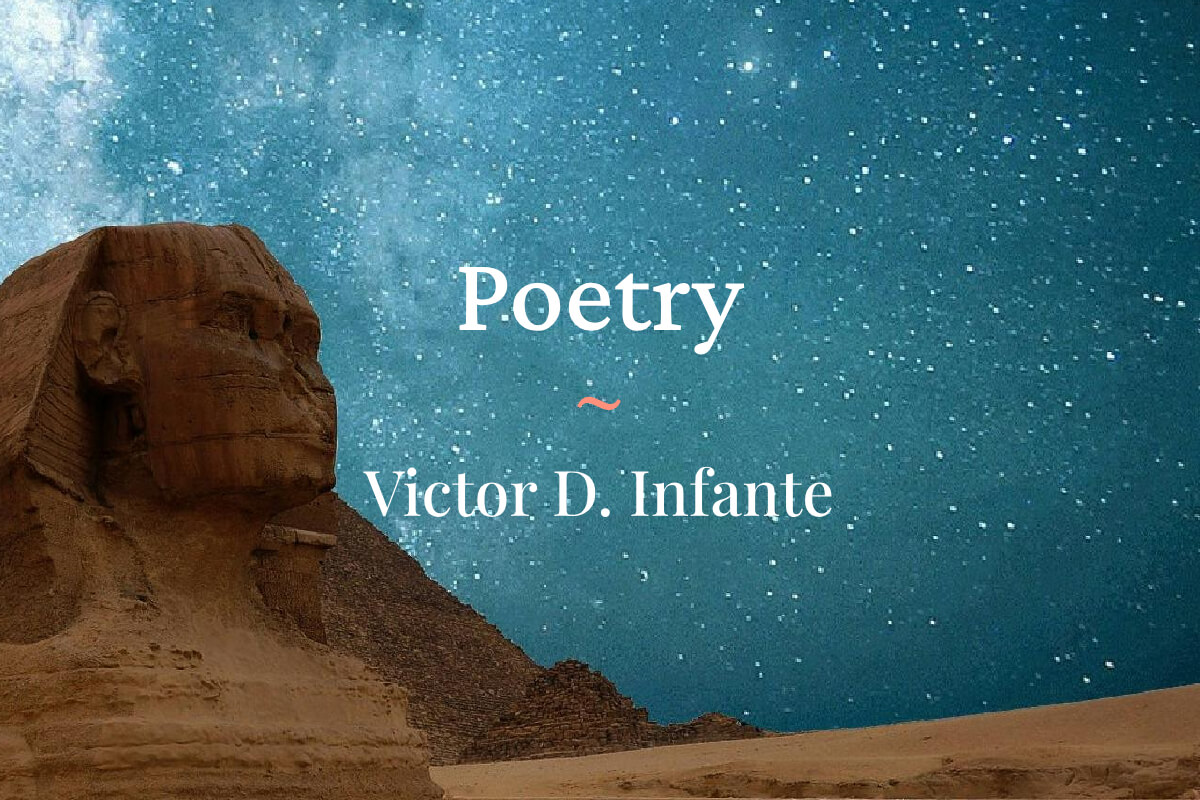
Brick After Imperfect Brick

“How could a commoner know so much about kings?”
asks another twit plumbing Shakespeare for academic credit,
defaming the dead for a spark of infamy in The Guardian.
The truth is, it is only commoners who can see kings clearly.
It is one of our few small mercies, shared only with cats.

What we're really asking is, how could a man of modest means
write the English language's greatest works of literature?
It is the same question they voice on “Ancient Aliens,”
when they ask how these backward primitives
could build the pyramids.

The truth is, I have been to Giza and seen the pyramids,
and they were clearly chiseled by human hands,
brick after imperfect brick.
And Stratford-Upon-Avon seems as fitting a place
for genius as Liverpool, Hamburg or the Mississippi Delta.

I have known many artists – literally thousands –
and few of them have come from aristocracy.
A few here and there, but they're mostly exceptions,
and no more prone to genius than the drunken punks
that smashed awake the soundtrack of my adolescence.

You ask me where art is born, and I will tell you this:
It is born in blood and terror, in violence and poverty.
It is born in the shadow of the police baton
and doors closed because one has the wrong skin or name,
because you genuflect in the wrong order.
Art is born of an innate differentness one struggles to articulate.

You ask me where art is born, and I will tell you this:
It is born in love, in that space where you wish to shelter
someone from all possible harm, to put yourself as a shield
between them and pain, that place where you allow yourself
to be nailed to cross, die for someone else's sins, and forgive.

A different twit in a different article tries to paint artists
as transcended, spiritually enlightened Saints and Bodhisattvas,
and this, too, seems to miss the point. If there is a flawless artist
who delivers impeccable wisdom from an unblemished past,
I have yet to meet them, read them, or be entranced in their brushstrokes.

The point is not that artists are born of privilege, or are spiritually superior,
it's that we're as small and flawed as anyone else. That we are human,
and even the most wretched among us is capable of beauty,
can build pyramids where UFOs will never land.


The Mixtape Is Now a Silenced Poem

In the will-o'-the-wisp of romance
between college semesters,
summer in California, stolen moments
outside a gas station, in a park at night –
we were the essence of poor timing.
We disappeared with the tide.

Autumn, and she slipped a cassette
into my jacket as we kissed one final time
outside of LAX – me, back to England,
she on to her next chapter, too.

The cassette burned in my jacket pocket.
My Walkman was in my suitcase. I watched
a terrible movie. I don't remember what:
something romantic and hackneyed.
A lover stopped the woman of his dreams
at the airport terminal before she vanished.
It might have been an Adam Sandler film.

Even at 20, we were far too sensible for that.
We promised to write, and did, but we knew
I was too weak for distance, that even now
the absence of loved ones is so sharp I flinch
when the absence demands acknowledgment.

I played the tape in my dorm room.
Richard Marx's “Right Here Waiting”
was the final song. I bawled for an hour.
I didn't even like that song, although I do now.
It also had Rupert Parker's “Lady in Red.”
I think of her when I hear it on TV dance shows.

Our letters dwindled. We didn't have email back then.
She wrote more frequently. I avoided pain. We drifted.
I took a different girl to the pub where I hid from my real life.
She married one of the best men I know.

I don't know what became of that mixtape,
and the letters are in one of many boxes
I've left scattered with my vagabond history.

I wish I had written her more poems.
Those always seem to stick around.
Occasionally, they re-emerge to remind me
of the beautiful folly of youthful romance –
a haunting of earnest sentiment and clanging rhyme.

It's different now, and playlists aren't the same.
I can see why so many young people
have gravitated toward poetry.
Now that the mixtape is dead,
the poem may be the last true language
of stupid, operatic love.


Philophobia

We never spoke
of button-fly jeans and cinema,
barely tasted pomegranates,
the lies we told each other
in the interrogation
of sinew and synapse –

What shuddered off
the pit-roasted bone of us;
what searchlights flashed
against the heart-attack sky

as our hearts became
Persephone vanishing
into rusting leaves,
and the advent of snow,

as the silence
filled our lungs
like God.


~
Bio
Victor D. Infante was born in Pittsburgh, raised in SoCal, educated in England, now lives in Worcester.is the features editor for The Worcester Telegram & Gazette and the editor for Worcester Magazine. His first full-length poetry collection, “City of Insomnia,” was published by Write Bloody Publishing, and his poetic novella, “Suffer For This,” is set to come out later this year on Moon Tide Press.
You can find him on X at @ocvictor, Instagram at Infante_Victor and Facebook at Victor.Infante.
More
- Night Shift Politics by Michael Wegener
- Shangri-La by Robert M. Ingram
- Pauli by Matt Gossman
- The Butterfly Collector by Eamonn Furey
- Intoxication by Lynda Williams