Dirty Realism, Poetry

Poetry by Ralph Spurgin

Share this article

Bad Ass

He’s a black-baller,
a night-screamer,
the dark architect
of despair.

Virgins go barren,
their screams frozen
in their throats.

He is a fire-melter—
an ice-maker—
an embalmer
with hollow eyes
and marble hands.

He is a blackguard,
a widow-maker,
an opium-eater,
a doom merchant.

Dogs skulk
with tucked tails.
The wind blows
a piercing cold.

He never knew
happily-ever-after.

When he was gone,
three women spilled tears:

A virgin.
A widow.
His lover.

Share this article
Dirty Realism, Flash Fiction, Noir

Two by Ian Clark

Share this article

Baker taps his foot—a white Reebok trainer. His fist punches his thigh in time with the beat.
He stops the tape. A solid thunk as the mechanism cuts out. He hits eject, holds the cassette for a moment, then looks away. He slides it back into the deck and presses play.
Incessant. Hard rhythm.

Outside, a train rolls to a halt at the station. Rain streaks the glass. Metallic squeal. Muffled tannoy announcements.

He looks down at a small drop of dried blood on the side of his shoe. He licks his finger and rubs the spot until it vanishes. Satisfied, he nods his head.

The doorbell rings.

He looks towards the bay window. Stands. Carefully pulls back the net curtain.

A man in his early twenties. Stooped posture. Baggy purple hoodie. Long, greasy hair.

Footsteps upstairs. Pipes rattle and sigh.

He bangs the table once with a clenched fist and walks to the hallway.

Takeaway menus and leaflets litter the floor. He pushes them aside with his foot.

The door has patterned glass panels and dark green paint peeling at the edges.

He pauses.
Looks at the dark silhouette behind the glass.

Opens the door.

The man is soaking wet. Lank hair dripping.

Share this article
Dirty Realism, Poetry

Poetry by Vanya

Share this article

Tonight I should write

Tonight I should write.
I have swept her memories under the rug
and the table is clean.
I dusted the chair,
straightened the books,
put the phone on silent,
turned on the lamp.

I have thought about the fountains
that are still running.
I have also thought about the mosquito
buzzing in my ear.

If the rug weren’t worn through.

Share this article
Dirty Realism, Noir

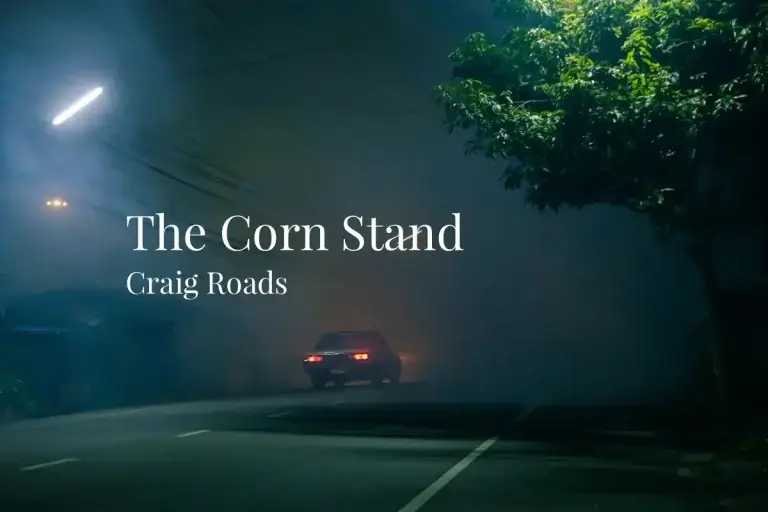
The Corn Stand by Craig Roads

Share this article

Running west out of Rockford Illinois, US Route 20 skirts the spine along the Wisconsin border, and the land rises as it nears the valley carved out by the Mississippi River. Out there near Terrapin Ridge, right along the highway, sat the neat and tidy farm of Roland Fleck. 

Roland ran a decent-size dairy operation and sold most of his milk to the many cheese producers along the Illinois/Wisconsin state line. He also kept a few hogs for personal use, which Roland always clarified to mean pork chops and not some darker purpose, and on the few acres where he didn’t grow dent corn for feed, Roland decided to plant a crop of sweet corn, which he intended to sell at a roadside stand out on the highway. 

Roland put together a little stand using scrap two-by-fours and plywood. In his shop he found a half-used can of spray paint he used to letter out a sign that said, “Sweet corn”. As a retail establishment, it was not impressive, but functional enough. 

The first season, Roland being plenty busy with his cows and the rest of his operation, he operated the stand on the honor system; he’d stock the counter with ears of corn and put out a can where people could drop in payment. Just before he came in for supper, Roland would go out to the road and shut the stand, collect the money from the can, and re-stock the corn.  It worked well for a while, people being generally honorable, but one evening Roland came out to the stand dismayed to discover that his faith in humanity had been misplaced; all the corn was gone and the cash can was empty.

Share this article
Dirty Realism, Noir

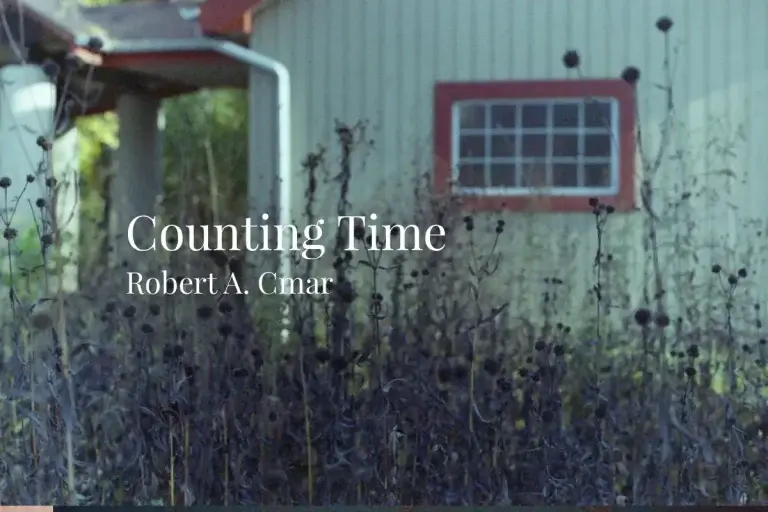
Counting Time by Robert A. Cmar

Share this article

randma, she was smart, right up to the end.”

My cousin Linda was standing at the sink, washing dishes. Grandma’s sink, Grandma’s dishes.

Grandma was gone, but in those few days we were together, settling her things, we kept everything just as it had been. 

“I’m so sorry I wasn’t here,” I said. “It must have been hard, just you, taking care of her.”

“No, don’t give yourself guilt. I knew you couldn’t come,” she said. “I learned so much in these months, and it was nice to get away from L.A. and all my shit. But if you want to help, come here, these dishes aren’t going to dry themselves.”

She turned, smiled, and tossed a dish towel into my lap.

We stood at the sink, looking out the window at Grandma’s little garden.

“I remember when we were kids, she’d pay us a penny for every weed we pulled,” I said.

“She was out there last month, kneeling on her little bench, fussing with her tomato plants.”

“How did she get out there? I thought she couldn’t walk?” I asked.

“She was stubborn. She’d push her walker out the door, down the ramp we built, and yes, I had to help her back up after she was done gardening, but like I said, she was stubborn. Like you.”

Standing there at the sink, our heads were close. I gave her a smirk and kept drying dishes.

“She even planted a plum tree this spring,” Linda continued. “Grandma said it wouldn’t have fruit for another ten years, but she insisted. She said the younger generation had their heads full of foolishness, that we’d forget how to feed ourselves, so she had to show us.”

“Did she have much pain?” I asked.

“Pain? Hah, you men, worried about pain. Yes, she had pain, but she didn’t talk about it. She talked about you, though. You were her favorite, you know.”

I stood there, a cracked old plate in one hand, a wet rag in the other.

“Me? Favorite? Maybe when we were all little, but I haven’t exactly been her angel for a long time.”

“No, she asked about you every day. If I had heard from you, or your lawyer, how long until you would get out.”

“I wanted to see you both so badly. I’m out three days for the funeral, and they’re the best I’ve had since I screwed everything up.”

“She said you did the wrong thing, taking the fall for that girl.”

“I thought she liked Sheila,” I said, and finished drying the last coffee cup.

“She did. But she knew. I talked to Grandma during your trial. She said Sheila would do what any good woman would do, be gone in a month. She was only wrong by a week or so.”

“You should have told me,” I said, and pulled a beer out of the refrigerator.

“Put that down. You know they’ll give you a piss test when you go back in.”

I put the beer back and took out a can of ginger ale.

“I did tell you,” Linda said. “You didn’t listen.”

Linda took the towel from my hand and draped it over the oven handle.

“Grandma was stubborn, like you. We told you. You just didn’t hear,” she said.

We stood in the kitchen without speaking. Outside, the garden was going to seed in the August heat, the tomato stakes leaning a little, the leaves turning brown. Near the fence, the plum tree Grandma had planted was hardly more than a switch in the ground, tied to a crooked pole with a strip of old cloth. It looked too thin to live.

Share this article
Dirty Realism, Flash Fiction

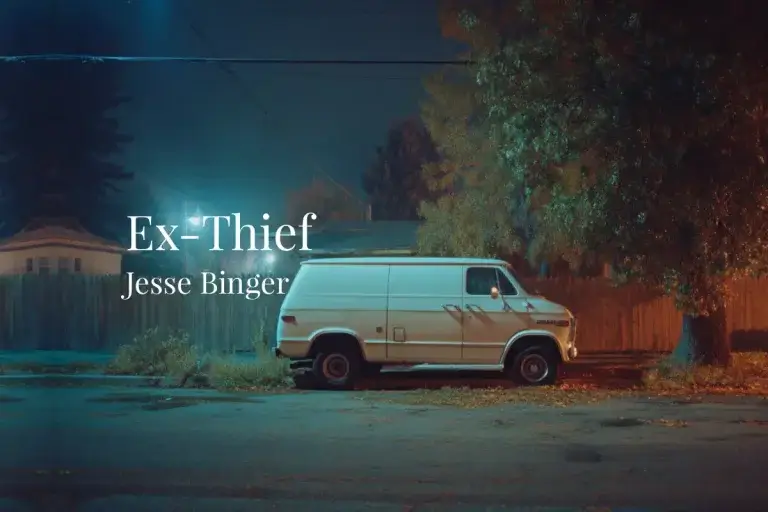
Ex-Thief by Jesse Binger

Share this article

Frank’s been stealing for so long, he can’t even imagine a life without it. 

So New Year’s comes. Spent sitting around his brother’s stuffy bungalow. Eating crusty fried shrimp. Drinking cheap champagne. No one to kiss when the ball drops so he makes a vow. That’s what normal people do, right?

2026 would be different.

The thieving was over.

So he tries. The wholesome life. And no, he can’t make it to church. Can’t even imagine walking into that place, eyes of St. Peter would probably shoot fire or some shit at him and he’d end up convulsing on the ground.

But he does other things. Plays chess at the YMCA. Goes to solitary movies, usually matinees. Cheaper and no one steals any popcorn from him.

Then comes Clara. 

Anyway, it happens at the coffee shop. Him next in line, ready to order an extra-large iced cup of black. Because, well, caffeine helps keep the other urges at bay. He feels her shimmying behind him. Nervous energy. Foot tapping on the floor. Keys jangling by her waist.

Knows that feeling too well.

“Why don’t ya cut in front of me,” he says.

“Aw, aren’t you the gentleman.”

Maybe he is.

Then things change. Instead of solitary Frank, it becomes Frank and Clara. Frank and Clara holding hands at the ice rink. Frank and Clara shoveling gourmet food into their mouths at the newest gastropub—the one with the chef from Chopped.

It’s all perfect.

Until it isn’t.

The call comes in when Clara’s lounging on the couch watching one of those 90 day spinoffs.

“You coming, babe,” she calls in.

Frank holds out a finger and retreats to the bathroom. 

“Buddy boy.”

Tommy Caprese. Bad sign.

Share this article
Dirty Realism, Flash Fiction

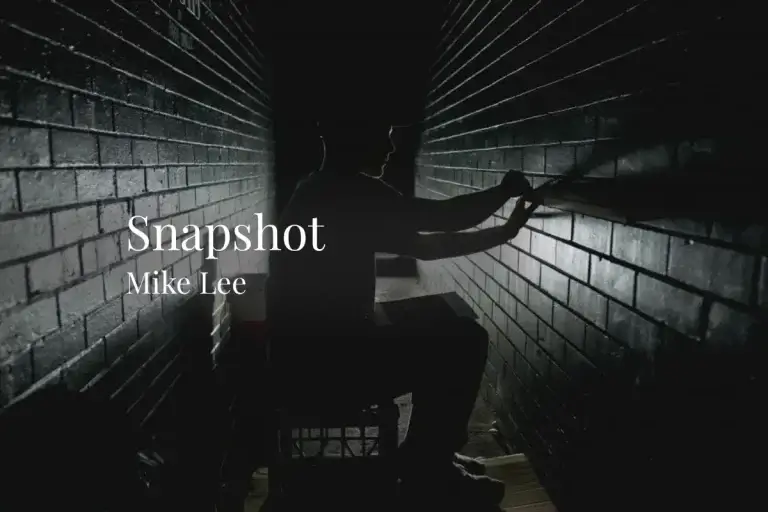
Snapshot by Mike Lee

Share this article

“Blood to the body is what water is to stone. Flows over the surface, filling pores into magenta pools. That’s how I feel right now.” 

Kennison whispered those words so no one nearby could listen. He leaned back, blond bangs falling over his face, balanced forward on his bar stool, hands firmly gripped on the edge of the bar.

When he went in to check on his then-wife getting blasted on rum and Diet Cokes, the bar was painted black. Kennison did not want to remember those nights, but those nights are often hard to forget.

The bar eventually closed a decade ago. A year later, the space was rented out to new owners.

The paint was removed during the remodelling. The bartender mentioned that the owners told him the black paint in the bar and the dark walls really bothered them. He added that the owners felt an inexplicable cold in both the main dining area and the downstairs bathroom.

During the remodeling, which included repainting and prints of mid-century modernist paintings, the place certainly looked brighter. The owners also burned sage and brought a Catholic priest over to bless the new restaurant and bar shortly before opening day.

There were televisions up, broadcasting sports events. Football during fall and winter. Baseball in summer. Pro and College Basketball, Hockey, European championships, Premier League, tennis, golf, and the entire array of sporting events. As he sat, Guiness in front of him, the Atlanta Falcons were knocked out of the playoffs again.

Share this article
Dirty Realism, Poetry

Laughing by Christian J. Farber

Share this article

I hear laughing at Sixty-Five,
I am surprised while—
I am still hanging on to life.

I feared many things as a child.
I feared everything as a young man.
I feared fear itself as an adult.

All living hurts.
All living is suffering.
All living is filled with sorrow.

I held my breath through the laughter.
It caused a sharp pain in my chest
that I feel now, many decades later.

But now
I am starting to hear my laughter.

As I write and share my stories,
as I teach others and my own,
and they teach theirs—

and on and on
and so on.

Waking up is overrated.
A mind in chinos
never completely clears—
it just gets hidden.

We have blankets of substances
and blankets of counsel,
blankets hanging
on chairs.

Share this article
Dirty Realism, Short Story

The Molted Things by Jill Williams

Share this article

Jill Williams writes from the intersection of the sacred and the profane, where theological rot meets musty linen reality. Her prose aims for a piston-like violence that should come with warning labels. Her work has appeared or is forthcoming in EXPAT PRESS, CLOSE TO THE BONE, and HORROR SLEAZE TRASH, with additional fiction featured in several other journals. She lives in Georgia, where she still tries to find the sweet beneath the rot.

Share this article