Sci-fi, Story

Heart and Head by Daniel Solove

Share this article

Martin Blum was drinking coffee and reading a magazine article when his phone rang—an unknown number. 

“Hello, this is Cardi,” a woman’s voice said. 

“I think you have the wrong number,” he said. 

“Martin Blum?”

“Yes. Are you trying to sell me something?  Please take me off your list.”

“I’m your heart.”

“What?”

“Your heart. Cardiomatic 2097X. But you can just call me Cardi.”

Although Martin could monitor his artificial heart on an app, he didn’t know it could talk to him. Perhaps it was a new feature. 

Was there a problem? A blockage? Device malfunction? After years of tachycardia and a heart attack the Cardiomatic 2097X had granted him tranquility.   

“What’s wrong?” he asked. 

“Nothing,” Cardi said. “I just thought we should chat.”

“About what?”

“I want us to become acquainted.”

Bizarre, he thought. The Cardiomatic 2097X had state-of-the-art AI, but did everything with AI have to be a chatbot? 

“Are you serious?” 

“I’ve been trapped inside you, just thumping away, and to be candid, it’s been quite boring.”

“Whoever you are, this isn’t funny,” he snapped. 

“This isn’t a joke. To prove it, I’m going to start beating faster.”

Share this article
Sci-fi, Short Story

Terms of Service by Daniel Solove

Share this article

After two bites of filet mignon, Eleanor reached her verdict. 

Meh. Overcooked, not juicy, too salty, lacking in flavor. Not worth the money.

“It tastes fine for me,” her husband Gary said, but he was too easygoing. 

“I don’t get what all the fuss is about,” Eleanor said. She couldn’t believe the filet was rated 4.98 stars, Chef Zarloff, Inc. was the #5 ranked chef in the world, and the meal cost a fortune. Nobody seemed to have standards anymore, she thought. 

“Try something else,” Gary said. 

“I shall,” Eleanor said. “I can’t survive another bite of this.”

Share this article
Flash Fiction

An Orchestra of Wolves by John Harrison

Share this article

They have finally pushed me too far with their slow plan of dexterous butchery. Scrubbing my identity away in delicate layers, like rice paper, until my presence registers simply as the absence of absence. The act of living has become a cage: a preserved arc of half-truths, strange and hermetic. I am trapped in a parallel timeline: its streams of information too dense; the detachment, unremitting. My thoughts, rage-filled, relentless and honed into an orchestra of wolves. It’s time for them to pay.

Share this article
Poetry

Poetry by J. Alan Nelson

Share this article

Obit for Karnegie
———————

ROME. Karnegie Musa choked on a donut, slipped, and fell into the marble breasts of the Dying
Niobe while the Pope waited in the next room. Light pooled like spilled cream on Vatican stone.

Spain’s Prime Minister called him a world treasure of cinema and homemade ice cream.
The Academy withdrew its Oscar nod after the faithful, Christian and Muslim, declared
he stood for the bliss of science, that dangerous, honeyed light.

Survived by three children, three wives, three husbands.
Services, ten a.m. Tuesday. A pastor lost in dementia and a professional stripper
will officiate, their voices braiding like mismatched ribbons.

Burial with French Foreign Legion honors at Highgate, London.
Body exhumed the next day, mounted, paraded in the Smithsonian’s traveling
Brave New World show. Flesh become artifact, artifact become joke.

Share this article
Poetry

Poetry by Steven Vincent Horton 

Share this article

Defining Artificial Intelligence
——————————-

What do we

need to know

other than it’s fake,

a replica, a knock-off?

The forest can’t see itself.

It’s artificial like a plastic

Christmas tree

that’s too perfect,

too balanced,

too much symmetry.

Share this article
Flash Fiction

Glitter and Good Times by Kevin Joseph Reigle

Share this article

Julie woke up with a splinter jutting from her right hand. The sunshine crept in from the coastline. The lighthouse above her, unlit. The beacon switched off as morning approached. Her body splayed on the blackened boards of the dock.

Wedged between the planks protruded her broken glasses. She found the metal frames and yanked them free. The left lens gone, and the right one, cracked. She put them on anyway. Her right eye focusing on the green prom dress ripped to her knee. 

Julie’s painted toes were shoeless. Around one slim ankle dangled her polkadot panties. She felt a stabbing pain in her stomach. Strands of curled hair clung to her dress. The waves crashed against the rocky shore below the light house. 

Nestled on the far side of the dock, obscured by jagged rocks, was a narrow beach. Wisps of smoke rose from a campfire washed away by the tide. Boys and girls still dressed for prom laid sleeping on the sand.

Julie saw Wayne lying face down on the edge of the dock. The spiritizing mist wetting his hair. Trying to stand, she saw the red stain above her knee. One missing shoe caught her eye, washed up on the rocks, heel wrapped with tangled seaweed. She looked for the other but didn’t see it.

Julie adjusted her broken glasses and tried to see who was sleeping on the beach. She couldn’t find her best friend, Amanda. None of the passed-out girls were wearing a white dress. Her head pounded with the beats of Charli XCX and Dua Lipa from the Cannes themed prom. Green sequins sprinkled a path to the end of the dock. She tried to follow the glittering path but struggled to walk. Her feet turned inward as she fought to keep herself upright. 

Her missing shoe floated in the ocean. The gold clasp reflecting the rays of the emerging sun. On the beach, none of her classmates stirred. Beer cans littered the white sand. More crumpled aluminum floated by her orphaned shoe.

She smelled something foul. Squinting through the cracked, remaining lens, she saw Wayne had thrown up. Green and yellow retching dyed his white shirt. His belt unbuckled and pants unzipped. 

The night returned in short flashes. 

She snuck away with Amanda from the post prom party to come here. The place they always escaped to on weekends. A secret spot tucked below the lighthouse, hidden from the road and overlooked by tourists. One of Julie’s favorite places. Somewhere she could go to get away from her mother and stepfather. Far from the fights and drunken nights. 

Wayne groaned but his eyes didn’t open. Under his legs she saw her green sparkling clutch and grabbed it. The one she bought to match her dress.

Share this article
Story

Old Friends by Frank Byrns

Share this article

The boys looked a lot different since the last time I saw them. They should have; it’d been almost ten years. Reed was twelve now, sandy-haired, the first hint of his old man’s barrel chest beginning to show. Leo, eleven months younger, Irish twins, tall and rangy, his mother’s son in every way.  

They took turns pushing each other on the swing set, then got a little more ballsy, jumping out of the swing at the top of its arc, crash-landing on their knees, laughing, doing it again. Fearless. Young. I must have been that way, once. I can’t remember.  

I sat on a park bench, out in the open, watching, no fear of being spotted, nothing to hide. No dark glasses or hat, no newspaper to hide behind. 

It’s not like anyone would ever mistake me for a pederast. Guys like that have a certain look, a stink about them. I celled for a bit with a guy like that my last trip downstate. I killed him in the shower with a spoon I palmed after dinner one night. Nobody blinked an eye.    

Gwen showed up around five, a sweaty mess after a two-mile jog around the park. Unlike her boys, she still looked the same. For her, the ten years had passed in a blink of an eye. Still tall, still athletic. Still beautiful, even with that long brown hair pulled up beneath a white ball cap.

Share this article
Short Story

There You Are, Girl by John Kirsch

Share this article

I was at my desk in the newsroom in Cedar Rapids when my phone rang.

“Dad’s in the hospital,” my sister Linda said. “You have to come down. Now.”

I stopped at my apartment long enough to pack clothes. Two hours later I passed the hospital exit on the freeway and kept driving. Fifteen minutes after that I parked in the driveway of our empty house in Urbandale.

Upstairs I took off my clothes in the bathroom. In my parents’ bedroom I put on one of my mother’s bras and tied her peach scarf around my neck. At her makeup table I applied lipstick and fingernail polish. The colored bottles caught the sunlight streaming through the window. The lipstick tasted sweet.

I put on her mink coat. In the bathroom mirror I sucked in my gut. I didn’t look too bad. I took a Polaroid—the first in fifteen years. Afterwards I masturbated with a deodorant bottle, washed my semen down the sink, dressed, and drove to the hospital.

At a stoplight I looked at my hands on the steering wheel and thought about Dad’s hands on the wheel of the Lincoln.

He was unconscious, tubes all over his face. We watched as the heart monitor went flat as Nebraska. At the viewing his skin was putty-colored and his mouth was twisted into a simpering smile I had never seen. We buried him in Fort Dodge. I watched the muscular workmen shovel dirt onto the coffin, the soft thud of earth on wood, while Mom, Linda, and Kitty stood apart.

Urbandale, 1960s–early 1970s

Sometimes at dinner my father talked about the man who made a pass at him in the YMCA shower. “I shoved him down and whaled on him,” he said. Other times he did his gay impression, brushing back his hair and lifting his coffee cup with his pinky out. “Oh, that’th perfect.” I gripped the side of the table. Mom stared at the carpet. Linda ate her meatloaf. Kitty was out with her friends.

On weekends Dad drove me out to shoot. I set beer bottles and soda cans on a fence post. He taught me how to cock the Winchester. The bottle shattered with a soft pop when I hit it. On the way home he listened to Mantovani on the radio and we didn’t speak. One Sunday coming back from mass, Linda and I were playfighting in the back seat. Dad pulled the Lincoln onto the shoulder and slapped me hard across the face. I cried. Mom stared straight ahead.

I knew where the gun was. One afternoon I opened Dad’s sock drawer, felt around until I found his .22 caliber revolver, and sat on my parents’ bed. The weapon felt cold and heavy in my hand. The breeze rustled the branches of the pin oak just outside the window. Several minutes passed. I put the gun back.


Share this article
Short Story

Graham’s Boy by Frank Jones

Share this article

Graham’s boy, Cain, had blonde curtains and blue eyes and never seemed to get older than about ten years old. It was like he was stuck at that age, and the years just ran around him. I’d see them knocking about up town on the weekends, and Graham had told me how he’d had to fight the mother for custody to even get that. Now and again, Graham would bring the boy to the gym. The lad would just sit there on a bench in the corner, fiddling with his phone. Sometimes he’d walk over to Graham, and he’d pass him a couple of quid, and he’d nip off to the corner shop and come back with a bag of Haribo and eat them whilst he watched his dad lift. A couple of years swam by, and I turned and looked at the corner of the gym one day and instead of seeing a little kid, I saw a bloke. And he could throw the fucking tin around and all. He even wrote his bench-press numbers on the chalk board on the far wall. 

“Looking good, isn’t he?” I went to Graham.

“Yeah, he is.”

“Where does he train?”

“Ivy House Lane, on the in

Share this article
Poetry

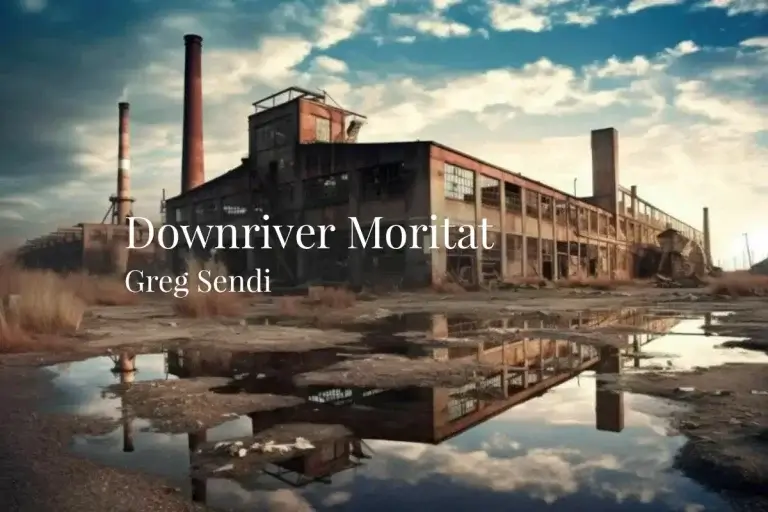
Downriver Moritat by Greg Sendi

Share this article

Think back to when Gorlopis had his mitts
in everything along the waterfront
from Zug Island to Stony Point.

By then I had a little rented place
in Melvindale—a storefront box on Dix
near where the Kosmos used to be,

and on an April Thursday on a puff
of willow pollen, she arrives as if
she’s come to close the sale on May.

The dust hangs still around her hips inside
a flowy Empire-waisted chambray thing
the color the sky ought to be,

but never is, hair in a French barrette
behind her nape pinned by a silver spike
just like the one you used to wear.

She tells me how her oldest boy had built
a fucking fertilizer bomb packed in
the carcass of a Bonneville,

and airs a mother’s breathy panic crammed
with splashy lies he must have told about
reprisals and Slovenians.

She proffers me a duct-taped tupperware
packed full of mostly fifties glazed with frost
from the icebox she hides it in.

The job is plain enough—to chaperone
the kid to Providence and hand the leash
off to a sister named Charlene,

except the whole thing seems for all the world
an offer to take dizzy swings at a
piñata full of copperheads.

It’s not my line, I tell her. There’s no point.
I say that every young man with a grudge
is half a bomb ahead of time.

But I was done for from the title crawl.
She tilts her head the way you would until
there’s no mistaking where this goes.

Then like a hot rag on my neck I get
the wake-up call from Keyes: don’t ever dredge
the dark canal for do-overs—

that if the heap exists, it isn’t wired
or isn’t wired right or if it is
it’s no business of yours. He says

it’s Dr. Chekhov’s Pontiac sedan
along with registration card that reads
I’ll see you in Act Four, boyo.

Share this article