
(1,327 words)
At a party on Varick Street, just south of Houston, I ran into Laurie in a refurbished, solid red brick warehouse bereft of graffiti, well-kept by the secretive cult that had bought the building from the city several years ago.
I stepped hesitantly into the foyer, attempting to prepare myself for the crowd. I didn’t know anyone there; I only received an invitation through customers I waited on the previous Thursday. Just a typical “new in NYC? C’mon over. Here’s the address.”
I usually blow off such invitations. I’m intimidated, preferring the comfort of self-isolation. However, breaking up with my girlfriend and her moving out earlier that month into a new apartment had changed my view. Satisfying curiosity is a vital part of my well-being.
The room inside was exactly as I remembered it from two years ago. Spacious, sturdy, a vast expanse partially covered with Mexican cantina tables and folding chairs, people gesticulating wildly over paper cups of coffee and soda.
A few others scurried about, pulling people who had clustered in groups away and leading them to the tables. I was struck by this; I realized it was what I had suspected—a weird cult thing.
As I turned to leave, the woman who had invited me touched my shoulder.
“Glad you could come.” She hugged me, not too tightly.
“Yeah.” I faked sincerity, a skill picked up from living with my now ex-girlfriend. “Really glad to be here, but…” My eyes searched the room.
The woman detected my shyness. “C’mon over here.” She led me to a group of people huddled at a corner table. Three men sat uncomfortably, definitely out of their element. One, an older man holding a video camera on his lap, smiled when he saw me. I relaxed.
After introductions, the four of us staggered into an inconsistent conversation. Unfortunately, the woman had already disappeared, leaving me with the three men searching for words.
I broke the ice by asking to look at the video camera. I toyed with it for a few moments and even filmed a couple making out in the supposed sanctuary of the bathroom doorway. I swung the camera around slowly, taking close-ups of faces conversing, enjoying with voyeuristic relish the facial distortions of passion. After several minutes, the feeling wore off, and I grew bored with the bathroom tryst. I handed the camera back with a polite thank you and went back to sitting silently with my arms crossed over my chest, wondering how I would leave without insulting my attractive host.
Fortunately, she returned to rescue me.
“Here’s somebody you should meet,” she said, showing me who was escorting her.
I stood, reaching out my hand, and then my mouth dropped open.
“Eddie …?” Her face was lit by the dim overhead lights.
“Um … hi. Laurie.” My stomach tightened, full of a sensation I hadn’t felt since high school. Almost laughed out of sheer nervousness.
She smiled, beaming. The angel in a white cotton dress, leather belt, and scuffed up stilettos.
* * *
When we first met, in 1980, it was late July, just before the finals for my last summer school session. I went with Thompson, my then-best friend, to see bands and raise hell at Raul’s, the local punk club. It wasn’t much of a crowd, but the bands put on a great show, and I remember floating as I stage dove, flying in slow motion over outstretched hands.
The lead singer for one of the bands spotted Thompson and zeroed in on him. “This song goes out to the boys in the audience,” he shouted. “Teen Challenge!”
Thompson and I stepped up to the front and danced, self-conscious. There was newfound freedom in the air—an emotional looseness flowing unstoppably every minute of our lives, an ability to be different and daring without risking victimization. This gave us a sense of power we had never felt we would have as we jumped and swayed our arms out to celebrate our release.
I didn’t know any of this then. I just wanted a good time.
After the song finished, Thompson went to the bar for more beer as I stood swearing under the amplifier stacks out by the side of the stage. That was when Laurie entered.
It was the first time a girl said hello first. By the time Thompson returned with two Millers, we were already out the door. He tossed an unopened can that I caught backhanded.
She lived with a roommate in a ranch-style house out in South Austin. The grass needed cutting, and the kitchen was a disaster.
But she had piercing blue eyes and a beautiful smile that melted away misgivings.
The following day, I woke up to her nude figure beyond the open bedroom door, bathed in the morning sunlight at the end of the hall. Laurie was standing in a ballerina’s first position.
Staring at her, I felt I had finally made it.
However, we went out on a few sporadic dates until the end of the summer, when I figured out she was patronizing, to the point where I couldn’t start a conversation without an unpleasant twinge. It was seemingly effortless to shed the other by the beginning of October.
* * *
I smiled, wondering where I was in the constellation of her personal history.
Laurie had aged, even in shadows. So was I. It had been a long time.
Helen walked to another table to play her mix-and-match games.
We talked. Mutual acquaintances who either became friends or not. Who went to LA, detoxed, or died? Those we knew became religious cultists or taught Caribbean literature. We discussed our own lives and were cautious about unpleasant surprises.
We left and lit Marlboros as we wandered down Varick Street. We watched a car fire near the Holland Tunnel and a fight outside a bar in SoHo before doubling back and heading east, stopping off in a deli to buy more cigarettes.
She held my hand at Broadway and kissed me on Mulberry Street.
I had placed a blanket and a bed sheet on my mattress. After undressing, I remembered the girl practicing the first position in the hallway.
* * *
After waking up, we ate breakfast at the café down the block. I still hadn’t learned much about Laurie’s life, and I grew curious. Why was she at that party? I think she felt the same uneasiness. Not enough to cast a pall, but we remained wary of the present tense.
I wrote down my telephone number and handed it to her as our breakfast arrived. Laurie stared at it, wrote hers on a napkin, and slid it across the table.
“I always loved you,” she said before taking a bite of her apple pancakes, chewing slowly. “More than the stars than the sky.”
I wish she hadn’t said it. I know better–Laurie loves the stars more.
In the moonlight, I already saw the cluster of tracks behind her knees—a constellation.
.
THE END
Bio
Mike Lee is a writer and editor at a trade union in New York City. His work appears in or is forthcoming in The Airgonaut, Wallstrait, Bristol Noir, The Opiate, Roi Faineant, Brussels Review, Brilliant Flash Fiction, BULL, Drunk Monkeys, and many others. His story collection, The Northern Line, is available on Amazon.
Out Now
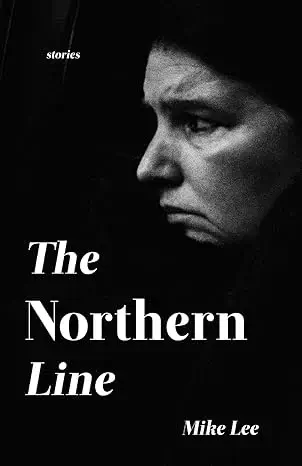
A young man returns to his hometown to mourn the reasons he left. An abused spouse copes with a lifetime of bullying in identifying with the lead character from an independent film. A political prisoner is snatched from a firing squad to find himself exiled in an obscure land. A family flees the Dust Bowl of the 1930s, using magic as a tool to survive.
The Northern Line is a collection of stories about dreamers of what was mislaid, lost souls seeking redemption, sudden opportunities and missed chances. The stories are of people grappling with a world of unexpected changes, striving for stability in uncertain, and often surreal, times.