
(100 words)
I found out about it just like everybody else. Her social media went dark, even her finsta, where she posted about movies and music and occasionally books that not many people had heard of. I was always in a state of pretending with her, pretending to be cooler, pretending to care less, pretending to know what she was referencing.
She was beautiful, like an anemic Snow White, with long dark hair and Betty Davis bangs that she often cut herself, so they were charmingly uneven. She wore orange lipstick and dark liner on her full, doll-like features. If she was a little taller, she would’ve been a famous model, but as it was, she wanted to be a musician.
She had a powerful, emotive voice, sure, with a great, expressive tone, and she wrote interesting lyrics, but more than anything, she was a star, and if you knew her, she was the whole celestial galaxy.
It’s hard to explain what makes a person magnetic, why you can’t take your eyes off them, why you think about what they say for hours as if there’s hidden insight in every syllable, why you take their calls at all hours.
Whenever we went out to eat it was always sushi. I later learned that all that miso soup and green tea made everything come up more easily. I couldn’t eat it for years after.
I had been bulimic too, but without much commitment. If you do bulimia really well, if you’re committed to throwing up every single thing you’ve eaten, you might lose weight. I didn’t, but she was tiny, matchstick legs in skinny jeans, child-size shirts, colourful, eye-grabbing style.
Her name was Alba, which was Latin for sunrise. The people closest to her called her Sunny. It took two years, including six months where we didn’t talk at all, but eventually I became a member of her inner circle. She moved to New York for an internship, and then waited tables and played shows in Hell’s Kitchen. She was oddly upbeat about working so hard, always excited to hear about what I was doing.
She seemed impressed with me for the first time. In the past, she’d chided me about my obsessive writing and editing. “You think work is so great,” she’d said one day, “because it’s more reliable than people. What you put into work, you get out of it, right? But how much of your life are you missing out on?”
Now she said she couldn’t believe that I’d had a book published. She was excited to read it.
I became closer to her friend Chelsea, a singer she admired, who she’d once called toxic. She begged me to visit her, to bring Chelsea even, and I said I would, but I didn’t. I didn’t know how finite our time was.
I had a feeling she was lonely, even though she was always posting pictures of new friends. She wasn’t writing as much or playing shows. People knew her by different names. Someone knew her as Iman. Someone else knew her as Parisa. They said she read tea leaves, that she wore smudgy black eyeliner, that her kindness was boundless. They were all in love with her. Someone graffitied her words in rainbow colours onto a Spanish Harlem Wall:
If You Think I’m Too Much, Go Out and Find Less
Her sister said she always hated her birthday, but that year, she let her whoop it up and serenade her, and the dread she’d had about her, her whole life, the heavy feeling, temporarily left her.
She smashed through a bedroom window, on the 24th floor of an apartment building and jumped.
I could see her, flying through the air, Manhattan panoramic and beautiful, her hair fanning out, her eyes capturing every piece of beauty like tiny cameras.
I read about it on the internet. I had wondered where she’d gone, what was happening in her life, so I googled her. I wondered if she knew how many headlines she made.
That night, I dreamed I was in the apartment with her. She was showing me a notebook full of song lyrics. “No one found the note,” she said quietly, her eyes downcast.
It was one line, in her black notebook and it sounded like a song lyric.
In loving memory of when I gave a shit about what anyone like you thought
In my dream, she disappeared, and I wrote a few lines on the next page.
Dear Sunshine,
May you feel only deep happiness, and no pain
May you feel at peace with every decision you’ve ever made
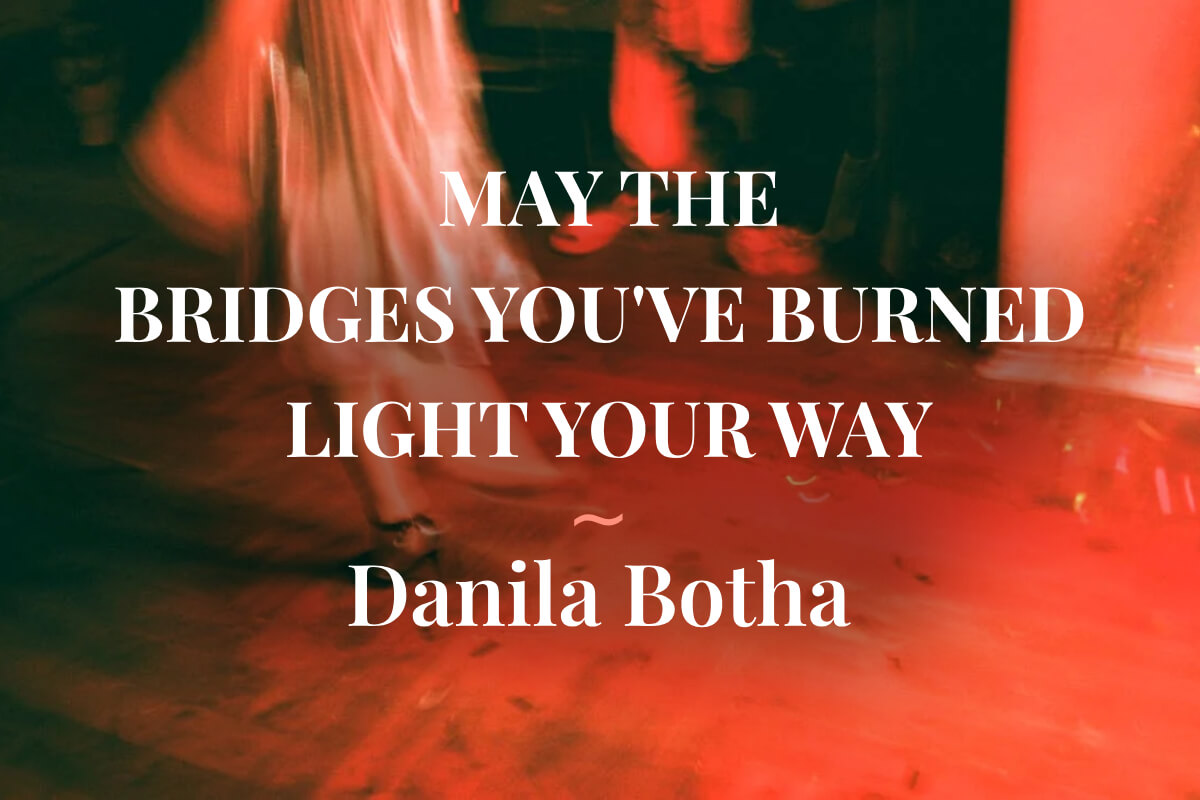
May the bridges you’ve burned light your way
Into a world where you feel free, and cherished and valued
You should know that everyone here loves you and misses you,
But we all understand, like we did in life,
That stars that glisten that intensely belong to the whole universe
In my dream, she floated back for a few minutes. She read the words and nodded her head at me.
“I think you’re getting better at this writing stuff,” she said, and laughed.
She hugged me, and I felt her spine as my hand rested on her back.
“Promise me, you’ll keep writing about everything, including me.”
I nodded.
I woke up, amazed at how un-dreamlike it all felt. Later that day, I found the only photo of Sunny and I that existed. It was from when we first met, as interns at a small publishing house. We went to her place after. We sat on her bed, a poster of Klimt’s The Kiss looking down at us. We were both scribbling in our notebooks, long hair falling in front of our faces like shiny, messy curtains, while PJ Harvey blared in the background.
I hope wherever she is, she’s writing and singing, taking in the thrilled looks of the audience around her as she keeps creating infinitely.
. . .
THE END
Danila Botha Bio
Danila Botha is a fiction writer based in Toronto, Canada. She is the author of the critically acclaimed short story collections, Got No Secrets, the Trillium and Vine finalist For All the Men (and Some of the Women) I’ve Known, and the forthcoming Things that Cause Inappropriate Happiness (Guernica Editions, 2024) She is also the author of the novel Too Much on the Inside, and the forthcoming A Place For People Like Us (Guernica 2025)