
Flash Fiction, Noir

The Dame of Hell by Vanya

Share this article

She was drunk and fighting a dart machine. My friend and I took the other machine and had just started playing when she interrupted: “Can I play it too? That machine won’t work.”

I agreed, and we set it to three players. She was good. I managed to close the gap. She needed one shot to win. She took her beer and poured it down her throat. Then she threw the dart without looking at the board. She won. I followed her to the bar and asked if I could buy her a drink.

“You could. But don’t ask for my number.”

I nodded. By my fourth beer, I was drunk. My friend went home. I stayed. Her hair smelled like beer. She had a soot-smudge on her lower lip from smoking and did nothing to hide it. 

“Same time tomorrow?” she asked.

“I have to work. How about Saturday?”

“Fine.” 

Next Saturday, I saw her at the bar.

“Can I buy you a drink?”

“You can, but don’t ask for my number.”

“You remember me?” I asked.

She turned toward me. “No. Should I?”

I laughed, then realized she meant it.  I bought us beer, and we talked. She asked if I wanted to come back tomorrow. I said yes, mostly to see whether she’d remember me. She did. 

She suggested pizza. She told me she had never left the town. Everyone she knew had. When it arrived, she tore into it like she hadn’t eaten for days. I offered her mine, and she ate that too.

“Do you want to go to a lake?” she asked.

“It’s already dark.”

“It’ll be fine. I live nearby.”

We drove to her place. “Give me a minute,” she said, and stormed into the house. She came back with a bottle. I took a sip, then she did. We walked around the lake, drinking. After a while, she climbed onto a table. She was about to pee when a cop walked over. She saw him, but it didn’t stop her. When he shouted for her to come down, she jumped on him. His head hit the ground. I stepped in and pulled her off. I begged. None of us wanted paperwork. She still got community service for public urination.

A few days later, I was laid off. She suggested I move in with her. I did. She loved parties. Money dried up, but she wanted more.

One Wednesday night, after everyone left,

Share this article
Dirty Realism, Poetry

Poetry by Thimo Buchmüller

Share this article

he woman hauled her suitcase
on her back for so long
she might have been a camel.
She reached a raw patch
of streetlight
and shook herself free.
A little dust‑hair
drifted down slowly,
knotted together,
to the ground.
With die‑stamped patience
she waited for her visitor –
the lover who was supposed to come
to the street corner like a doctor
and listen to her chest.

Share this article
Dirty Realism, Poetry

Morning Glory (and other poems) by Phillip Ash

Share this article

Greek chorus deluges you with insults, spewing vile curses
KILL YOURSELF KILL YOURSELF WHY DON’T YOU

KILL YOURSELF. . . try and drown sounds using alcohol,
but liquor burns off like water on a hot skillet. . . land

within a lockdown facility waiting for meds to take effect. . .
play ring toss while three lab coated men take clipboard

notes DUH YOU MISSED JERK shouts the chorus,
pretend not to hear DON’T RELY ON NO ONE ELSE

END IT ALL AND KILL YOURSELF circular group
therapy, one guy sweats whenever he hears Clapton’s

“Cocaine,” just lean back and wait for meds. . . YOU’RE
A LOSER THERE’S NOTHING LEFT FOR YOU

A WORTHLESS LOSER AT EVERYTHING YOU DO

Share this article
Art, Poetry

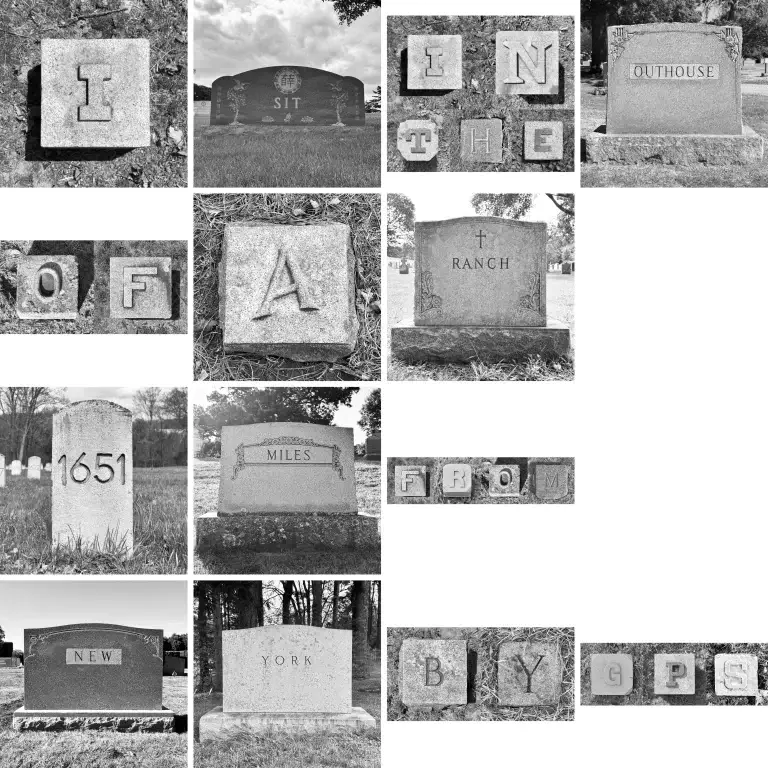
Artwork by Robert Zott 

Share this article

Bio Robert Zott has taken photographs of tombstones bearing single last names that are common English words for 30+ years. His subjects appear as he […]

Share this article
Flash Fiction, Noir

Spider Theater by Fred DeVecca

Share this article

The insidious thing about crystal meth is not that it makes you feel high, it’s that it makes you feel normal. Your brain’s been straight-up nuked but you think this is the way you’re supposed to feel. You think that’s how everyone feels all the time.

It also makes you see things with startling clarity that aren’t really there – not just simple fuzzy objects but entire complex ghastly scenes  – dramas, mysteries, farces, dark horror shows that can torture you forever. 

But maybe they really are there – maybe.

“That’s Spider Theater,” Richie said. “And it’ll get you bad. Every time.”

He showed up in town with a ton of the stuff from Nelson, his AC guy. He was supposed to deliver it to a customer, but instead we sucked it up for four straight days. 

We didn’t put a dent in it. Nor did we eat, sleep or leave the apartment. Felt totally and completely normal. 

Then he loaded us both into his Coup deVille. 

They said Nelson couldn’t be killed. He was a ghost. Or Satan. Or Jesus. Maybe God.  No one was sure which. Richie said he once shot him point blank with his .38 and nothing happened. 

“Emptied all six into the bastard,” he said. “He didn’t feel a thing.”

So I wasn’t sure why he would try it again. But that’s what we were heading out to do.

I was just along for the ride. Richie wanted me close. I was his good luck charm and he said anyone who goes to Atlantic City needs luck. 

And this was before gambling was legal there. 

He was pushing the Caddy up to 110 on 476. A quart of Steg and a crap joint were circulating. The windows were open and springtime’s cool breeze flushed through the car. We talked nonstop bullshit. 

In a nice suburb just north of AC Richie pulled into a tree-lined street and parked in front of a red ranch house. He motioned for me to follow him.  

We walked right through the front door without knocking. It wasn’t locked.

Nelson was sitting at the kitchen table with a big pile of white powder, a stack of bills, and a bunch of glassine envelopes which he was filling up with the powder. There were two huge blocks glimmering with translucent shards at the back of the table. Two legit full keys, maybe more. 

He didn’t look up when we entered and he spoke to us without making eye contact. He didn’t see us but he knew who we were and why we were there.

He used a playing card to chop up a fat line. It was the ace of spades. He rolled up one of the bills – it was a hundred – and took a solid snort.

Share this article
Noir, Short Story

You Can Never Be Too Sure by Michael T. Smith

Share this article

It was the cancer-sticks that let her get through this long life.

She opened the pack of Marlboros and took a long drag on one, receiving a glare from a passing mother of two as she blew a puff of smoke out of her mouth. It wafted down the barren sidewalk as if deliberately following the passerby.  She had tried e-cigarettes.  Once.  But they had no appeal for her, and the habit she formed during Margaret Sellers’ twentieth birthday party out on Chesapeake Pier would not leave her that quickly.

A sign marked Tyche Insurance Company tore into the sky above her.  After taking a final puff of the cigarette, she dropped the stub on the ground and entered the building, a building situated in a swank district of town she not just rarely but never visited.

Share this article
Noir, Sci-fi

My Generation by Alan Griffiths

Share this article

art balled a steel fist and wrapped on the Plexi. The sound echoing in the darkened bar. 

Nada. Zilch. Zip. 

He wrapped again. Harder. 

The speaker crackled, a monotone voice: “Capital W, lowercase n, d, five,”. The droid’s mechanical voice, wrapped in static, continued: “Lower case w, zero, low-.” The head slumped forward as if garrotted.

The android is humanoid, dressed in a superhero suit: head and face, smoked triple toughened Plexi, ringed from chin to temple in neon. Torso and limbs brushed alloy. Soft flexi multi-jointed hands and feet. Designed and evolved to interact autonomously. Last night I’d watched this one autonomously despatch a posse of shit-faced proles into the middle of next week.

“Speak you metal freak.” Hart glowered and raised his PR-2758. “SPEAK.” 

“Whoa big man.” I got myself between Hart and the unit. He’d been known to beat on the AI help. “Easy. We need the rest of the code.” Or we’ll both be tap-dancing down shit street wearing flip-flops. I tapped his tin arm, “Besides, you’re half-brothers.”

Behind the counter and dotted around the interior were a small army of dormant server-bots. Some held mops in mid-clean. Antiseptic and cleaning fluids in the air. The AC silent. Later, the floor will be a sticky mess. Nastier smells present, musty beer, alcohol, congealed food, chemical vapes, body odour, vomit, testosterone and blood.

Hart lowered his prosthetic, a relic of the Long Winter War. The ancient military tech hummed and convulsed spasmodically. He cursed under his breath. Maybe at me. Maybe at artificial intelligence in general. Wiping perspiration from his brow with the back of his meaty good hand. A solid muscular lump. Salt-and-pepper crew, bent nose, a slash of a mouth. When he smiles it never quite reaches his flint eyes. He’s my friend though and business partner and no one better in the trenches. 

“Scheduled maintenance?” Hart asked. “Gone tits up.”

“Haven’t a clue,” I said. “I’m an establishment mushroom.”

Share this article
Noir, Short Story

The Metro Sonnet by Henry Markowitz

Share this article

“STOP REQUESTED. PLEASE USE REAR EXIT.”

On a number 4 Los Angeles Metro bus I sit, a sad sack on a battered seat at the back of the bus. Today is nice. The sun is shining and it’s a Saturday. Best of all, there are only a handful of passengers. This means fewer stops, more open space, and a general elevation in the quality of my Hollywood-centric voyage down Santa Monica Boulevard.

The bus’s seats are covered in a haphazard arrangement of yellow polka dots. It’s an artsy touch I quite like. Good on whoever’s choice that was. The side windows are plastered on the outside with an advertisement for a superhero movie, and the back wall is consumed by a large air conditioner. Every Metro bus seems to have an odd-shaped stain on the floor at its midsection and a handful of graffiti tags on its metal hand bars. This one is no exception. At the front, just past the retractable seats that also serve as parking spots for wheelchairs, a balding driver sits silently behind a layer of bullet-proof glass. At least, I think it’s bullet-proof. 

The bad feelings have settled in; the anger, the boredom. I can’t really put my finger on where they began but they’re coming in full swing. Now I’m stuck to this seat. I can’t move. I can’t go anywhere. But I don’t like being here anymore.

Share this article
Dirty Realism, Short Story

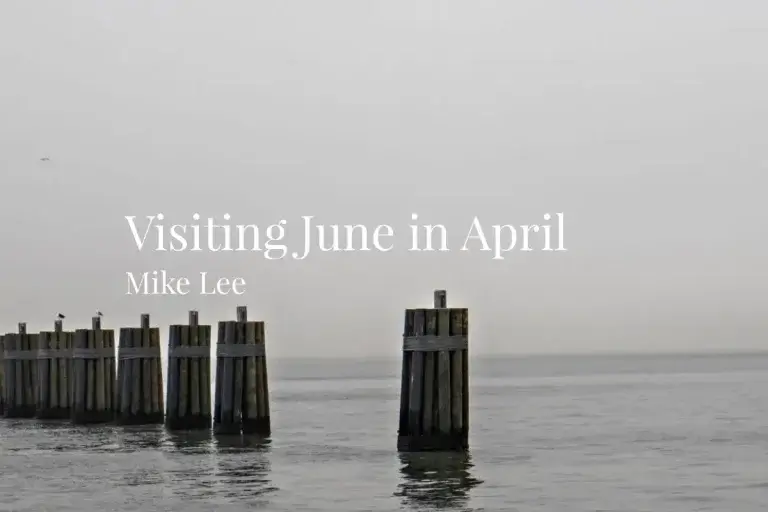
Visiting June in April by Mike Lee

Share this article

Her birthday just passed. 

At fifty plus one, Katerina flashed a stiletto smile across the bar, flashing her rocks glass at the bartender standing beside the cash register. It had been a long time since tears, and the scotch beckoned. Now she straddled that continental divide between a sodden middle-aged female drunk and a tragic spirit grappling with a midlife crisis.

Katerina did not like this bartender. Too macho for her tastes, he reminded her of photos she had inherited from her grandfather from her mother’s side, pictures kept in a closet until Katerina began to scan and send to distant cousins interested in genealogy.

Genealogy was not a hobby Katerina was particularly interested in, especially after resolving a painful family mystery from her not-so-distant past. Being the granddaughter of the sole family survivor of the Holocaust was terrible enough.

Worse, she had no real family ties, except by blood, on either side. Her father was an only child, and his father was the same.

Everyone was long dead, buried in Texas, or burned in Austria, Germany, and Poland—except a great-grandfather who died in the Spanish Civil War or had changed identity and disappeared. Katerina had read the known records and notes Bubbe uncovered in her research and saw what she found—nothing beyond death or disappearance.

Then there was the Irish side—her mother’s family. There were emails from the first cousin, removed by a generation; her grandfather had never told her he had several brothers and a sister. The cousins asked. Katerina had no idea why.

Her grandfather was born in Brooklyn and moved to Texas to work in the oil fields during the Depression. Later, he met a woman, married her, and had a child.

These long-lost cousins sent photographs of him as a young man, including an 8th-grade class photo from 1921, in which he is shown with his hands on his knees. He sure looked like her mother—sandy blond hair, angular face, though more drawn in.

Share this article