Sci-fi, Short Story

Felis Catus by Zoë Sutton Harris

Share this article

Castor stood before the Highness on his home planet of Htrae in his best uniform, a sparking blue aura with all his insignia glowing green. His five large black eyes focused on the Highness, waiting. 

“Castor, we are assigning you to planet Earth to garner information on the human condition. We are sending you as a lower life form, Felis Catus, to minimize detection.” The Highness gave him the dismissal signal. 

From Castor’s studies at the University of Htrae, he knew humans presented a risk to his planet. If their scientists developed the warp bubble, exceeding the speed-of-light, the probability of a violent invasion became a dominant fear among leaders and intellectuals alike. Earth’s history of aggression coupled with the cultural genocide of peaceful groups did not bode well for Htraeites. 

The third planet from the sun held a penchant for violence, well known to the floating brain academics of Htrae. Their study of earth looked for any redeeming characteristics that might save the planet from Htrae’s ultra-deep-sky blast.
Share this article
Sci-fi, Short Story

Nuked by Robert Walton

Share this article

July 12th, 1959 was a quiet day. Ike was president and the Russians were behaving, no Sputniks or anything. The mob was in Vegas counting other people’s money next to an air conditioner.  But, hey, in L.A. something always crawls up out of a storm drain when you’re not looking. I was working the night assignments desk for City News when it did and when it did it was my job to deal with it. I’m a reporter.

My phone rang at 10:35 P.M.  “City News, Al Murphy speaking.”    

A hoarse voice answered me. “I want to report a nuclear accident.”

I took a deep breath. “What’s your name, sir?” 

“That’s not important. There’s been a nuclear explosion.”

I shook my head. Nutcase. “When did this bomb go off?”

“No bomb – the reactor at Rocket Dyne is melting down. There was a small explosion, but a massive plume of radioactive debris leaked. It’s headed for L.A.”  

I straightened up. “Sir, I believe you, but I need a credible source. Again, what’s your name?”

The man sighed. “I’m Dr. Padgett Brewster.”

“Medical doctor?”

“Nuclear physics, M.I.T.”  

“Doctor Brewster, could you stay at that phone?”

Brewster hesitated.  “Ten minutes, no more.”

“What’s your number there?”

Share this article
Short Story

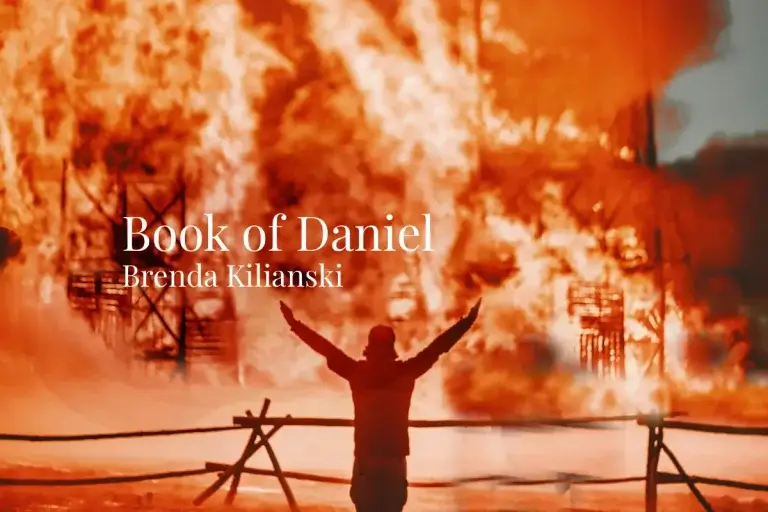
Book of Daniel by Brenda Kilianski 

Share this article

Strike a match. There’s no wind, so the flame holds steady for a moment, and you can survey your handiwork through the chain link fence. Even after two decades, the rubble remains. Suburban decay. That’s what the Catskills Leader editorials scream annually – that the town of Etna won’t – or can’t – bulldoze the debris. But you see it more like an unintentional monument to a twelve-year-old genius. It’s the least they could do for you. The flame inches toward your fingertips. You shake the match, toss it to the ground. Light another. Hold it up looking at the arched doorway beyond the fence. St. Ignatius Academy, the gold lettering burnt around the edges. Ignatius was a warrior too.

Share this article
Poetry

Haunted Tenancy (& Other Poems) by Gabrielle Munslow

Share this article

Haunted Tenancy

Love is a ghost
that turns you into a bedevilled mansion.
The lovers from before all live inside:
your first kiss, your first fight,
your first crush.

You are a body inhabited by secrets,
you remember in your bones
every soft touch, every hard punch.
Each emotional scar, each fleeting joy
glimmers,
decorating the wallpaper of your soul.

You play reruns of bad love affairs
like films flickering in the dark.
A gramophone spins lost songs,
voices like Etta James
flooding through the floorboards,
filling you up:
All I could do
was cry,
the voice whispers in the mist.

But in the flood comes release—
an uprising of relief,
knowing you lived in your house,
you painted it with art,
tuned its rooms with feeling.
Now it stands,
a museum of love—
the ghosts charge rent,
but you can’t leave.

Share this article
Sci-fi

The Dozen by Ron Wetherington

Share this article

The company tried hard not to make it traumatic, so I’ll give them that. They almost succeeded. 

“Do you know anyone else here, Joe?” Fran whispered, looking around. 

I shook my head. “You?” 

“Afraid not,” she said. “What’s this meeting about?” We sat in the rec room with ten others, waiting for the company’s VP to join us. I only knew Fran. The other ten I had not seen before. Probably from other divisions. 

It was just after 1:00 pm on a Saturday. We had been asked to reserve this particular afternoon for a ‘training session’, whatever that meant. 

“Thank you, everyone, for giving up part of your Saturday,” Brent Stevens, the Vice President for Personnel, said as he entered. In his fifties and a bit older than me, we’d been friends for years. “Today we will all participate in a company experiment,” he said congenially. “Please, let’s put our chairs in a circle so we can see each other.” He placed a folding chair in front of him and straddled it, as the rest of us arranged ours. Five men and five women, all in our 30s and 40s, I guessed. All of us dressed casually.

“We’re beginning a new personnel policy and, as supervisors, you’re the guinea pigs,” he explained. His gaze moved around the circle. “One or two of you are not what you appear to be.” He waited, smiling, as we looked at one another. “We are introducing artificial intelligence into our workspace, beyond what’s already in your computers. One of you,” a pause, “or maybe more, is an android.” 

Fran grabbed my arm, and we looked at each other. Everyone was startled. There was nervous laughter. Brent held up his hands.

Share this article
Dirty Realism, Poetry

Golden Spirit (& Other Poems) by Sean Wang

Share this article

Golden Spirit

Today shines like yesterday.
My colleagues and I, in a family’s refrigerator,
discovered a lone row of gold bars.

The evidence is undeniable—
ill-gotten wealth.

Justice chants through sirens;
my superiors purr with kisses.

—Even a hero’s medal
cannot be eaten.

So home.

My mouth tears the fridge.
My smile meets
row upon row,

bars of glorious gold.

Share this article
Short Story

Direction by Laura O’Meara

Share this article

“We could have it crawl in along the ceiling, across those beams. The tit angle would look amazing, right Jen?”

“Mmmm,”

Jen can’t bring herself to agree to that. She despairs at the number of times she’s had to consider “the tit angle” since taking this job. Terry throws himself down on the floor, always the most dramatic of directors, to get a better appreciation.

“We move those tables over here. The remaining nuns are having dinner when it comes down. They start screaming. Then chaos,”

Jen despairs, again, at the number of times she could have said no, but didn’t. No, thank you, at the beginning. No more, at the end of the last film they worked on together. Absolutely not, at Terry’s latest request: driving from convent to convent in middle-of-nowhere, unpronounceable Ireland, hunting for his next location.

Share this article
Short Story

Uncle Pat by James Jenkins

Share this article

I swing my feet on a crumbling wall, watching the circling gulls. They cry with impatience waiting for someone to drop a pink morsel from the stall bragging fresh prawns. The sea is calm today and lulls against the coast but you can feel the calm before the storm. Bitter breeze carries over shallow waves and bites at my bare knuckles. A child’s huddling towards their father for warmth as I bury lonely hands into the shelter of my pockets. I don’t have any one reason for taking so long to visit my uncle, but I do have one reason for coming back – guilt. I’m ashamed to admit that Uncle Pat died over five years ago but it was only my father’s dying wish that made me return to the island. Uncle Pat never done me any wrong and with the hindsight of adulthood it’s easy to see that he sacrificed much of his life to play the unwitting guardian. My own mother passing away before my tenth birthday and a father who favoured a career in the North Sea over a conventional life with his son. Mum’s death had been hard on us both and I guess isolation was our therapy. 

Share this article