
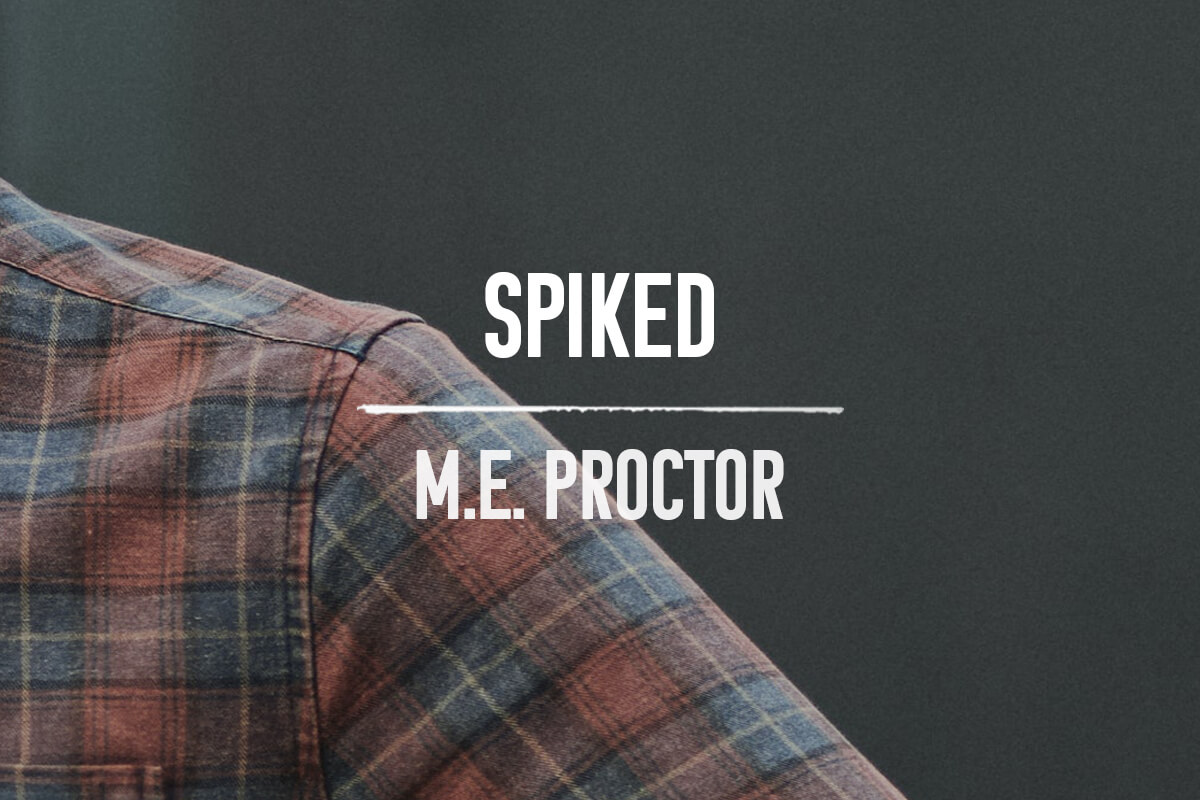
There isn’t much left of the old man. He sits on the side of the bed with his big hands on his knees, the jeans leached of color where the hard crease and relentless starch have whipped the fabric into rigid submission. The plaid shirt buttoned all the way up to his knobby Adam’s apple falls in folds from shoulders as thin as cheap dry cleaners’ coat hangers. He’s an assemblage of loosely connected bones inside a fragile sack of papery hide. There’s a dribble of life remaining in there, a habit of breathing, the whiff of a heartbeat.
I watch him from the hallway of the house I haven’t been in in twenty-two years. I’m not sure what I expected to find but it isn’t this.
The gun is in my hand, hanging loosely at my side. It’s a revolver, a .38 Special. It belonged to my friend Billy. It’s an inheritance of sorts. The only gun suitable for what I came to do; what I should have done years ago.
This ghost seated on the bed, this husk with vacant eyes, my father, is a reaper and a tormentor of souls. He kills for money. There’s no lack of customers. People get annoyed at other people; it’s inevitable, it comes with living in society. My father doesn’t work for a crime syndicate or a cartel. He’s there for the terminally flustered, the long-suffering downtrodden, those who need revenge or, in some cases, justice and don’t have the gumption to do it themselves. He might very well be the best in the trade. He has no name and no face. Nobody knows what his voice sounds like or in what part of the country he lives. He’s spread so thin across so many police files that he’s achieved invisibility. Like the Bible says: he is many.
I know my father for what he is, but for many years, I’ve doubted what my eyes told me and what my scars prove.
If Billy hadn’t died the way he did, I might still be doubting. Such is the power of legend.
I’m not some conspiracy nut or religious zealot. I’m a rational hard-nosed reporter for a reputable, if financially struggling, paper in a town two hours away from this forsaken place. Billy was my friend. He was a stubborn cop. Sometimes we worked the same beat, poking at the same misdeed, and we pondered the nature of guilt over more than a couple of drinks after the sun went down. Who’s worse, the sponsor of the crime or the one who commits it? Billy used to say that the head should pay a heavier price than the hand. He put a premium on brains. Me? Not so much. I grew up steeped in violence and I know a fist is a fist with or without smarts. Billy didn’t know my full story. I told him my mother died in a car accident shortly after I started college. That’s true. I believe she was running away frantic and lost control of the vehicle. I told Billy my father abandoned us when I was a toddler. That’s a lie. I wish he’d left before I learned he was a monster. Before I found the toolbox in the shed. Before he tore the skin off my back with barbed wire. The web of scars is still there, stretched out. The grooves don’t take the sun too well. On mist-wrapped nights I wonder if that was my father’s intent, in the obscurity of his warped mind, to mark me as a creature better suited for the shadows, like himself. The story my mother told the nurses and the doctors has been repeated so many times by now that it has gained ponderous legitimacy. It’s a boulder that can’t be turned over. The boy got tangled in the broken fence. The more he struggled, the worse it got. If anybody questioned the statement, the suspicion was quickly stifled. Who would do such a thing to a child?
Unthinkable. That was my father’s genius and his signature, at home and on the job. What better place to hide than behind the inconceivable?
I stand on the cracked linoleum of the hallway, the butt of the gun is warm in my hand, and I fear. Oh, how I fear what being this man’s son might have done to me.
Things changed at home after my mishap in the cow pasture as we called it. I remember I used to like war movies and TV shows, with brave grunts under fire-throwing grenades at impregnable bunkers. I didn’t care for make-believe adventures anymore after I was released from the hospital. I had enough sense, at age twelve, to know I slept next door to live ammo, unstable dynamite. And I started noticing things I hadn’t paid attention to before, too preoccupied by my buddies and baseball. I started remembering things. Mom’s sunglasses on cloudy days, her long-sleeve shirts in 90 degrees heat, her hands that shook when she brought plates of food to the dinner table. How she seldom sat down to eat with us but stood in a corner of the kitchen and watched with her hands holding her elbows as if she was cold.
There were many domestic tyrants like my father in our small town, angry men shaped by boredom and booze, descendants of scores of scrapers that barely survived in a place that ground everything to dust including whatever spirit they happened to be born with.
My father belonged in a separate chapel in hell. What I found in the toolbox in the shed went well beyond trailer park liquor-soaked Saturdays and habitual malice. Individually the instruments were banal if potentially deadly in motivated hands. You would find them in kitchens or doctor’s offices. Together, side by side in regimental precision, they painted a picture of savagery. I never lacked imagination and the script wrote itself. On the spot, I invented a grisly scary story that gave me goosebumps. Then I saw the plastic baggies at the bottom of the box. I couldn’t identify all the samples – small bones, hair, dried strips that looked like leather, squishy things. I knew they were some bad shit that I had no business messing with.
With time, the horrors of the toolbox and the torture of the shed morphed into the kind of sick fascination that draws millions of eyeballs to the footage of train wrecks. I spent hours at the public library scanning newspapers for reports of murder, the more bizarre the better. I was doomed to become a crime reporter. I am keenly aware that I owe my livelihood to a toolbox and a length of barbed wire.
The kind that was used to shred Billy’s throat.
I lean on the wall and close my eyes. The house reeks of mould and stale bacon grease. I haven’t gone into the kitchen. I remember it glossy and scrubbed. My mother kept it as neat as hours of drudge work could make it. The old man looks dusty but clean. He must have somebody doing housework and laundry. I make a lousy criminal. I never considered my father might have a helper or a live-in caretaker. Shortsighted. Lack of preparation and surveillance. The kind of mistakes he never made.
“Davie? Dave Ragland, is that you?”
The voice jerks me out of a jumble of thoughts. It’s reedy, female, and comes from the end of the corridor. The light is behind the woman and I can’t see her face. She’s small and wide in the hips, white hair like a halo. Our neighbour. I remember her.
“Mrs. Robbins?” I’m about to walk to her when I remember the gun. There are benefits in being left-handed; my entire body blocks her line of sight. I look at the old man. He hasn’t moved.
“It is really you?” she says. “For a minute there I thought it was him, raised, so to speak.” She put a hand flat on her chest. “It gave me a nasty start, it did.”
“I’m sorry, Mrs. Robbins,” I say. “I came to see him.”
She tiptoes to the sitting room and I follow her. The gun is in my coat pocket now; I can feel its weight pulling against the lining.
“Are you taking care of him?” I say.
Mrs. Robbins sits in a ratty recliner next to the TV. “Me and my daughter. He should be in a proper place but he’s a mule, you know that. He won’t budge.” She shakes her head and the thin white hair catches the light that slips through the drawn blinds.
I recall long-ago school days, when she sat on her porch with a bottomless pitcher of lemonade for the gaggle of kids that roamed the area. We delivered the paper, washed windows or weeded yards, anything to make a buck. I took her daughter to the prom. I didn’t care for the girl, but Mrs. Robbins was kind and I owed her a favour.
“How long has he been like that? I mean, stuck frozen like a dummy.”
She shoots me a quizzical glance. “And what does it matter to you, Davie, after all these years?”
The lie that isn’t really a lie comes easy. “I lost somebody I loved. It’s one of these things… makes you look back. At family and such.” I sit on the couch that faces the door leading to the hallway. In case the motionless being in the bedroom decides to go a-walking. I can’t believe my father is struck down. Men like him don’t just stop because they run out of juice. The gun rests snuggly against my thigh. It’s comforting.
Her fingernails pluck at the torn leather of the recliner’s armrest. “I’m not reproaching you, Davie. He’s more than half gone now but he was a demon for many a year. I often told Molly to pack you and a bag and hit the road. You know what she said?”
“That he’d find her no matter where she went.”
I’m not imagining the cloud that darkens her eyes. She sticks her hands in her lap. To capture the shakes. “What is it that sickens the men around here? Is it in the air or the water like they say on TV?”
I sure hope not because I swallowed and inhaled eighteen years-worth of the stuff. It might be in the genes, but I’m not going to put that thought in her head. I smile instead. “What’s your first name, Mrs. Robbins? If I may be so bold.”
She laughs and throws her hands up. There hasn’t been much laughter in this house. Ever.
“Imelda. Would you believe it? Of course, everybody calls me Millie. Like that movie with Julie Andrews. She tap dances in the elevator. You know it?”
I confess to my ignorance but promise I’ll look it up. Then, when enough time has passed, I get back to my question. The reason why I’m here. Billy’s murder. How long has my father been part of the furniture?
“Well, it’s been a while,” Imelda, Millie, says, tap dancing around the facts.
I wait. Something Billy taught me. The power of silence. Very few can withstand it. There’s an innate urge in humans to populate the void with words. Confessions, revelations, banter.
“He fell and broke his hip, oh, two years ago or so,” Millie says. “When he came back from the hospital, he wasn’t himself.” She nods. “Like something heavy hit him on the head. He needed help getting around. He had to be reminded taking his pills.”
Two years. “He didn’t recover?” I say.
“Oh, he did somewhat I suppose. He’s pig-headed alright. Early this year he started tooling around in that old Mercedes again. Went away for days at a time, like he used to. Came back as mean as he’s ever been. But something was broken, I could tell.” She waits for a prompt from me. When it doesn’t come, she sighs. “After each trip he was weaker, couldn’t get out of bed for days. The last time…” She motions at the bedroom. “He’s been like this since.”
Can a man’s sins catch up with him? If they do it’s taken a fucking long time for the One up above to take notice. I don’t want to ask the question but I have to. “When was that last trip?”
She ponders. “We’re end of June now… It must have been April. Yes. He wasn’t here for Easter because we had the family gathering and Jonah, he’s my grandson, he parked his truck in the driveway.”
Meaning the Mercedes wasn’t there.
Billy died on Good Friday. A prick at the paper suggested the killer misplaced a crown of thorns. It took three guys to pull me off him. My editor told me later that the fucker apologized. He didn’t show up at Billy’s funeral. That was fortunate. I would have killed him.
“He’s sort of awake today,” Millie says. “Still hanging. It won’t be long now.”
I know what she’s thinking. My father waiting for the return of the prodigal son. I’m sure that’s why he killed Billy. In his fucked-up mind, he figured that would make me come home. He was right.
“I’ll go in there, Millie,” I say. “In a minute.”
She pulls herself out of the recliner. She pats my shoulder on the way to the door. “There’s no need, boy,” she says. “In the doorway is close enough. You can’t miss from there. It’s a waste of a good bullet, though.” She trots to the front door.
Millie is right about the gun. He doesn’t deserve to go easy.
But I have to go in. To take a long look at the man who’s responsible for my existence. To put away the fear that made me a coward all my life. I remember his eyes when he stared at me in the shed and pondered my punishment. His glossy eyes, ripe with piercing glee and the promise of pain. I need to see the fire in these eyes extinguished.
THE END
ABOUT THE AUTHOR
M.E. Proctor is a strange cultural hybrid: a European living in East Texas. She’s currently writing a series of contemporary detective novels.
Her short stories have been published in Close to the Bone, All Worlds Wayfarer, Bristol Noir, Tilde, Expat Press, The Bookends Review, Fiction on the Web, and a bunch of others.
When she doesn’t write crime, she dabbles in SF and quiet horror.
Follow on Twitter: @MEProctor3